
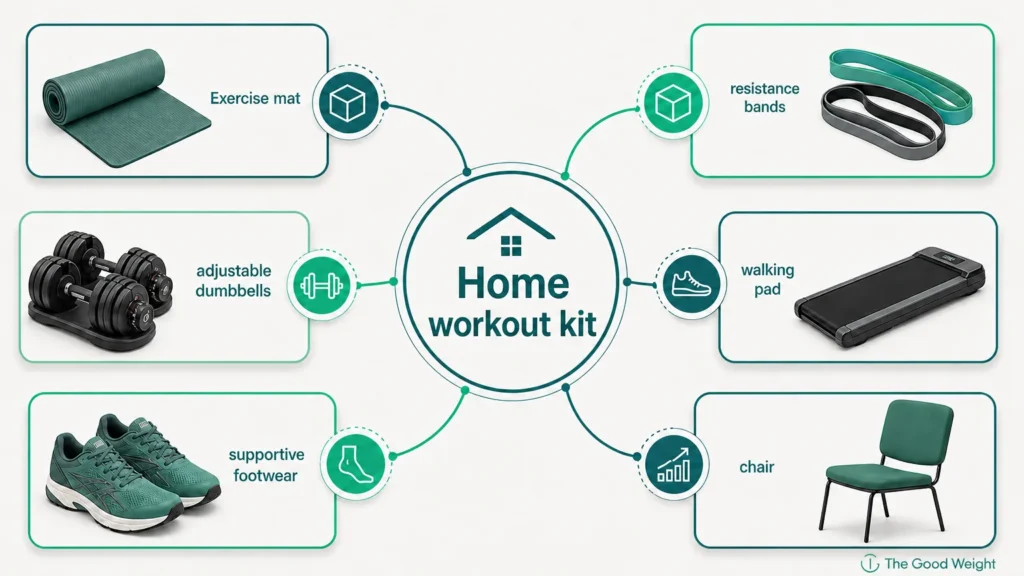
Buying home workout equipment for weight loss can feel surprisingly high-stakes. A walking pad, adjustable dumbbells, resistance bands, a yoga mat and larger machines all promise convenience, but the best purchase is not necessarily the most expensive or popular one. It is the item – or small combination of items – you can use safely and repeatedly in your actual home and routine.
For sustainable weight loss and metabolic health, movement works best as one part of a broader plan that may also include nutrition support, sleep, medical care and realistic habit-building. Rather than trying to create a perfect home gym, start by reducing one barrier: making it easier to walk, strengthen your body, fit in short sessions or return to activity with more confidence.
Start with the purpose, not the product
Before comparing equipment, identify what you want it to make easier. A purchase is more likely to sit unused when it is based on an abstract goal such as “lose weight fast,” rather than a practical need such as “walk for 15 minutes after work” or “do simple strength movements twice a week.” Home equipment cannot target fat loss from one body area, but it can support regular activity that contributes to overall health and energy expenditure.
Use this short decision path before spending money:
- If your main barrier is getting more steps: consider a safe walking option, such as a walking pad or a dependable indoor walking route that needs no equipment.
- If your priority is building or rebuilding strength: begin with resistance bands, a mat and, if appropriate, a small set of adjustable dumbbells.
- If time and confidence are the biggest barriers: choose equipment that can be taken out and put away in minutes, such as a mat and loop or tube bands.
- If you are returning after inactivity, illness or an injury: begin with the smallest, most adaptable setup and seek clinical guidance before increasing intensity.
This approach matters because a machine cannot create a routine by itself. A compact kit placed where you can see it may be more useful than a large treadmill that is difficult to access, noisy in an apartment or intimidating to use. The goal is not to buy motivation; it is to make the next small session more practical.
For people managing fatigue related to PCOS or other health concerns, the starting point may need to be especially gentle. Our guide to building a sustainable PCOS exercise plan when fatigue is a factor explains why pacing, recovery and consistency are often more helpful than trying to compensate with intense workouts.
Compare the smallest useful starter kits
A starter kit should match your available floor space, storage options and current ability. The comparison below is product-neutral: the right choice depends on what you will realistically use, not on a claim that one item is inherently better for weight loss.
| Item or simple combination | Typical use | Storage needs | Progression potential | Limitations and who may not benefit |
|---|---|---|---|---|
| Exercise mat | Floor-based mobility, seated exercise, stretching and body-weight movements | Rolls into a cupboard or corner | Supports more stable practice, but does not add resistance alone | Not essential if you have a safe, non-slip surface; getting down to and up from the floor may be difficult with some joint or mobility limitations |
| Resistance bands + mat | Pulling, pressing, squatting patterns, supported core work and mobility | Very small; can fit in a drawer | Different band tensions and more controlled repetitions offer gradual challenge | Bands can snap if worn or poorly anchored; some people need instruction to use them safely |
| Adjustable dumbbells + mat | Strength work for major movement patterns | Requires a protected storage spot and clear floor area | Weight can be increased without buying several pairs | May not suit people with painful gripping, poor balance or no safe place to store heavy equipment |
| Walking option + supportive footwear | Indoor walking, short activity breaks and gradual walking-time goals | Varies: none for an indoor route; more space for a walking pad | Time, pace and frequency can increase gradually | A walking pad may be noisy, costly or unsuitable for unstable flooring, limited space or certain gait and balance concerns |
| Bands + mat + walking option | A practical all-round starter setup | Low to moderate | Covers walking and simple whole-body strengthening | It still needs a realistic schedule; more equipment does not automatically mean more use |
For many beginners, a mat and bands are enough to start learning controlled whole-body movements. Adjustable dumbbells can be a sensible later addition if strength is a clear priority and you have safe storage. A walking option is most useful when weather, safety, time or travel makes regular outdoor walking difficult – not simply because it seems like the “correct” item for weight loss.
Use a small kit for whole-body movement
Public-health guidance does not require a commercial gym. The CDC advises adults to do muscle-strengthening activity involving all major muscle groups – legs, hips, back, abdomen, chest, shoulders and arms – on two or more days each week. This is a useful framework for choosing equipment because it shifts attention from isolated “problem areas” to functional, whole-body movement.
Think of a balanced strength session as a set of movement categories rather than a rigid universal workout:
Lower body → pull → push → carry or hold → trunk control → mobility. A chair-assisted sit-to-stand or squat pattern can work the lower body. A band row can represent pulling, while a wall push-up, band press or light dumbbell press can represent pushing. Holding light weights during a controlled walk or standing exercise can build grip tolerance, while simple bracing and balance practice can support trunk control.
The exact movements, range of motion and resistance should reflect your fitness level and health history. A person with knee pain may need a different lower-body pattern from someone with shoulder discomfort, and someone recovering from bariatric treatment may need individual advice about activity progression. The aim is not to complete every category perfectly on day one; it is to build a well-rounded routine gradually.
Regular movement also has value beyond the scale. The CDC notes that physical activity can support health and weight management, while even smaller amounts of activity can be meaningful when someone is starting from a low baseline. For a patient-centred approach, it is reasonable to treat a five- or 10-minute session as practice for the habit rather than dismissing it as “not enough.”
Build progression before buying more equipment
Once you have a small kit, give it time to work before shopping again. New equipment is often less important than improving familiarity, regularity and technique. Progress should feel manageable enough that you can repeat it next week, not so demanding that it creates pain, fear or exhaustion.
1. Establish technique and comfort
For the first few sessions, focus on learning how a movement feels with little or no resistance. Use a stable surface, move at a controlled pace and stop before form becomes strained. If you are using bands, inspect them for cracks and avoid attaching them to doors or furniture unless the manufacturer specifically permits that setup and it is secure.
2. Add consistency first
Choose a frequency that fits your life, such as two brief strength sessions and several short walks. Put equipment where it is easy to reach and pair movement with an existing cue, such as after morning tea or before an evening shower. Consistency gives you better information about what is sustainable than one unusually hard workout.
3. Increase repetitions or walking time
When the current amount feels comfortable and your technique remains steady, add a small amount of volume. That may mean a few more controlled repetitions, another short set, or several more minutes of walking. This is often the most practical way to progress because it uses the same equipment and does not require major changes to your space or budget.
4. Consider resistance only after that
Increase band tension or dumbbell weight only when your current resistance no longer feels challenging near the end of a controlled set. Make one change at a time rather than adding more time, more repetitions and more weight in the same week. If you notice joint pain, chest discomfort, dizziness, faintness, unusual breathlessness or symptoms that concern you, stop the activity and seek medical advice before continuing or escalating.
Check these details before you buy
Use this checklist to decide whether a piece of home workout equipment genuinely fits your circumstances:
- Measure usable floor space. Allow room to step safely around the equipment, not just enough space for the machine itself. Check ceiling clearance if you will lift weights overhead or use a tall frame.
- Plan safe storage. Heavy dumbbells should not be left where children, pets or other household members may trip over them. Bands should be kept away from heat and direct sunlight when possible.
- Consider noise and building access. A walking pad can create vibration, particularly in flats. Think about the time you will use it, your flooring and whether you can carry it through lifts, stairwells or narrow doorways.
- Check footwear and flooring. Stable, supportive shoes and a non-slip surface can matter more than buying another accessory. Avoid exercising in socks on smooth tiles or polished floors.
- Account for injuries and health conditions. Joint limitations, balance concerns, diabetes-related foot problems and recent surgery can all affect what is appropriate. Equipment should adapt to your needs, not force you into painful positions.
- Test the “10-minute rule.” Ask whether you can honestly imagine using the item for 10 minutes on a busy weekday. If the answer is no, choose something simpler or delay the purchase.
These questions can prevent duplicate purchases and reduce the pressure to make a large financial commitment before you know what you enjoy. As NIDDK guidance on staying active at any size emphasizes, choosing activities you enjoy and can do regularly can make an active lifestyle easier to maintain.
Put your small kit into a sustainable week
The CDC recommends that adults aim for at least 150 minutes of moderate-intensity activity each week plus muscle-strengthening activity on two or more days. This is a weekly destination, not a requirement to achieve everything immediately. If you are currently less active, a gradual build is safer and more sustainable than trying to make up the full amount in a few difficult sessions.
Here is an example of a flexible beginner week using only a mat, bands and a walking option. On two non-consecutive days, use the mat and bands for a short whole-body session built around lower-body, pull, push, trunk-control and mobility categories. On several other days, walk in shorter blocks – perhaps before work, after lunch or while listening to a podcast – while leaving space for rest, gentle mobility or ordinary household movement.
A week might include a 15-minute walk on Monday, a brief strength session on Tuesday, an easier recovery day on Wednesday, walking on Thursday, a second strength session on Friday and one or two relaxed walks over the weekend. Over time, walking blocks can become longer or more frequent. The sustainable version is the one that still works during a demanding workweek, not the most ambitious plan on paper.
Frequently asked questions
Do I need a walking pad to lose weight at home?
No. A walking pad can reduce barriers for some people, especially when outdoor walking is inconvenient, but it is not essential. Walking outdoors, using stairs where appropriate, following a safe indoor route or doing short movement breaks can also contribute to activity. Choose a walking pad only if it fits your space, noise limits, budget and confidence.
Are resistance bands or dumbbells better for beginners?
Neither is universally better. Bands take up less space and offer a lower-cost way to begin resistance training, while adjustable dumbbells can make gradual load changes straightforward. A beginner with limited space may prefer bands; someone who enjoys traditional strength exercises and can store weights safely may prefer adjustable dumbbells.
Can home exercise replace medical weight-management care?
Home movement can be an important part of comprehensive wellness, but it does not replace personalised assessment when health risks are present. Weight changes can be influenced by medications, sleep, nutrition, hormones, stress, metabolic conditions and mobility limitations. A doctor-led plan can help put activity in the context of your wider health needs.
Choose the kit you will use, then build from there
The most effective home workout equipment for weight loss is usually not a complete home gym. It is a compact, versatile setup that makes walking and whole-body strength work easier to repeat safely. Begin with your purpose, choose the smallest kit that reduces your main barrier and progress through consistency before buying more.
If you have obesity-related symptoms, diabetes risk, significant joint limitations or uncertainty about restarting activity, arrange a personalised medical and movement review before increasing intensity. The Good Weight provides doctor-led support for sustainable weight loss and metabolic health that can integrate movement, nutrition support and evidence-based care around your individual needs.