
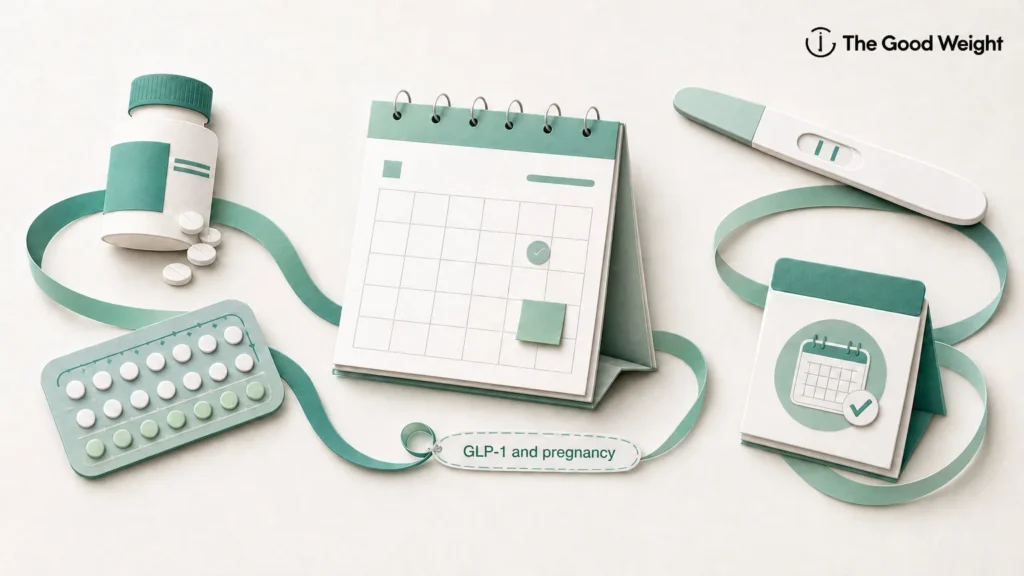
You may be considering GLP-1 treatment while also wondering whether to change contraception, try for a baby or continue breastfeeding. These decisions belong in the same consultation, even if pregnancy feels some way off. A medicine that supports metabolic health outside pregnancy may need to be stopped before conception, and some treatments require additional contraceptive precautions.
Questions about GLP-1 and pregnancy are therefore about more than whether a medicine is “safe”. They involve the exact product, your reproductive plans, other medicines and how your health will be supported if treatment changes. This guide helps you prepare for a coordinated discussion with your prescribing clinician and gynaecologist, obstetrician or fertility specialist.
Why reproductive planning belongs in weight care
GLP-1 medicines help regulate blood glucose and appetite, and can slow the movement of food out of the stomach. However, products discussed together as “GLP-1 treatments” do not all have identical instructions. Tirzepatide, for example, acts on both GIP and GLP-1 receptors, and its prescribing information includes specific precautions for oral hormonal contraception.
Your pregnancy intentions affect which treatment is appropriate and when it can be used. Someone hoping to conceive soon needs a different plan from someone who wants reliable contraception for several years. Someone taking medication for diabetes also needs continuity of glucose management if treatment is stopped; diabetes guidance recommends reviewing and changing medicines before conception where necessary.
Fertility deserves discussion even if your periods have been irregular or you have previously struggled to conceive. Changes in weight and metabolic health may alter ovulation in some people, particularly those with polycystic ovary syndrome, but GLP-1 treatment is not an established fertility treatment. Do not interpret irregular periods, previous infertility or social-media stories about “GLP-1 babies” as a reliable guide to your pregnancy risk.
What to bring to a GLP-1 consultation
Prepare a short written history rather than relying on memory during the appointment. Include medicine names or photographs of packaging, because brand names, formulations and doses matter. If your weight-care and reproductive-health clinicians work in different clinics in Chennai, ask how their recommendations will be shared.
Use this checklist to organise the discussion:
- Current contraception: Name the pill, device, injection, implant or barrier method you use. Mention missed pills, recent changes, unprotected sex or difficulty using the method consistently.
- Menstrual history: Record your last period, usual cycle pattern and any recent missed periods or unexpected bleeding. Note whether irregularity is longstanding or new.
- Pregnancy intentions: Say whether you want to avoid pregnancy, may try within the coming year, are actively trying or are receiving fertility treatment.
- Pregnancy history: Include previous pregnancies, miscarriage, ectopic pregnancy, gestational diabetes, high blood pressure in pregnancy and fertility difficulties.
- Breastfeeding: Record whether you are exclusively or partly breastfeeding, your baby’s age and any feeding or growth concerns.
- All medicines and supplements: Include prescription medicines, contraceptives, hormone replacement therapy, non-prescription products and herbal preparations. List your GLP-1 product, dose and last dose if already taking it.
- Relevant health conditions: Mention diabetes, PCOS, kidney disease, significant digestive symptoms, previous pancreatitis or gallbladder problems. Bring relevant reports and describe any history of disordered eating.
- Practical concerns: Explain your food intake, nausea, vomiting, hydration, treatment costs and ability to attend follow-up appointments.
You do not need to decide your reproductive future before seeking care. “I am unsure whether I want a pregnancy soon” is useful information in itself. The clinician can explain how that uncertainty affects medicine choice, contraception and review dates, alongside the wider assessment of GLP-1 eligibility and metabolic health.
GLP-1 and pregnancy: planning ahead versus a positive test
Planning a pregnancy and discovering a pregnancy during treatment require different conversations. Planning allows time to arrange a medicine-free interval and any replacement treatment before trying to conceive. A positive test requires prompt contact and product-specific advice, not waiting until a routine review.
If you are planning a pregnancy
Tell your prescriber before stopping contraception or starting fertility treatment. The FDA-approved Wegovy label revised in March 2026 says to discontinue Wegovy at least two months before a planned pregnancy because of semaglutide’s long half-life. This is a semaglutide-specific instruction, not a universal waiting period for every medicine discussed as a GLP-1 treatment.
Ask your clinician to turn that instruction into a dated plan. It should identify your final dose, how long contraception should continue, when trying to conceive can begin and what monitoring is needed during the transition. If you take treatment for diabetes, the plan should also cover pregnancy-appropriate glucose management rather than leaving a treatment gap.
Before leaving the appointment, confirm:
- The exact medicine and formulation: Do not transfer advice from another brand or a friend’s prescription.
- The stopping interval: Record the interval recommended for your product and circumstances.
- Contraception during the transition: Clarify when it can be stopped.
- Ongoing metabolic care: Agree on glucose monitoring, nutrition support and follow-up where needed.
- Fertility treatment coordination: Ensure your fertility specialist knows the medicine and planned final dose.
This is not simply a question of finishing the current pen or reducing the dose yourself. The purpose is to coordinate medication clearance with reproductive care while continuing support for your health. A clinician-guided stopping and maintenance checklist can help organise the broader transition, but it does not replace pregnancy-specific prescribing advice.
If you discover you are pregnant
Contact your prescriber and obstetric or gynaecology team promptly, ideally the same day you obtain a positive test. The same FDA label states that Wegovy may cause fetal harm and should be discontinued when pregnancy is recognised when used for weight reduction or cardiovascular-risk reduction. Contact the team to arrange the next steps rather than substituting another medicine, tapering independently or waiting for your next scheduled appointment.
Have the product name, dose, last-dose date, first day of your last period and pregnancy-test date ready. If you have diabetes, explicitly ask how your glucose treatment and monitoring should be managed now. Do not stop unrelated medicines without review, because each medicine needs its own pregnancy assessment.
An exposure before you knew you were pregnant does not establish that harm has occurred. A prospective observational study involving 168 pregnancies exposed to GLP-1 receptor agonists in the first trimester found no increased risk of major birth defects compared with its reference groups. However, the study was relatively small and observational, so it cannot establish safety or justify continuing treatment during pregnancy.
The practical message is to seek an individual exposure assessment without assuming either certain harm or complete reassurance. Your clinician can review the timing, medicine and underlying health conditions and explain appropriate antenatal care. Human evidence remains limited, which is why planned avoidance and prompt review remain important.
FAQs: contraception, breastfeeding, menopause and other medicines
Do GLP-1 treatments make the contraceptive pill less reliable?
This is a product-specific question, not a rule that every GLP-1 medicine cancels out every pill. Tirzepatide’s prescribing information advises people using oral hormonal contraception to switch to a non-oral method or add a barrier method for four weeks after starting treatment and for four weeks after each dose increase. Its effect on gastric emptying can reduce the effectiveness of oral hormonal contraceptives.
Raise this before the first dose and again before a dose increase. Ask which contraceptive option suits your medical history and whether any temporary additional protection is required. Do not assume the same instruction applies unchanged to semaglutide or another product.
Vomiting or severe diarrhoea creates a separate reason to review oral contraception. Ask your pharmacist or reproductive-health clinician which missed-pill or illness instructions apply to your specific pill. If you have had unprotected sex and think contraceptive protection may have been reduced, seek prompt advice about emergency contraception rather than waiting for a pregnancy test.
Could fertility change even if my periods remain irregular?
A previous diagnosis of PCOS or infertility should not be treated as contraception. Ovulation may not be predictable from bleeding patterns, and a change in cycles does not by itself tell you whether conception is possible. Bring both your fertility history and any new menstrual changes to the consultation.
Ask whether pregnancy testing, a contraceptive review or assessment of the menstrual change is appropriate. If you want to conceive, explain that goal directly rather than assuming weight treatment automatically forms part of fertility treatment. Your clinicians can then agree on the sequence of care and avoid conflicting instructions.
Can I use treatment while breastfeeding?
There is no single breastfeeding answer that applies to every product, formulation and infant. A small study described in the semaglutide fact sheet found that semaglutide was not detected in breast milk from eight women using injections. That finding is limited evidence, not proof of safety for every dose, oral formulation, newborn or premature infant.
Tell your clinician your baby’s age, feeding pattern and any concerns about growth or milk supply. Ask about the exact medicine’s current prescribing information, the reason treatment is needed and whether an alternative or a delay would be preferable. The discussion should also consider your own recovery, adequate nutrition and management of any diabetes.
Do not stop breastfeeding or restart a previously prescribed medicine solely on the basis of a reassuring online headline. Ask for a documented, product-specific plan and a review date. The balance may differ between treatment for weight management alone and treatment needed for another medical condition.
What changes during perimenopause or menopause?
Irregular periods during perimenopause should not automatically be interpreted as an end to pregnancy risk. Tell your clinician about cycle changes, contraception and any hormone replacement therapy, including whether it is taken orally. HRT is not contraception, so the two issues need separate consideration.
Ask whether contraception is still needed and whether your hormonal medicines require review alongside treatment. If you use oral progesterone as part of HRT, name it specifically rather than describing all your treatment as “hormones”. This is a prompt for personalised review, not evidence that every person using GLP-1 treatment needs a different HRT dose or route.
Which other medicines need review because of delayed gastric emptying?
Slower stomach emptying can affect how some oral medicines are absorbed, but it does not mean every tablet becomes ineffective. The Wegovy prescribing information notes the potential to affect oral medicine absorption and the need for additional monitoring for certain medicines. The significance depends on the medicine, formulation and how closely its effects need to be controlled.
Bring a complete list and specifically ask about medicines that require blood tests, precise exposure or close symptom monitoring. Examples to flag include anticoagulants, thyroid replacement, anti-seizure medicines and transplant medicines; mentioning them does not mean an interaction is inevitable. Your prescriber or pharmacist should decide whether monitoring, timing or treatment needs to change.
Also report persistent vomiting, difficulty keeping tablets down or new symptoms after a dose increase. Do not repeat a tablet automatically after vomiting or move all medicines to a different time without advice. Record the medicine, dose and timing so the clinician can give a specific answer.
A practical appointment template
Copy this template into your phone or bring it on paper to both appointments. Complete what you know and leave uncertain details blank rather than guessing. Ask each clinician to review the same version so that stopping dates, contraception advice and follow-up arrangements remain consistent.
| Planning item | My notes |
|---|---|
| My main health goals | |
| Pregnancy intention: avoid, unsure, planning or trying | |
| Preferred conception or fertility-treatment timeline | |
| Last period and usual cycle pattern | |
| Current contraception and any missed doses | |
| GLP-1 medicine, formulation, dose and last-dose date | |
| Other medicines, supplements and HRT | |
| Pregnancy history and relevant conditions | |
| Breastfeeding status and baby’s age | |
| Recent vomiting, diarrhoea or difficulty eating | |
| Agreed final dose and waiting interval, if relevant | |
| Contraception plan during treatment and transition | |
| Replacement treatment or glucose-monitoring plan | |
| Prescriber and reproductive-health clinician contacts | |
| Next review date and whom to contact with concerns |
Before the consultation ends, ask three questions: “What should I do now?”, “What changes if my pregnancy plans change?” and “Whom should I contact if I have a positive test?” Request written instructions where possible, especially when more than one clinician is involved. Your follow-up care after starting GLP-1 treatment should revisit reproductive plans rather than treating them as a one-time screening question.
Plan the conversation before changing treatment
Reproductive planning is part of personalised weight care, not an obstacle to it. The safest next step is a coordinated discussion before starting, continuing, changing or stopping treatment, with prompt contact if pregnancy is recognised. Product-specific instructions and your medical history matter more than assumptions or social-media advice.
For adults in Chennai, The Good Weight offers doctor-led weight care with metabolic assessment, nutrition support and ongoing guidance. If pregnancy, fertility, contraception, breastfeeding or medicine interactions are part of your decision, book a clinician-led assessment with The Good Weight before initiating or changing treatment. Bring your medicine list and appointment template so your weight-care and reproductive-health clinicians can build a clear plan together.