
You feel well, your weight has barely changed, and your BMI does not seem concerning. Yet a parent developed diabetes, a sibling has fatty liver, or someone in your family had a heart attack unusually young. Should you wait until your weight or blood sugar rises before asking for a review?
For adults in Chennai and South Asia in general, metabolic health deserves more than a BMI-only check. Waist size, family history, blood pressure and laboratory results can justify an earlier conversation. Screening guidance offers useful starting points, but it cannot assign one exact screening age to every person based on ancestry or country of origin.
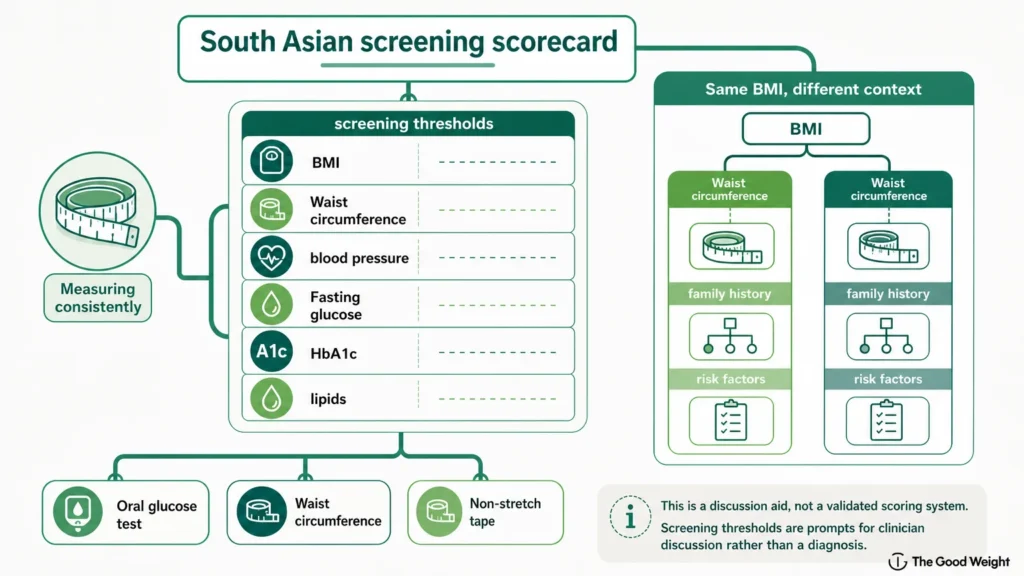
This scorecard explains those starting points and what a personalised assessment might add. It is a discussion aid, not a validated scoring system: there are no points to total and no “safe” score that rules out risk.
Why can metabolic risk show up at a lower BMI for South Asian adults?
BMI compares weight with height, but it does not distinguish muscle from fat or show where fat is stored. Two people with the same BMI may therefore have different metabolic profiles. Population patterns help explain why BMI alone can miss concerns, although they do not determine any individual’s health.
The ADA’s 2026 clinician guide describes beta-cell dysfunction at lower BMI thresholds, insulin resistance, lower lean muscle mass and higher visceral adiposity as factors contributing to earlier type 2 diabetes onset and progression in South Asian populations. In practical terms, several processes can overlap:
-
Insulin resistance: Insulin helps move glucose from the bloodstream into cells. When cells respond less effectively, the pancreas needs to produce more insulin. Glucose may remain within range initially, so feeling well does not settle the question.
-
Visceral fat: This is fat stored around internal organs, rather than just beneath the skin. Greater visceral fat can accompany metabolic risk even without a markedly high BMI. Waist measurement provides a practical, imperfect clue.
-
Lean muscle and beta-cell function: Muscle helps the body use glucose, while pancreatic beta cells produce insulin. Lower muscle mass and reduced insulin-producing capacity can make glucose regulation more difficult. These are biological considerations, not evidence of personal failure.
What does a waist measurement add that BMI cannot?
Waist circumference adds information about abdominal size that BMI cannot provide. The ADA’s 2026 obesity standards use waist thresholds of 80 cm for women and 90 cm for men with an Asian background, compared with 88 cm and 102 cm for non-Asian-background adults. These thresholds flag a reason to assess risk; they do not diagnose diabetes or measure visceral fat directly. A waist below them also does not cancel out a strong family history.
A worked example: same BMI, different clinical questions
Consider two hypothetical men, each 1.70 metres tall and weighing 66 kilograms. Both have a BMI of approximately 22.8, calculated as 66 ÷ 1.70². Their other measurements and histories differ:
| Information | Person A | Person B |
|---|---|---|
| Waist circumference | 84 cm | 94 cm |
| Family history | No known first-degree relative with diabetes | Father developed diabetes at 42 |
| Blood-pressure history | Previous readings within range | Repeated elevated readings |
| Discussion priority | Routine review based on overall history | Earlier metabolic review despite BMI below 23 |
These are illustrative profiles, not patient cases or predicted outcomes. Person B has several reasons to discuss screening sooner, while Person A is not guaranteed to be free of risk. The useful distinction is the information surrounding BMI, not the BMI number alone.
Measuring consistently
Use a non-stretch tape on bare skin, standing upright with your abdomen relaxed. Place it horizontally midway between the lowest palpable rib and the top of the hip bone, keeping it snug without compressing the skin. Read the measurement after a normal breath out, without pulling your stomach in. Ask your clinician to demonstrate the method, because changing the measurement site can change the result.
Which history and health markers should prompt an earlier conversation with a clinician?
The checklist below is for discussing screening, not self-diagnosis. Tick anything relevant and bring the details rather than trying to interpret every result yourself. Several modest concerns together may matter more than one isolated number.
-
Family history: Record diabetes in parents or siblings, markedly high cholesterol, fatty liver and early heart disease. Include the relative’s age at diagnosis where possible. “My father had a heart attack at 44” is more informative than “heart problems run in the family.”
-
Previous gestational diabetes: Mention diabetes during pregnancy even if glucose returned to normal afterwards. The ADA recommends lifelong diabetes screening every one to three years after gestational diabetes. This deserves attention independently of your current weight.
-
Blood pressure and sleep: Bring previous readings and a medication list. Mention loud snoring, witnessed breathing pauses or persistent daytime sleepiness. These symptoms warrant assessment but do not establish a metabolic diagnosis.
-
Weight or waist changes: Note recent abdominal growth, reduced strength or unexplained weight change. Unintentional weight loss with thirst or frequent urination should prompt medical attention rather than waiting for routine screening. A stable scale reading does not make changes in body composition irrelevant.
-
Glucose, lipids and liver findings: Bring complete reports, including dates and whether you were fasting. Mention previous fatty liver on imaging or abnormal liver enzymes. These findings need interpretation alongside your history, not in isolation.
The screening thresholds worth discussing
The ADA’s 2026 diabetes screening recommendations and diagnostic criteria provide the following reference points. These are clinical starting points, not a substitute for locally appropriate judgement. In particular, laboratory thresholds describe test results; they are not numbers you should wait to reach before requesting screening.
| Measure | Reference point | What it means for the conversation |
|---|---|---|
| Age | Routine screening begins at 35 years under ADA guidance | Earlier assessment may be appropriate when risk factors are present. |
| BMI | At least 23 kg/m² in adults of Asian ancestry, with a screening risk factor | A first-degree relative with diabetes strengthens the reason to test; BMI below 23 does not exclude risk. |
| Blood pressure | Hypertension, including readings at least 130/80 mmHg, or treatment for hypertension | Bring repeated readings; one measurement is not the whole picture. |
| Fasting plasma glucose | 100-125 mg/dL | ADA impaired-fasting-glucose range; review is appropriate. |
| HbA1c | 5.7-6.4% | ADA prediabetes range; interpretation depends on clinical context. |
| Two-hour glucose after a 75-g oral glucose tolerance test | 140-199 mg/dL | Impaired glucose tolerance; this test is used when appropriate. |
| Diabetes-range results | Fasting glucose at least 126 mg/dL, HbA1c at least 6.5%, or two-hour glucose at least 200 mg/dL | Confirmation is generally required without unequivocal symptomatic hyperglycaemia. |
| Lipids | HDL cholesterol below 35 mg/dL and/or triglycerides above 250 mg/dL | These are additional ADA diabetes-screening risk factors, not universal lipid treatment thresholds. |
There is no single LDL-cholesterol value that determines when every South Asian adult should first be screened. Lipid testing and treatment decisions also depend on age, family history, existing disease and the overall cardiovascular picture. A family history of unusually high cholesterol or early heart disease deserves discussion even before your own results are known.
Country of origin adds context, not a precise personal timetable. Indian, Pakistani, Bangladeshi, Sri Lankan, Nepali and other South Asian backgrounds should not be treated as identical risk profiles. The thresholds above do not establish a validated country-by-country screening schedule. For someone in Chennai with a strong family history, asking now is more useful than waiting for a supposedly definitive ancestry-specific age.
What might a doctor-led metabolic assessment include?
A useful appointment connects your history with a focused examination and appropriate tests. It should explain what each test could clarify and how the result would change care. The tests, interpretation and follow-up interval depend on the individual; everyone does not need an extensive panel.
-
History-taking. Your doctor reviews family diagnoses, pregnancy history, medications and previous results. Sleep, activity, food patterns and changes in weight or strength provide context. The timing of relatives’ diagnoses can help guide the discussion.
-
Waist and blood-pressure context. Measurements are checked using a consistent method rather than treated as stand-alone verdicts. An elevated clinic blood pressure may need repeat or home measurements. BMI remains useful, but it is interpreted alongside these findings.
-
Appropriate glucose and lipid testing. Your clinician may select fasting plasma glucose, HbA1c or an oral glucose tolerance test according to the question being investigated. A lipid profile helps assess cholesterol and triglycerides. Unexpected or borderline findings may require confirmation rather than immediate labelling.
-
Liver-risk and nutrition review. Previous fatty liver, liver-test abnormalities and relevant exposures deserve discussion. Further assessment depends on the overall picture, not waist size alone. Nutrition advice should also consider muscle preservation, preferences and practical meal routines; our explanation of how fatty liver care depends on metabolic risk explores this connection.
-
A clear follow-up plan. You should leave knowing which findings need action, which need monitoring and when to return. Care may involve nutrition support, activity planning or treatment for an identified condition. Understanding what a metabolic health assessment can clarify can help you prepare questions.
What can I do while I wait for a metabolic-health appointment?
Preparation is more helpful than trying to transform your routine before the visit. Your clinician needs a realistic picture of everyday life, including shift work, travel, family meals and disrupted sleep. You do not need to arrive having lost weight or followed a perfect diet.
-
Gather previous reports. Bring glucose, cholesterol, liver and blood-pressure records, plus scans and current medications. Older results help show trends.
-
Write down family history. Include the condition, relationship and approximate age at diagnosis. Record what you know without feeling obliged to investigate every relative.
-
Measure consistently if advised. Use the same waist-measurement method rather than repeatedly checking throughout the day. Bring the measurement and explain how you took it.
-
Notice ordinary patterns. Brief notes on sleep, walking, strength activity, meals and alcohol can support a useful discussion. Avoid extreme dieting, unnecessary supplements or stopping prescribed medication.
Make the next step personal, not BMI-led
A reassuring BMI is useful information, but it is not a complete metabolic assessment. Family history, waist size, blood pressure and laboratory markers can justify an earlier review, even when you feel well. Book a doctor-led metabolic assessment with The Good Weight in Chennai to review your individual risk factors, diagnostic needs and sustainable care options.