
You lose 8, 15, or 25 kilograms. Your waistbands sit differently, your face looks leaner, and climbing stairs feels less punishing. Yet, in photos or sleeveless clothing, your upper arms still seem fuller than you expected. It can feel unfair, especially after months of consistent effort.
The expectation makes sense. Most people assume fat loss works like turning down a dimmer switch: every part of the body becomes smaller at about the same pace. Bodies do not work that neatly. Genes, hormones, age, muscle mass, skin elasticity, and long-standing fat distribution all affect where change appears first and where it lingers.
That’s why conversations about arm lipo need more honesty than “diet versus surgery.” Weight loss reduces overall body fat and supports metabolic health. Arm contouring procedures address a local shape concern. An arm lift addresses excess skin. Those are different jobs, with different trade-offs, recovery periods, and limits.
Before anyone books a procedure, it helps to identify what they’re actually seeing. Is the arm still carrying enough fat that further medically supported weight loss makes sense? Has weight loss left loose skin behind? Or is the concern mainly the natural width and structure of the upper arm? The answer changes the plan.
Why weight loss does not shrink every arm evenly
A calorie deficit, regular movement, sleep, medication when medically appropriate, and nutrition support can lower total body fat. But no one can instruct the body to take fat from the upper arms first. That frustrating truth is called the limit of spot reduction.
Arm exercises still have real value. Rows, presses, push-ups, and triceps work can build muscle, improve strength, and alter how the arm sits against the torso. They can also support bone health and make daily activities easier. What they cannot do is selectively melt the fat covering that muscle.
Picture two people who each lose 12 kilograms. One may notice a large change in the arms early on. The other may lose more from the face, abdomen, or legs while the upper arms change slowly. Neither result proves that one person worked harder. It reflects different body-fat patterns.
The way I see it, the scale is often a poor reporter of contour. It tells you about total mass, not where tissues sit. Someone may reach a healthier weight and still dislike the arm area, while another person at a higher weight may feel perfectly comfortable with their arms. Both reactions are valid, but they call for different next steps.
A working definition: Arm lipo, or arm liposuction, is a surgical contouring procedure in which a qualified surgeon removes selected deposits of subcutaneous fat from the upper arm through small incisions. It is not a treatment for obesity or a substitute for sustained weight management.
The Mayo Clinic describes liposuction as a body-contouring procedure rather than a weight-loss method. That distinction may sound dry, but it saves people from spending money on the wrong solution.
Three reasons upper arms can look larger
A raised arm can make several tissues visible at once. Treating all of them as “fat” creates disappointment fast. During an in-person assessment, a clinician will look at fat thickness, skin recoil, muscle, asymmetry, and the relationship between the arm and shoulder.
Fat beneath the skin
Localized subcutaneous fat can make the upper arm look rounder or wider, even in someone whose weight is stable and close to their personal goal. In that setting, arm lipo may enter the discussion if the skin has enough elasticity to contract after fat removal. Age alone does not decide skin quality, though time, sun exposure, smoking, genetics, and large weight fluctuations all play a part.
A practical clue: if you can gently pinch a soft, thick layer and the surrounding skin still springs back well, fat may be the larger contributor. That is only a clue, not a diagnosis. A surgeon’s examination matters because the wrong amount of fat removal can leave unevenness or make lax skin more obvious.
Loose skin after weight loss
Loose skin behaves differently. It may wrinkle, hang, or shift when you lift your arm, even when there is little soft fat underneath. Removing fat from an arm with marked laxity can sometimes worsen the drape. This part is honestly a pain, because no cream, wrap, or targeted workout can remove a large amount of excess skin.
An arm lift, also called brachioplasty, removes skin and reshapes underlying tissue. The trade-off is a scar, often placed along the inner arm and sometimes extending toward the chest depending on how much correction is needed. Scars fade over time but never disappear, so a good consultation treats that point seriously.
Natural frame and muscle
Some arms are broad because of bone structure, shoulder width, muscle development, or family traits. A person who swims, lifts weights, carries children, or works in a physically demanding job may have strong upper arms that do not match a narrow-arm beauty ideal. Surgery should never aim to erase healthy muscle or force a body into someone else’s proportions.
Look, a stable body can still have features you would prefer to change. The useful question is not, “Why didn’t weight loss fix me?” It is, “What tissue am I hoping to change, and can the proposed treatment change that tissue?”
Arm lipo, exercise, and an arm lift do different jobs
Trying to make exercise compete with surgery is a category error. Exercise serves long-term health, strength, and body composition. Surgery changes contour in a selected location. One does not replace the other.
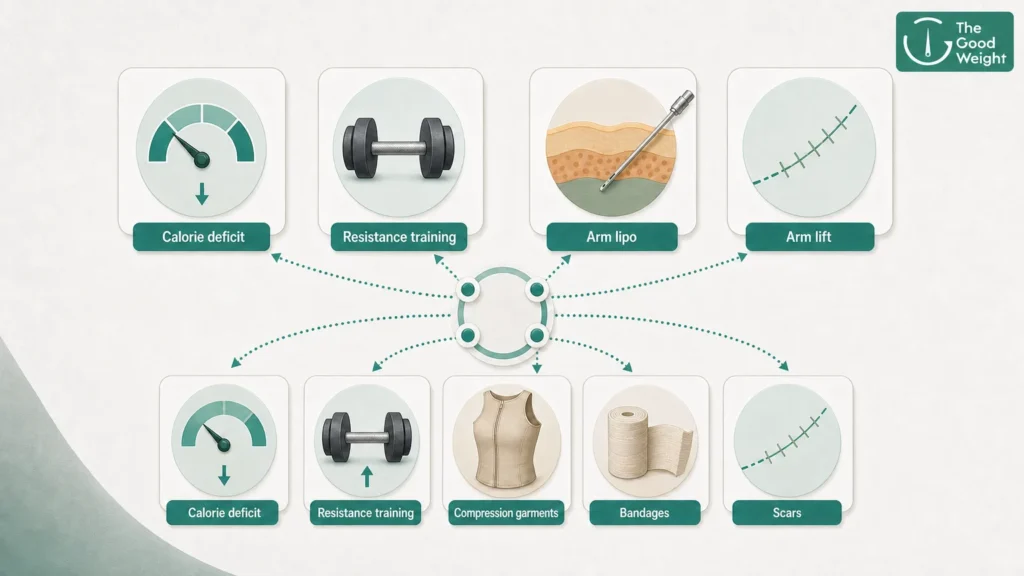
| Option | What it can change | What it cannot reliably change | Main trade-off |
|---|---|---|---|
| Continued weight-loss care | Total fat mass and metabolic risk | A chosen “problem area” on command | Requires time and weight stability |
| Resistance training | Muscle tone, strength, posture | Loose skin or selective fat loss | Progress may be gradual |
| Arm lipo | Localized fat deposits with good skin recoil | Major skin excess or obesity | Surgery, swelling, contour risks |
| Arm lift | Hanging or loose upper-arm skin, with some reshaping | A scar-free result | Longer scar and recovery |
For a person still actively losing weight, the first row often matters more. Further loss may reduce arm fat and change the surgical plan later. At The Good Weight, doctor-led weight care starts with the health picture: weight history, metabolic markers, medications, eating patterns, mobility, and goals. An aesthetic concern deserves respect, but it should not eclipse diabetes risk, blood pressure, or the need for a plan you can live with.
Arm lipo can suit someone who has stable weight, localized fat, realistic expectations, and skin that is likely to retract well. The procedure uses small access points and a cannula to remove fat. Bruising, swelling, soreness, compression garments, and temporary activity limits are part of the package. Results also settle slowly, not on the day the bandages come off.
An arm lift belongs in a different conversation. After major weight loss, someone might have little fat left but still have a skin fold that rubs, causes irritation, or makes clothing difficult to fit. In that case, more fat removal may not solve the concern. A review of arm-contouring techniques after massive weight loss discusses why procedure choice depends on skin excess and the patient’s pattern of tissue laxity.
When it is wise not to rush into surgery
A wedding, holiday, reunion, or milestone birthday can create an intense deadline. That pressure makes a procedure feel urgent. Bodies do not share our calendar anxiety, unfortunately, and recovery has its own timetable.
Pause if any of these apply:
-
Your weight is still moving sharply up or down. Further loss may alter arm volume and skin drape. Weight regain can also change a result later, even though removed fat cells do not return in the same way.
-
You want a procedure to solve distress about your entire body. A contouring operation can change a physical area. It cannot settle grief, comparison, or the feeling that every photograph must be perfect. A thoughtful clinician should ask about expectations instead of treating that conversation as awkward.
-
You cannot make room for recovery. You may need help with lifting, driving, work tasks, and caring for children during the early phase. A surgeon should explain compression, incision care, movement restrictions, and follow-up before you commit.
-
You have been offered unapproved injections as a shortcut. The FDA warns that unapproved fat-dissolving injections can cause serious harm, including infections, scarring, skin injury, and deformity. “Non-surgical” does not automatically mean low-risk.
Weight stability does not mean waiting until life becomes perfectly calm. Few people get that luxury. It means reaching a period where your eating pattern, medical treatment, and weight trend feel settled enough to judge your actual contour.
Bring better questions to the consultation
A useful consultation should feel less like a sales pitch and more like a careful sorting process. Bring a brief weight-history timeline, a list of medications and supplements, previous procedures, and a clear description of what bothers you. Photos showing stable weight over time can help too, though they are not mandatory.
Ask the surgeon or obesity specialist questions that force a specific answer:
-
“Am I seeing mostly fat, loose skin, or both?” Ask them to explain their examination in plain language. If the response feels vague, keep asking.
-
“Would more medical weight loss change your recommendation?” A clinician who says “not yet” may be protecting you from a poor-timing decision.
-
“How much skin retraction do you expect in my case?” No one can promise an exact result, but they should discuss the variables that affect recoil.
-
“Where will the scars sit, and what happens if I heal with a widened or darker scar?” Scar planning deserves the same attention as liposuction planning.
-
“What can I lift, wear, and do during each recovery stage?” Specific instructions beat a breezy “you’ll be fine.”
-
“What complications do you watch for?” Liposuction carries risks that include contour irregularities, fluid accumulation, infection, and anesthesia-related problems. A qualified surgeon should discuss them without drama or dismissal.
Then ask one more: “What result would make you advise me against surgery?” Honestly, that question reveals a lot. A clinician who can name the limits of a procedure is more trustworthy than one who sees every concern as an operation waiting to happen.
A sensible order for making the decision
You do not need to solve every part of your body image before seeking information. Still, a sequence can stop a rushed choice from becoming an expensive regret.
-
Clarify the goal. Write one sentence without using the word “fat.” For example: “I want the hanging fold under my arm to be smaller in sleeveless clothing,” or “I want less fullness at a stable weight.” The language often reveals whether the concern is skin, fat, or proportion.
-
Review your weight trajectory. Look back over six to twelve months. If weight is still changing because of a new nutrition plan, GLP-1 medication, bariatric care, stress, or illness, talk with your treating doctor before booking contouring surgery.
-
Build the health plan first. Blood pressure, glucose management, protein intake, sleep, and strength work matter around any procedure. Someone who has lost weight through overly restrictive eating may need nutrition support before surgery, especially if protein intake and muscle mass have suffered.
-
Seek a qualified surgical opinion only after that. Ask for a physical examination, clear scar discussion, recovery instructions, and written cost details. Get a second opinion if the recommendation does not match what you see in the mirror or what you understand about your own goals.
The result? Less guesswork. And less pressure to choose between “do nothing” and “have surgery now.”
Frequently asked questions
How long does recovery from arm lipo take?
Early bruising and swelling can last weeks, while the contour may keep settling for several months. Many people return to desk-based work sooner than they return to lifting, vigorous exercise, or unrestricted childcare. Your surgeon’s instructions should set the pace because the amount of treatment and your healing response matter.
Can fat come back after arm liposuction?
Removed fat cells are gone, but the remaining fat cells can enlarge with future weight gain. Arm lipo does not make anyone immune to weight regain, which is why stable routines still matter after surgery. A result often holds better when it follows sustainable weight loss rather than a crash diet.
Can exercise replace surgery for loose upper-arm skin?
Exercise can strengthen the muscle under the skin and improve how the arm functions. It cannot cut away a large skin fold or reliably tighten skin that has lost elasticity after major weight loss. For mild laxity, strength training and time may improve the overall look; for pronounced excess, an arm lift is the procedure built for that problem.
What should people after major weight loss know before arm contouring?
Give your body time to settle, protect your nutrition, and discuss weight stability with the clinicians involved in your care. People after major loss may need a different operation than people with small, localized fat deposits. A scar may be a worthwhile trade for some and a deal-breaker for others. Both views are reasonable.
Your arms do not have to be the final report card on your weight-loss effort. Start by naming the goal: fat loss, contour change, or skin correction. Then speak with The Good Weight about doctor-led medical weight loss, body-composition support, and whether a procedure referral fits your health plan.