
Weight management and fertility decisions work better with a shared plan for metabolic health, medication safety and timely reproductive care.
You may leave one appointment with a weight-management prescription and another with advice to start trying for pregnancy. Both recommendations may make sense on their own. But without a shared timeline, you’re left with the difficult questions: When should contraception stop? Does the medicine need to change? Should fertility assessment start now, or after weight loss?
For adults with polycystic ovary syndrome, or PCOS, the most useful starting point is knowing who handles each decision. A weight-care clinician can assess metabolic health and supervise weight treatment. A gynaecologist can investigate irregular bleeding and discuss contraception, while a fertility clinician assesses difficulty conceiving and plans treatment when needed. Their responsibilities overlap around pregnancy preparation and medication safety.
The uncertainty can be exhausting. You shouldn’t have to carry conflicting instructions between clinics, and a number on the weighing scale shouldn’t become an unexplained barrier to asking for fertility help. Equally, a pregnancy plan needs to account for medicines that aren’t suitable during pregnancy.
Weight care can run alongside reproductive care, but it shouldn’t delay appropriate fertility evaluation or be presented as a guaranteed route to pregnancy. That distinction matters if you’re planning ahead, already trying to conceive or considering fertility treatment. A coordinated appointment should end with named responsibilities and clear next steps, not simply “come back after you’ve lost weight.”
Who coordinates weight management and fertility care?
Coordinated preconception care means agreeing how your health treatment and pregnancy plans fit together before conception. It includes a medication review and decisions about referrals, with someone responsible for following up.
Your weight-care clinician can review your weight history and metabolic risks, then discuss appropriate treatment. Depending on your needs, that might include nutrition support or medication. If pregnancy is a goal, the treatment plan also needs a safe transition into trying to conceive.
Your gynaecologist can assess cycle patterns and abnormal bleeding, and discuss contraception while pregnancy isn’t yet planned. They may start investigations into infrequent ovulation or arrange a fertility referral. Ask who will review missed periods if you’re not currently trying.
A fertility clinician evaluates factors affecting conception, including ovulation and, where relevant, sperm or fallopian-tube factors. PCOS shouldn’t become the automatic explanation for every difficulty conceiving. Treatment decisions need to reflect the assessment, not the diagnosis alone.
Who holds the overall plan? That answer varies by clinic, but it shouldn’t remain vague. Before leaving, ask which clinician will coordinate medication changes and who will receive the consultation notes. Shared care needs an owner.
What should a preconception review cover?
A useful review starts with your daily life, not a demand for a particular weight. Bring your questions about food and activity, including anything that makes advice difficult to follow. Shift work, nausea from medication or a history of restrictive dieting can change what a realistic plan looks like.
The principle behind prepregnancy counselling is to review health conditions and medicines before pregnancy. Your clinician can then decide which checks or changes fit your circumstances. More testing isn’t automatically better; each test should answer a question.
Prepare these four areas:
- Your cycle history. Record the first day of recent periods and any long gaps. Note heavy bleeding or pain, too. An imperfect record is still useful, so don’t postpone an appointment because your tracking app has missing entries.
- Everything you take. Bring prescriptions, supplements and non-prescription products, including exact names and doses. Add your current contraception and any medicines used for acne or unwanted hair growth. Photos of packaging can help when brand names are confusing.
- Your health background. Bring recent results and mention diabetes, raised blood pressure or previous pregnancy complications. Your clinician may discuss glucose testing and other checks based on your history. Ask what needs attention before conception and what can proceed alongside fertility assessment.
- Your eating and activity patterns. Describe what happens during an ordinary week, including skipped meals or exercise that leaves you depleted. A plan should fit your food preferences and budget. The Good Weight’s practical PCOS nutrition guidance can help you prepare questions, but dietary advice isn’t a fertility prescription.
Also ask about folic acid and any other pregnancy preparation relevant to you. The aim is better health and safer treatment decisions. It isn’t a promise that changing your weight will lead to pregnancy.
Build a timeline before changing treatment
“I want a baby soon” can mean next month or next year. Put a rough date on paper, even if it may change. The difference affects medication decisions and referral urgency.
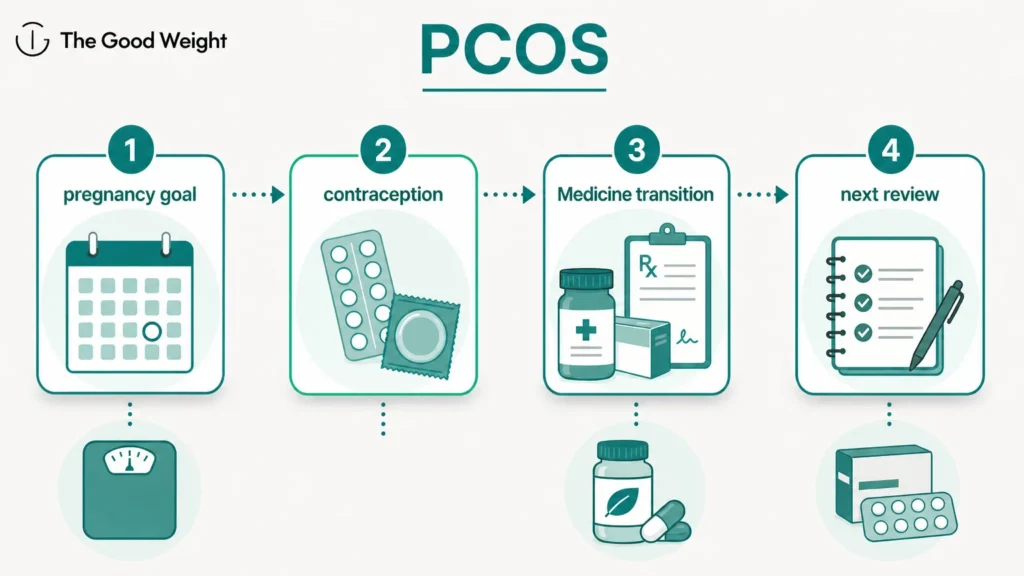
Use the following worksheet during an appointment. Fill in the answers with your clinicians, not from someone else’s prescription or social-media schedule. A blank space marks a question that still needs an owner.
- Write down your pregnancy goal and current situation. Record when you hope to start trying, whether you’re already trying and how long that has been happening. Add any known fertility concerns. If you’re uncertain about timing, say so; uncertainty is part of the planning discussion.
- Confirm contraception before starting or continuing treatment. Write down your current method and ask whether it fits the proposed medicine. Don’t assume infrequent periods mean pregnancy can’t happen. Ask what to do after missed contraception or a suspected pregnancy.
- Create a medicine-specific transition plan. For each medicine, record whether it needs to stop or change before conception and who will prescribe the replacement, if needed. Any interval between the last dose and trying must follow the exact product information and clinical advice. There isn’t one stopping interval for every weight-management medicine.
- Book the next review and any referral. Write the dates alongside the clinician responsible for each action. Ask what would trigger an earlier appointment, such as a positive pregnancy test or a change in cycle pattern. Keep a copy that both your weight-care and reproductive clinicians can read.
Honestly, the paperwork can feel tedious. But “stop later” is a poor instruction when pregnancy is possible. A written plan removes guesswork at the point when decisions become time-sensitive.
Why a weight target shouldn’t hold up assessment
A request to “lose weight first” needs an explanation. Is the concern uncontrolled diabetes, a procedure-related safety issue or a clinic’s treatment policy? Those are different problems, and they call for different discussions.
The American Society for Reproductive Medicine notes that weight-loss interventions before fertility treatment have not consistently improved live-birth outcomes. Its review also discusses the balance between possible benefits and the effects of delaying treatment. Better metabolic health can remain a worthwhile goal without treating weight loss as a proven route to a baby.
So, can assessment start while you work on health? Ask directly. Evaluation and treatment aren’t identical decisions: investigating irregular ovulation or arranging relevant tests doesn’t commit you to starting every treatment immediately.
A practical decision framework asks four questions. What needs attention before pregnancy for safety? What fertility investigations can start now? What treatment decisions depend on those findings? And when will the team reconsider any proposed delay?
For example, someone with long gaps between periods may need an ovulation assessment while receiving support for blood glucose management. Another person may need a medication change before trying, without pausing the referral process. Same diagnosis, different sequence.
A weight target alone can’t answer all of those questions. Ask clinicians to explain the reason for any delay and agree a review date. Open-ended waiting is not a coordinated plan.
The evidence conversation about ovulation treatment
If your periods are infrequent and you’re trying to conceive, a useful question is: “Am I ovulating, and what treatment might help if I’m not?” Weight care doesn’t answer that question by itself. A fertility assessment can clarify whether ovulation treatment is appropriate and whether other factors need investigation.
Evidence note for discussion with your clinician: the 2023 International Evidence-based Guideline recommends letrozole as first-line pharmacological ovulation induction for infertile anovulatory women with PCOS who have no other infertility factors. “Anovulatory” means not ovulating. The recommendation concerns a defined clinical situation, not everyone with PCOS who hopes to conceive.
Letrozole is a prescription treatment, not something to start from an online schedule. Your clinician needs to assess suitability and exclude an existing pregnancy before treatment. They should also explain any monitoring and the next steps if ovulation or pregnancy doesn’t occur.
Ask how promptly that assessment can happen alongside your metabolic review. The point isn’t to demand a particular prescription. It’s to avoid a situation in which months of weight treatment replace a conversation about an evidence-based fertility option.
GLP-1 medicines need their own pregnancy plan
A medicine that helps with weight management may still be unsuitable when pregnancy is possible. That can feel frustrating when treatment has made eating or weight care more manageable. Still, treatment success doesn’t remove the need for a preconception review.
The same international guideline says GLP-1 receptor agonists may be considered alongside active lifestyle intervention for higher weight in adults with PCOS, and advises effective contraception when pregnancy is possible because pregnancy safety data are lacking. Those recommendations belong in the same conversation. A discussion about starting treatment should include what happens if your pregnancy goals change.
Before making changes, ask your prescriber to document the exact medicine and the required preconception stopping interval. Ask when contraception can stop, and what support will replace the medicine. If the drug also treats diabetes, the team needs a plan for glucose management during the transition.
Don’t apply one product’s instructions to another. Different medicines can have different requirements, and some need specific advice about oral contraception. Your prescriber or pharmacist should check the current information for your exact product.
What if pregnancy happens unexpectedly? Contact the prescriber and your pregnancy-care clinician promptly for medicine-specific instructions. An exposure needs assessment, not an automatic assumption of harm; panic and internet comparisons won’t answer the individual safety question.
Safety FAQ: when should you ask for help?
My periods are irregular. Should I wait before asking about fertility?
Ask for an assessment now if your cycles are infrequent or absent and you want to conceive. Don’t assume you must first reach a weight goal or complete a long period of trying without advice. Your clinician can decide how soon investigations or referral should begin based on your cycle history and circumstances.
What if I haven’t had a period for several months?
Arrange a gynaecology review even if pregnancy isn’t your immediate goal. Long gaps deserve assessment, and a clinician can discuss pregnancy testing and whether treatment is needed to protect the womb lining. Seek earlier advice if you also have unusual bleeding or pain.
I’m already trying while taking weight-management medication. What now?
Contact the prescribing clinician promptly and explain that pregnancy is possible. Ask for advice before continuing the usual treatment schedule or making unsupervised changes, particularly if the medicine also treats diabetes. If pregnancy may already have occurred, discuss testing and the next steps with your care team.
Which symptoms need urgent care?
Severe pelvic pain, fainting or heavy bleeding needs urgent medical assessment. Pain or bleeding with a positive pregnancy test also needs prompt evaluation, without waiting for a routine fertility appointment. Use local emergency services if symptoms are severe or you feel acutely unwell.
What should I ask if nobody has explained referral timing?
Ask, “Given my age, cycle pattern and time trying, should fertility assessment start now?” Then ask who will make the referral and when you should follow up if you haven’t heard anything. You don’t need to settle every weight-management decision before requesting that conversation.
Leave with one shared plan
At your next review, bring your current medicines and cycle history, along with recent test results and your pregnancy timeline. Ask the clinician to record which treatment continues, what needs to change and when reproductive assessment should happen. Request that the plan reaches everyone involved in your care, so you don’t become the only link between clinics.
The Good Weight’s doctor-led metabolic health programmes can be a starting point for discussing personalised weight care in Chennai. Make your reproductive goals part of that discussion from the first appointment. Weight management and fertility care should support the same person, on the same timeline.
Arrange a clinician review to build that shared plan, with explicit medication instructions and referral responsibilities. Bring the unanswered questions, too; they deserve space alongside the test results. Learn more about The Good Weight’s doctor-led care.