
“Why am I not seeing progress if my weight is changing only a little?”
It’s a fair question, especially when your clothes fit differently, your waistband feels tighter after months at a desk, or your energy seems to dip hard between meals. The scale may show the same two or three kilograms moving up and down, as if nothing is happening. Yet your midsection can tell a different story.
Body weight is a total. It includes muscle, fat, water, food in your digestive tract, and bone. A bathroom scale cannot tell you where fat is stored, whether you’ve gained strength, or whether your waist has changed after a stressful month of late dinners and patchy sleep. That’s why abdominal fat deserves a closer look when belly changes feel out of proportion to overall weight.
Abdominal fat refers to fat stored around the stomach area. Some sits under the skin, while visceral fat lies deeper in the abdomen around internal organs. Visceral fat has stronger links with metabolic and cardiovascular risk than fat stored in many other areas of the body.
A person can have a body weight that seems stable, or even a BMI that doesn’t flag obesity, while carrying more fat around the abdomen. Research has linked greater central fat distribution with higher cardiovascular risk even among people whose BMI is not in the obesity range, as the American Heart Association reported from long-term population research.
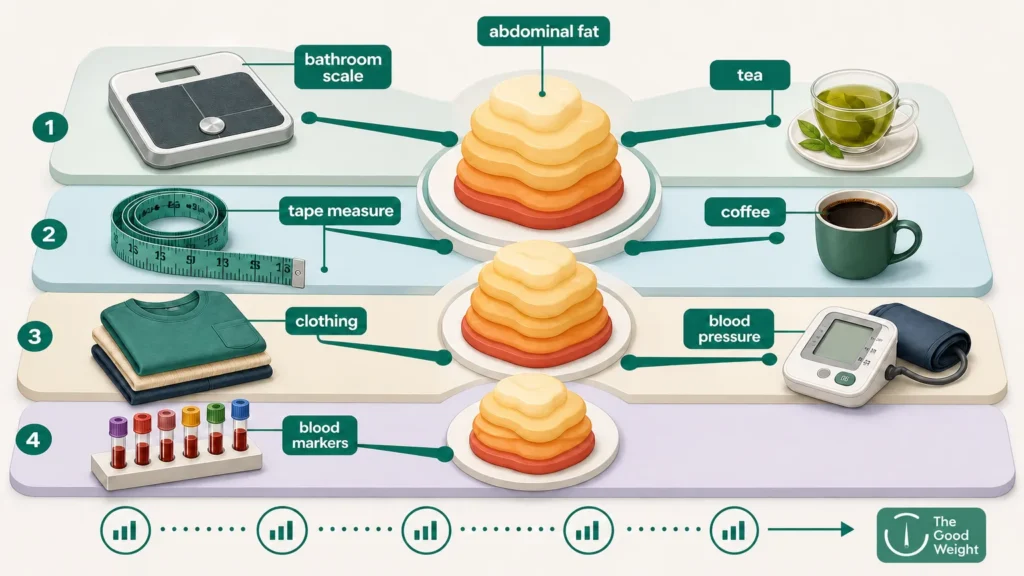
None of this calls for panic. It calls for better information. If belly fat is your main concern, tracking your waist trend alongside weight, sleep, daily movement, and blood markers can paint a much more useful picture than the scale alone.
Why abdominal fat and total body weight tell different stories
A scale can be useful. It just has a narrow job.
Picture two people who both weigh 75 kg. One walks daily, does strength training twice a week, and has built some muscle over time. The other has become less active during a busy work stretch, sleeps five or six hours most nights, and notices trousers getting tight at the waist. Their weight may match. Their health context may not.
Muscle is denser than fat, so body composition can shift without dramatic scale movement. Water retention also changes from day to day, especially around high-sodium meals, menstrual cycles, travel, alcohol, or a poor night’s sleep. A sudden one-kilogram jump often says more about fluid and digestion than fat gain. Frustrating? Yes. A reason to give up? No.
The deeper issue is distribution. Subcutaneous fat is the soft layer you can pinch under the skin. Visceral fat sits deeper and is associated with altered blood sugar regulation, blood pressure, and blood fats. A detailed review of the science describes visceral adipose tissue as more strongly tied to cardiometabolic risk than subcutaneous fat.
Look, you cannot diagnose visceral fat by pinching your belly or looking in a mirror. But a rising waist measurement can act as an accessible early signal that it’s time to look at the wider metabolic picture.
The scale still has a place
Ignoring weight completely can hide a pattern, particularly if it rises steadily over several months. But daily emotional negotiations with the scale rarely help. I’d rather see someone weigh under similar conditions once or twice a week, then compare a four-week trend.
Waist size adds another data point. Energy, hunger, activity, and laboratory results add context. No single number gets to play judge and jury.
How to measure your waist without fooling yourself
The tape measure has its own quirks. Pull it too tight and you get a flattering but useless number. Measure after a large dinner and you may feel discouraged for no good reason. Consistency matters more than chasing a perfect reading.
Use a flexible, non-stretch tape and take the measurement at the end of a normal exhale. Stand relaxed, feet about hip-width apart, and avoid sucking in your stomach. The World Health Organization describes waist circumference as a practical measure of abdominal obesity and discusses standard measurement methods in its waist-circumference measurement protocol.
For home tracking, pick one anatomical point and stick with it. Many clinicians measure midway between the bottom of the ribs and the top of the hip bone. Record the number once every two to four weeks, at roughly the same time of day and in similar clothing.
A useful routine looks like this:
-
Measure in the morning before breakfast. Morning readings reduce the noise from a full day of meals, fluids, and bloating. Use the bathroom first, then measure before tea or coffee.
-
Take two readings. If the first and second differ, take a third and record the average. A tiny bit of tape-measure wobble is normal, so don’t turn millimetres into a verdict on your effort.
-
Write down the conditions. Note poor sleep, travel, menstruation, constipation, or a weekend of restaurant meals. Patterns become clearer when you can see the real life around the number.
-
Review the trend after four to eight weeks. One reading is a snapshot. A gradual change across several readings carries more weight.
The more I’ve watched people track progress, the more I think the waist is a calmer metric. It often reflects real changes in routines before the scale catches up.
When the concern may be metabolic, not only cosmetic
A growing waistline does not diagnose insulin resistance, diabetes, or any other condition. Bodies are messy, and symptoms overlap. Still, certain patterns deserve a conversation with a doctor instead of another restrictive diet plan.
Keep an eye on these signals:
-
Your waist is climbing despite little overall weight change. This can happen during long periods of low activity or after a change in routine. A tape measure cannot identify the cause, but it can flag a direction worth checking.
-
You have sharp energy crashes or frequent intense cravings. A mid-afternoon hunger surge may reflect meal timing, low protein intake, poor sleep, or blood sugar changes. It does not automatically mean insulin resistance, despite what social media insists.
-
Most of your day happens sitting down. Chennai traffic, desk work, long meetings, and evening screen time can make movement vanish without anyone noticing. A gym session once a week doesn’t fully cancel hours of sitting, though it still counts.
-
Sleep is short or broken. People often blame themselves for hunger when sleep is doing part of the talking. The urge to reach for biscuits, bakery snacks, or another sugary tea can feel louder after a tired night.
-
You have family history or known health concerns. Diabetes, high blood pressure, abnormal cholesterol, fatty liver disease, polycystic ovary syndrome, or repeated gestational diabetes in the family change the context. They don’t predict your future with certainty, but they make screening more sensible.
If several of these sound familiar, ask a clinician about blood pressure, glucose testing, HbA1c, lipids, liver health, and other checks suited to your history. The team at The Good Weight can help connect diagnostic testing with an individual metabolic-health plan, rather than treating a waist measurement as the whole story.
What helps reduce abdominal fat in real life
The boring answer wins here. You cannot choose where your body loses fat first, but consistent food structure, movement, sleep, and medical care when needed can reduce overall body fat and often improve waist size over time.
Start with meals you can repeat on an ordinary Tuesday. Build lunch or dinner around a protein source such as dal with curd, eggs, fish, chicken, paneer, tofu, or chana. Then add vegetables and a measured portion of rice, roti, millet, idli, dosa, or another staple you genuinely enjoy. Cutting rice forever is not a plan if it makes you raid the kitchen at 10 pm.
Protein matters because it can help fullness and helps preserve lean tissue while you lose weight. Don’t turn it into a maths exam. Just aim to include it at each meal, especially breakfast. A plate of only toast and tea may leave you hunting for snacks well before lunch; eggs with vegetables, moong chilla, curd with fruit and nuts, or idlis with sambar may carry you further.
Walking is underrated because it fits into life. Begin with 10 minutes after lunch or dinner, then build toward a regular weekly routine. The CDC recommends gradual, sustainable weight-loss habits that include regular physical activity, not punishment workouts that last ten days and disappear.
Strength training matters too. Two sessions a week using machines, resistance bands, dumbbells, or bodyweight movements can help maintain muscle while body fat comes down. Start with a trainer or physiotherapist if pain, injury, or uncertainty has kept you on the sidelines. You don’t need to become a gym person overnight.
And sleep cannot stay in the footnotes. Set a realistic wake time, reduce late-night work where possible, and make dinner less likely to drift toward midnight. Not perfect. Just less chaotic.
Stop buying the belly-fat myths
Social media loves a visible promise: a seven-minute abs routine, a detox drink, a sweat belt, or an “empty stomach” ritual. The products change. The pitch doesn’t.
Can ab exercises burn fat only from the stomach?
No. Planks, crunches, and leg raises strengthen abdominal muscles, which is useful for stability and function. But working a muscle does not direct fat loss from the nearby area. A controlled trial found that six weeks of abdominal exercise improved muscular endurance but did not reduce abdominal fat or waist-related body composition measures on its own.
Keep core training if you enjoy it. Just don’t make it your only plan.
Do detoxes, juices, or sweat belts shrink the waist?
They can change water weight, bowel contents, or how much you sweat. None of those is the same as fat loss. A sweat belt may leave you hot, uncomfortable, and temporarily lighter from fluid loss, but your body rehydrates.
Crash diets create another trap. You may see a fast early drop, then face strong hunger, fatigue, and a rebound into old eating patterns. The result is a miserable cycle: restrict, regain, blame yourself, repeat. I’m not a fan.
Should you stop weighing yourself?
Not necessarily. Scale data can help when used calmly, alongside waist readings and behaviour trends. Scale obsession starts when a normal fluctuation changes your entire plan for the day.
Use it as information, not a mood report. Big difference.
When it’s time to get medical support
Some situations call for more than generic advice. If your waist keeps rising despite consistent efforts, if weight returns after every diet, or if you live with diabetes, high blood pressure, sleep apnoea, fatty liver disease, or PCOS, a medical review makes sense.
Medication may suit some people, and it may not suit others. The same is true of endoscopic procedures or bariatric surgery. A responsible clinician looks at your medical history, current medicines, eating patterns, past attempts, lab results, and personal goals before discussing treatment. The National Heart, Lung, and Blood Institute notes that treatment decisions for overweight and obesity consider health risks, medical history, and the intensity of support needed.
Repeated regain is not proof that you lack discipline. It can point to untreated hunger, medication effects, sleep problems, mobility limits, or a plan that was never realistic for your life. Doctor-led care can sort through those possibilities without shame.
At The Good Weight, medical weight-loss care can combine physician assessment, nutrition support, diagnostic review, and longer-term follow-up. For people who meet clinical criteria, the conversation may also include endoscopic weight-loss procedures. No one treatment fits every body. That’s the point.
Frequently asked questions about waist size and belly fat
Is waist size more important than BMI?
Neither measurement works well alone. BMI helps screen for weight relative to height, while waist size adds information about central fat distribution. If the two tell different stories, a clinician can help interpret them alongside blood pressure and lab results.
How quickly can abdominal fat reduce?
The pace varies with your starting point, medical history, activity, food intake, sleep, and treatment plan. Early changes may include less bloating or a looser waistband, while fat loss tends to require steady habits over weeks and months. Fast is not always better.
Can a normal-weight person have too much abdominal fat?
Yes. A stable or “normal” body weight does not reveal where fat is stored. That is one reason waist trends and metabolic screening can be useful when there is family history or a noticeable change around the middle.
What should I track besides my waist?
Track weight trends, how clothes fit, walking or training consistency, sleep, hunger, and relevant health markers. Keep the system small enough to maintain. A notebook works; a phone note works too.
Your body is more than a number that flashes for three seconds on a scale. Measure your waist trend, look honestly at your routines, and ask for blood-marker checks when the pattern calls for it. Then build a plan around your actual health risk and your actual life.
Learn more about doctor-led, personalized weight care at The Good Weight.