
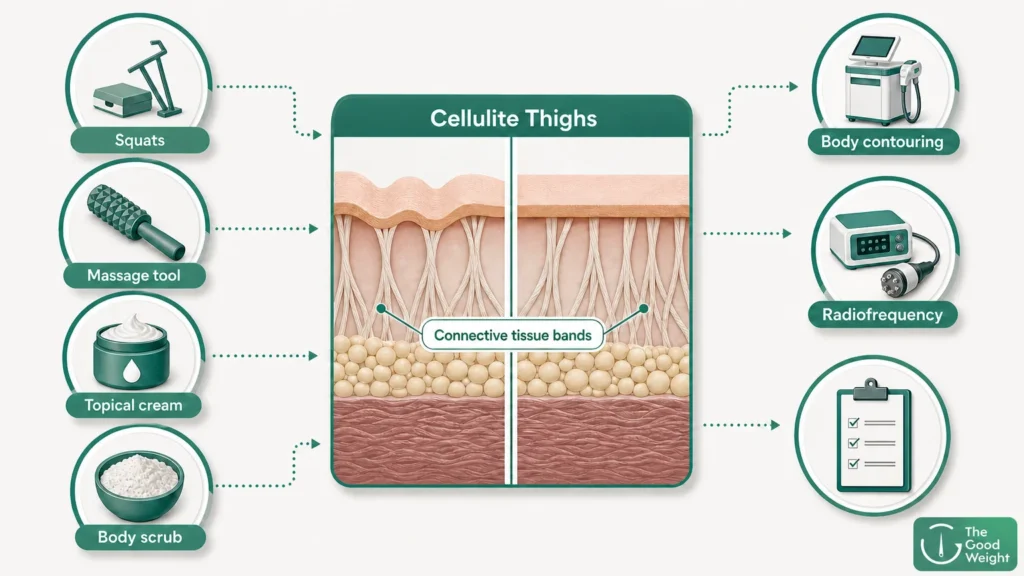
It is understandable to wonder why cellulite remains visible after weeks of walking, strength training, or weight loss. Many people expect that becoming fitter or changing their body size should make the dimpling disappear. In reality, cellulite thighs are influenced by more than the amount of fat beneath the skin, so the relationship is not always straightforward.
Cellulite, body fat, and loose skin are related but different concerns. Body fat is normal tissue that stores energy and supports many body functions. Loose skin refers to skin that does not fully retract after weight change, pregnancy, or ageing. Cellulite describes a textured or dimpled skin appearance – most often on the thighs, buttocks, or hips – that can occur at many body sizes.
The most useful approach is to separate what you would like to change from what may be realistically changeable. Exercise can improve strength and body composition. Sustainable weight loss can improve metabolic health and may alter body shape. Certain procedures may improve skin texture in selected people. None of these options can promise that cellulite will disappear completely.
What cellulite is – and what it is not
Cellulite is a very common skin texture, not a disease or a sign that you have failed to take care of yourself. It develops when bands of connective tissue pull downward between the skin and deeper tissues, while fat cells press upward around them. This combination can create the familiar uneven, “orange-peel” or dimpled appearance.
The structure of connective tissue differs between people, and hormones, genetics, skin thickness, age, and fat distribution can all affect how visible cellulite becomes. Research has found that the pattern and arrangement of the fibrous bands under the skin are closely linked to cellulite severity, rather than cellulite being explained by body weight alone. A review of cellulite anatomy describes it as a multifactorial condition involving skin, fat and connective-tissue structure.
This is why cellulite can appear on the thighs of people who are slim, active, larger-bodied, younger, or older. It is especially common in women, partly because of typical differences in fat distribution and connective-tissue arrangement. Men can develop cellulite as well, although it is reported less often.
Does cellulite mean you have too much body fat?
No. Having cellulite does not automatically mean that you have excessive body fat, poor fitness, or an unhealthy lifestyle. Someone can have a healthy body weight and visible cellulite, while another person with more body fat may have little visible dimpling. The amount of fat under the skin can influence the appearance, but it is only one part of the picture.
It is also important not to confuse cellulite with sudden swelling or a new change in one leg. Long-standing dimpling that has not changed significantly is usually a cosmetic concern. A sudden or painful change should be assessed by a clinician, particularly if it comes with redness, warmth, swelling, or tenderness.
What thigh exercises can realistically change
Exercise is valuable for health, mobility, confidence in movement, and long-term weight management. Squats, lunges, step-ups, cycling, brisk walking, and resistance training can strengthen the glutes, quadriceps, hamstrings, and hips. Over time, building muscle may change the contour of the thighs and can make the skin surface appear firmer for some people.
However, exercise does not selectively remove fat from one chosen location. This is often called “spot reduction,” and it is not a reliable strategy for changing cellulite in one area. Performing many thigh exercises may improve strength and endurance in your legs, but it cannot guarantee that the connective-tissue bands responsible for dimpling will loosen or disappear.
A well-rounded routine is usually more useful than repeatedly targeting one area. For example, two or three weekly resistance-training sessions combined with regular walking may support fitness, muscle mass, and overall body composition. These benefits are meaningful even if the texture of your thigh skin changes only slightly.
Can a cellulite thighs home remedy work?
A massage tool, dry brushing routine, topical cream, or body scrub may temporarily make skin look smoother by increasing surface circulation or creating mild swelling. That short-term effect is not the same as altering the underlying structure that causes cellulite. The American Academy of Dermatology notes that many home approaches offer limited or temporary benefits, while evidence for lasting improvement varies widely between treatments.
If you are searching for a cellulite thighs home remedy, it may help to think in terms of skin comfort rather than a cure. Moisturising the skin can improve its feel and appearance, while regular activity, adequate nutrition, and avoiding rapid weight cycling may support general skin and body health. Be cautious with products that promise dramatic or permanent results, especially if they do not clearly explain evidence, risks, or expected duration.
Can weight loss change the appearance of cellulite?
Weight loss can change how cellulite looks, but the direction and degree of change differ greatly from person to person. If a reduction in body fat decreases the pressure beneath the skin, dimpling may become less noticeable. For others, cellulite may look similar because the connective-tissue pattern remains unchanged.
In some situations, cellulite can become more visible after significant weight loss. Skin elasticity – the skin’s ability to retract – may be reduced by age, genetics, sun exposure, smoking, pregnancy, or the amount and speed of weight change. When skin is looser, its surface may not lie as smoothly over the tissues below.
For this reason, weight loss should not be prescribed solely to decrease cellulite thighs. A weight-management plan is most appropriate when it supports health goals such as improving mobility, blood pressure, blood sugar, sleep, or metabolic risk. At The Good Weight, doctor-led medical weight-loss care is designed around individual health needs, nutrition support, and sustainable progress – not an unrealistic promise to alter one skin feature.
Will losing weight definitely remove cellulite?
No. It may improve the appearance for some people, make little difference for others, or reveal more skin laxity after substantial loss. A slower, sustainable approach to weight change can be easier to maintain and gives the body time to adapt, but it still cannot guarantee a particular cosmetic outcome.
If weight loss is part of your plan, consider tracking outcomes beyond the mirror. Improvements in energy, strength, waist measurement, blood markers, sleep, or daily comfort may better reflect meaningful progress. Where appropriate, diagnostic testing and personalised nutrition support can help make weight care more specific to your metabolic health and routine.
Where body contouring may fit
Body contouring is a broad term for treatments intended to change body shape, reduce a localised fat deposit, improve skin laxity, or address skin texture. It is not one single procedure, and it is not automatically the right answer for cellulite. A responsible consultation starts by identifying the primary concern: is it fat volume, loose skin, dimpling, muscle contour, or a combination?
Some cellulite-focused procedures work by targeting the fibrous bands beneath the skin. Others use energy-based approaches, such as acoustic wave, radiofrequency, laser, or vacuum-assisted treatments, with the goal of improving texture. The evidence and durability of results vary; some treatments may require multiple sessions or maintenance, and none should be presented as a guaranteed permanent cure.
It is also important to distinguish cellulite treatment from fat-reduction treatment. Non-invasive body-contouring technologies may reduce small, localised fat deposits in appropriately selected patients, but the FDA states that these devices are not intended for weight loss or for treating obesity. Reducing fat volume may improve shape, yet it may not release the connective bands that create dimples.
What can a responsible consultation tell you?
A thorough assessment should clarify whether a procedure is likely to match your actual concern. For example, treating a small thigh fat deposit will not necessarily tighten loose skin, and treating skin texture will not replace the health benefits of exercise or a sustainable nutrition plan. Your clinician should explain the likely degree of improvement in plain language, including whether the goal is subtle smoothing rather than complete removal.
The consultation should also cover candidacy, alternatives, cost, recovery, and risks. Depending on the technique, risks may include bruising, swelling, discomfort, changes in sensation, skin irregularity, pigment changes, burns, infection, or the need for further treatment. The American Academy of Dermatology advises that treatment choice should be based on the type and severity of cellulite, since different options have different evidence and expected duration of benefit.
Questions to ask before spending money on treatment
Before deciding whether to pursue a procedure to tighten cellulite thighs, take time to understand both the treatment and the provider. Marketing images may show an excellent outcome for one person, but they cannot predict your result. A useful consultation should leave you with clear information, not pressure to make a same-day decision.
Use this checklist when comparing options:
-
What exactly is being treated? Ask whether the clinician believes the main issue is cellulite, a localised fat deposit, loose skin, or several concerns together. The answer should shape the proposed treatment plan.
-
What result is realistic for my skin and body? Ask what degree of improvement is typical, how long it may take to appear, and whether complete removal is unlikely. Request an honest explanation of what the procedure cannot change.
-
What are the possible risks and downtime? Clarify expected soreness, bruising, swelling, activity restrictions, and warning signs that would require follow-up. Recovery differs considerably between non-invasive treatments and surgical procedures.
-
Are results temporary, lasting, or dependent on maintenance? Some approaches provide temporary smoothing, while others may have longer-lasting effects but still do not stop future ageing, weight changes, or skin changes.
-
What alternatives exist? You may decide that strength training, stable weight management, accepting a normal skin texture, or delaying treatment is the best option for now. A clinician should be comfortable discussing those choices.
-
Who will perform the treatment and handle follow-up? Ask about the practitioner’s qualifications, experience with the specific device or procedure, emergency arrangements, and how concerns will be managed after treatment.
When should you seek medical advice?
Cellulite that has been present for years and causes no symptoms is generally a cosmetic concern rather than an urgent medical issue. You may still choose to discuss it with a qualified clinician if it affects your comfort or if you are considering treatment. An individual assessment can help you avoid spending on a procedure that does not address the feature you want to change.
Seek prompt medical advice for sudden one-sided leg swelling, pain, redness, warmth, a new hard area, rapidly changing skin colour, or skin breakdown. These symptoms are not typical of ordinary cellulite and may require timely assessment. Persistent swelling or discomfort also deserves evaluation rather than self-treatment.
The realistic goal: informed, individual care
Exercise can strengthen and shape the thighs. Weight loss may alter body composition and support metabolic health. Procedures may improve selected aspects of skin texture or contour. Yet cellulite is influenced by connective tissue, skin quality, and anatomy, so no single strategy can reliably erase it for everyone.
If you live in Chennai and would like help understanding whether your concern is related to body composition, skin laxity, cellulite, or a combination, schedule an individual consultation with The Good Weight. Our approach is to provide clear, doctor-led guidance that supports informed decisions, realistic expectations, and sustainable health goals.