
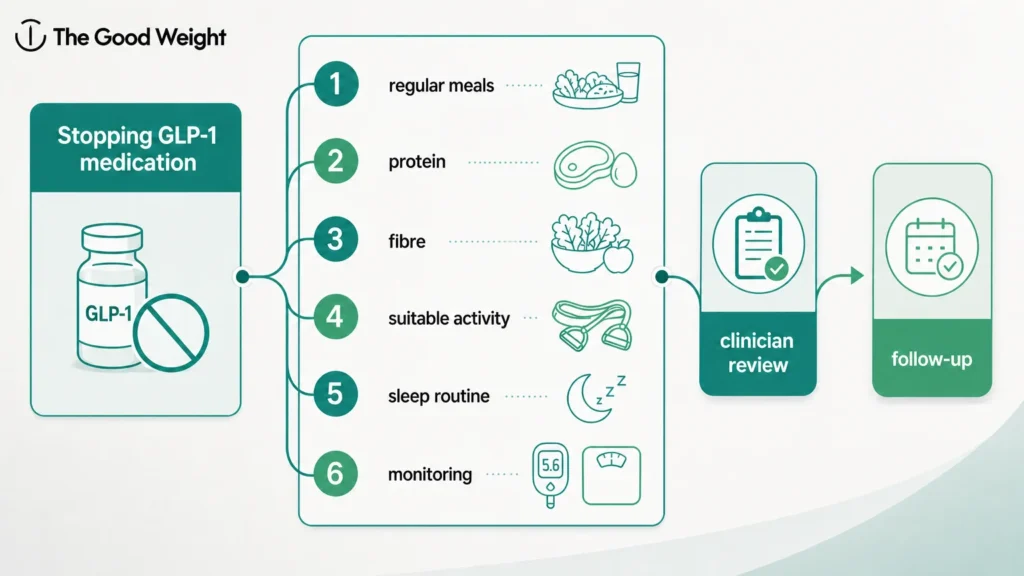
You have lost weight on a GLP-1 medicine, but continuing treatment may now feel uncertain. Perhaps the cost is difficult to sustain, side effects are interfering with meals, or you are wondering whether reaching your goal means treatment can end. These are reasonable concerns, and they deserve a medical review rather than a standard stopping schedule.
Stopping GLP-1 medication is an individualized clinical decision, with a maintenance plan needed before – not after – the last dose. Research shows that weight regain is common after treatment ends, but it cannot reliably predict your personal outcome. This checklist explains what to discuss with your clinician, which routines to establish, and where the evidence on tapering remains uncertain.
Why maintenance planning should start before treatment changes
GLP-1 medicines help regulate appetite and food intake while treatment continues. When treatment ends, those effects can diminish, making hunger and eating patterns harder to manage. Weight regain is therefore not simply evidence that someone has stopped trying; the biological support provided by treatment has changed.
A 2026 systematic review and meta-analysis of 17 studies involving 5,814 participants found that stopping approved weight-management medications consistently produced clinically significant weight regain. It estimated that someone losing 15% of their starting weight on semaglutide 2.4 mg would regain nearly half of that loss within 52 weeks after stopping. This is a research estimate, not a forecast for every patient, and the review covered weight-management medicines rather than GLP-1 treatments alone.
An earlier semaglutide study also illustrates why follow-up matters: participants regained approximately two-thirds of their previous weight loss during the year after withdrawal. Several cardiometabolic improvements moved back towards baseline as well. Together, these findings support discussing weight, nutrition and metabolic health before changing treatment, rather than waiting for difficulties to appear.
The clinician review before reducing or stopping treatment
Bring your medication list, recent weight history and your main reason for considering a change. Explain what is hardest: nausea, cost, low appetite, treatment fatigue or concern about long-term use. The aim is to decide whether continuation, an adjustment, a different treatment or supervised cessation best fits your circumstances.
Use these prompts during the appointment:
- Review health goals and weight trends. Discuss benefits beyond the scale, including mobility, blood pressure, glucose management and quality of life. Review whether weight is stable, still falling or already increasing. Reaching a target weight does not, by itself, answer whether treatment should end.
- Describe side effects, hunger and food intake. Explain whether you can eat regular meals, drink adequately and manage symptoms. Mention persistent vomiting, constipation, food aversions or unusually strong appetite changes. A plan that maintains weight but leaves you struggling to nourish yourself needs reassessment.
- Check other medicines and relevant health markers. Review all prescriptions, particularly diabetes treatments, with your clinician. They may assess glucose or HbA1c, blood pressure, lipids, kidney function or other tests according to your history. If the medicine also treats diabetes, any change needs a glucose-management plan.
- Discuss pregnancy planning or changing medical circumstances. Raise pregnancy intentions before making treatment decisions. Recommendations and the time needed between stopping and conception depend on the specific medicine. New illness, procedures or other health changes also need an individualized review.
- Be open about access and everyday routines. Discuss affordability, supply interruptions, work schedules and your ability to maintain meals and activity. Ask what options exist before your prescription runs out. The Good Weight’s guide to planning GLP-1 maintenance before treatment changes can help you prepare questions.
Why different situations need different plans
There is no single stopping schedule that accounts for every medicine, medical history and reason for changing treatment. Someone benefiting from treatment with manageable symptoms faces a different decision from someone who cannot keep fluids down. The comparison below outlines discussion priorities, not instructions for changing a dose.
| Situation | What the clinician needs to assess | Possible discussion |
|---|---|---|
| Ongoing benefit with manageable side effects | Health benefits, nutrition, preferences and affordability | Whether continued treatment remains appropriate, with regular reassessment |
| Troublesome side effects | Symptom severity, hydration, food intake and possible alternative causes | Symptom management, treatment adjustment, switching or stopping under supervision |
| Changing medical circumstances | Pregnancy plans, new diagnoses, procedures or changes in other medicines | A medicine-specific transition and monitoring plan |
| Missed doses or uncertain adherence | Actual dosing history, barriers and the length of any interruption | Safe next steps using the product’s prescribing guidance |
| Cost or supply difficulties | Remaining supply, affordable options and continuity of care | A planned transition instead of improvised rationing |
| Diabetes alongside weight-management needs | Glucose patterns and the role of other diabetes treatments | A coordinated plan to maintain glucose management |
Do not assume that restarting after an interruption means returning to your previous dose. Restarting instructions depend on the medicine and the interruption, so contact your prescriber. Equally, severe or persistent abdominal pain, repeated vomiting or inability to keep fluids down warrants urgent medical assessment rather than waiting for a routine maintenance appointment.
Build your first maintenance routine
Maintenance habits are support, not a guarantee against regain. They should be realistic enough to continue during busy working weeks, family events and periods of stress. Start building them while treatment changes are being discussed, with nutrition and activity adapted to your health needs.
1. Establish regular, satisfying meals
Agree on a meal pattern that helps you eat adequately and avoids long gaps that leave you uncomfortably hungry. Include a protein source, fibre-rich foods and enough overall food, rather than responding to regain fears with severe restriction. A familiar meal might combine dal, vegetables, rice or chapati, and curd, with portions individualized to your needs.
2. Check protein and fibre adequacy
Ask your clinician or dietitian whether your usual intake meets your needs, especially if low appetite has made meals small or irregular. Protein options can include pulses, beans, eggs, fish, chicken, tofu, paneer or curd; fibre-rich choices include vegetables, fruit, pulses and whole grains. Build changes gradually and discuss fluid needs, particularly if constipation, kidney disease or another condition affects your plan.
3. Make suitable activity repeatable
Discuss resistance exercise or another appropriate way to support strength and physical function. Depending on your ability, this could involve supervised weights, resistance bands, chair-based movements or body-weight exercises alongside walking or other enjoyable activity. Choose a manageable starting routine rather than attempting an intense programme you cannot sustain.
4. Protect sleep and plan for difficult days
Set a reasonably consistent sleep routine and identify practical barriers such as shift work, late meals or caregiving responsibilities. Also decide what you will eat when tired, travelling or short of time, so maintenance does not depend on ideal conditions. Behavioural support can help address emotional eating, distress around hunger or all-or-nothing responses to a difficult week.
5. Monitor without making weight the centre of every day
Agree on a monitoring approach that feels useful rather than intrusive, such as a planned weight check alongside notes on hunger, energy and meal regularity. Review trends instead of reacting to a single reading, and avoid compensating with skipped meals. If weighing increases anxiety or compulsive behaviour, ask for a different approach, including clinician-led checks.
6. Arrange follow-up before changing treatment
Leave the appointment knowing when your next review will happen and how to contact the team sooner. Agree on personal reasons for an earlier check-in, such as persistent hunger, a sustained upward weight trend, difficulty eating or glucose readings outside your agreed range. The Good Weight’s overview of ongoing GLP-1 follow-up care explains how monitoring and nutrition support fit together.
What is known – and still uncertain – about tapering
Tapering means reducing treatment gradually, but that does not make it a proven method of preventing regain. A systematic review of GLP-1 receptor-agonist cessation studies concluded that individualized dose tapering may limit weight regain, while further research is needed for reliable long-term management after cessation. That is a cautious possibility, not proof that a particular schedule works for everyone.
Important questions remain about who benefits, how durable any benefit is and how different medicines should be managed. Strong maintenance habits are worthwhile, but they cannot establish whether an individual will remain weight-stable without medication. Any proposed taper should therefore include monitoring and a clear plan for reassessment.
Can tapering prevent weight regain?
It may help some people, but current evidence does not establish that it reliably prevents regain. There is no universal tapering schedule that can be recommended for everyone considering stopping GLP-1 medication. Ask your clinician what evidence supports the proposed approach and how they will judge whether it is working.
Who can safely stop after reaching a goal weight?
Research does not yet provide a reliable checklist that identifies everyone who will maintain their loss after stopping. Safety also includes nutrition, glucose management, other health conditions and the reason for cessation – not weight alone. Your clinician can assess whether a supervised trial without treatment is reasonable, but cannot promise that regain will not occur.
What if hunger or weight increases afterwards?
Contact your care team rather than waiting until the change feels overwhelming. They can review appetite, meals, activity, sleep, other medicines and metabolic health before discussing next steps. Reassessing treatment is part of chronic weight care, not a personal failure.
Make the maintenance plan your next step
Before changing treatment, aim to have a documented decision, an achievable nutrition and activity routine, and a booked follow-up. Include what to monitor, when to seek help and who will coordinate care if diabetes or another condition is involved. The plan should reflect your health, priorities and access – not just a target number on the scale.
Do not reduce, stop, stretch out or restart prescribed treatment on your own. Arrange a clinician review to discuss personalized maintenance, tapering or continuation. For adults in Chennai, The Good Weight offers doctor-led weight care with nutrition support and long-term guidance to help make that decision collaboratively.