
Many weight-loss diets fail for a simple reason: they ask people to tolerate too much hunger for too long. A breakfast of tea and biscuits, a light salad for lunch, and a very small dinner may reduce calories on paper, but it can also leave you tired, preoccupied with food, and more likely to overeat later. That is not a lack of willpower. It is a meal pattern that is difficult to sustain.
A healthy protein diet for weight loss can make calorie control more manageable by helping you feel satisfied after meals while supporting your body during fat loss. The goal is not to avoid carbohydrates, drink only shakes, or turn every meal into a calculation. It is to make protein a reliable part of balanced Indian meals, alongside vegetables, fruit, fibre-rich carbohydrates, and healthy fats.
For adults who have repeatedly started and stopped generic diet plans, this approach can offer a more realistic structure. Protein is helpful, but it works best as one part of sustainable weight loss – not as a shortcut or a fad.
Why hunger derails so many weight-loss plans
Weight loss requires a calorie deficit, meaning that you take in less energy than your body uses over time. But a plan is only useful if you can follow it consistently. The National Institute of Diabetes and Digestive and Kidney Diseases notes that healthy weight management combines an eating pattern with regular physical activity and long-term behaviour changes. A highly restrictive routine may create a deficit briefly, but it is less likely to fit real workdays, family meals, travel, stress, and social occasions.
Low-protein meals often contribute to this problem. Consider a typical rushed breakfast of toast, poha with very few peanuts, or a banana by itself. These foods are not “bad,” but when there is little protein and fibre, hunger may return quickly. By late afternoon, it becomes much harder to make an intentional choice rather than reaching for chips, sweets, bakery foods, or a large restaurant meal.
The answer is not to eliminate every enjoyable food. Instead, build meals that are substantial enough to hold you for several hours. A healthy high-protein diet for weight loss uses protein strategically: at breakfast, lunch, dinner, and, if needed, a planned snack. This can reduce the cycle of under-eating, intense cravings, and guilt that makes many diets feel like crash plans.
What protein does during fat loss
Protein is an essential nutrient used to build and repair tissues, make enzymes and hormones, and support immune function. During a calorie deficit, it has several practical advantages that can make a weight-loss plan easier to maintain. It is especially useful when paired with strength training and an overall eating pattern that supplies enough fibre and micronutrients.
Protein can improve fullness after meals
Protein-rich foods generally create more satiety than meals built mainly around refined carbohydrates or added fats. A review of research on protein and weight management identified protein intakes of roughly 1.2 to 1.6 grams per kilogram of body weight per day, with around 25 to 30 grams per meal, as a useful range associated with appetite and weight-management benefits. This is not a rigid prescription for every person, but it explains why a protein-containing breakfast can feel very different from a breakfast of carbohydrates alone.
Fullness is not just about a physical “heavy” feeling in the stomach. A satisfying meal can reduce frequent thoughts about food and make it easier to wait until the next planned meal. For example, vegetable oats with curd or eggs is often more sustaining than plain oats, while dal plus sabzi plus curd is more complete than a large serving of rice with a thin gravy.
Protein helps protect lean muscle while you lose fat
When body weight decreases, the loss may include fat mass as well as some lean mass, which includes muscle. Preserving muscle matters because it supports strength, mobility, daily function, and the ability to remain active. Research on dietary protein during weight loss has found that higher-protein approaches can help support lean mass retention during energy restriction, particularly when combined with resistance exercise.
This does not mean protein alone will build muscle while you are dieting. Strength training provides the signal for the muscles to adapt, while adequate protein provides important building blocks for recovery. Even beginner-friendly exercise such as body-weight movements, resistance bands, or supervised gym training can complement a protein-forward meal plan.
Protein creates better meal structure
A protein target gives meals an anchor. Rather than asking, “What can I eat that has the fewest calories?” a more useful question becomes, “What is my protein source, and what vegetables and carbohydrates will make this meal satisfying?” This shift encourages meals that are more balanced and less dependent on willpower.
Current dietary guidance emphasises nutrient-dense foods across the food groups, including protein foods, vegetables, fruits, whole grains, and dairy or fortified alternatives. For weight loss, portion sizes still matter. But building a meal around a meaningful protein source makes it easier to include carbohydrates thoughtfully instead of swinging between restriction and overeating.
What a balanced high-protein day can look like with Indian meals
There is no single “perfect” menu. Your preferred foods, cooking schedule, appetite, medical history, and calorie needs all matter. The example below is designed to show a pattern – not a fixed diet chart – and can be adapted for vegetarian and non-vegetarian eating.
Aim to include a clear protein source in every main meal. Portion sizes should be personalised, particularly if you have diabetes, kidney disease, digestive symptoms, are pregnant, or use weight-management medication.
| Time of day | Vegetarian option | Non-vegetarian option |
|---|---|---|
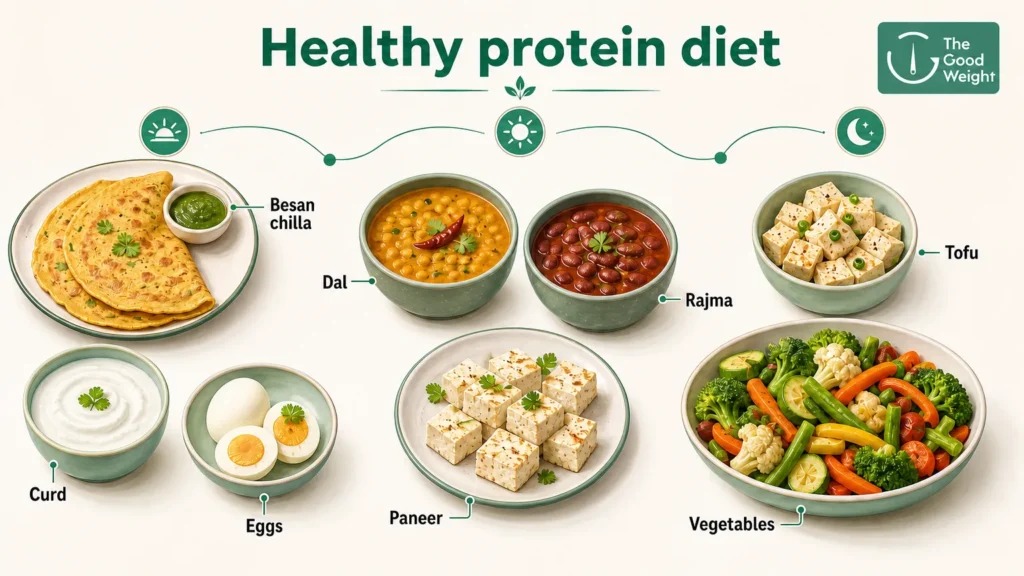
| Breakfast | Besan chilla with paneer or curd, plus vegetables | Vegetable omelette with two eggs and curd, plus one roti |
| Mid-morning, if hungry | Unsweetened curd with fruit, or chaas and roasted chana | Unsweetened curd with fruit, or a boiled egg with fruit |
| Lunch | Dal or rajma, a portion of rice or rotis, sabzi, salad, and curd | Grilled fish or chicken, rice or rotis, sabzi, salad, and curd |
| Evening snack | Sprouts chaat, roasted chana, tofu tikka, or buttermilk | Egg bhurji, chicken tikka, or buttermilk with roasted chana |
| Dinner | Tofu, paneer, soy chunks, or dal with vegetables and a modest portion of millet, rice, or rotis | Fish curry, chicken, or egg curry with vegetables and a modest portion of carbohydrate |
The purpose of this pattern is not to make every meal identical. It is to avoid leaving protein as an afterthought. Vegetarian adults may need to plan more deliberately because common staples such as rice, chapati, and vegetables contribute some protein but may not provide enough on their own. Dal, chana, rajma, soy, tofu, paneer, curd, milk, and eggs, where included, can help close that gap.
A practical plate at lunch or dinner may include one substantial protein source, plenty of non-starchy vegetables, and a measured serving of carbohydrates such as rice, chapati, millets, or potatoes. Carbohydrates are not the enemy; they can provide energy, fibre, and cultural familiarity. The key is that the plate is not dominated by refined carbohydrates or fried accompaniments while protein and vegetables remain too small to satisfy you.
For a more individualised approach, The Good Weight’s diet and weight-loss support can help translate this framework into meals that work with your schedule, food preferences, and metabolic health needs. A diet plan should be practical enough to follow on ordinary weekdays, not only when life is unusually calm.
Four mistakes that can stall a high-protein weight-loss plan
Relying only on shakes
Protein shakes can be convenient when you are travelling, short on time, or unable to eat a proper meal after exercise. They are not required for fat loss, and they should not replace most of your meals. Whole foods such as eggs, curd, tofu, dals, chicken, fish, and paneer offer texture, nutrients, and greater meal satisfaction for many people.
If you use a shake, treat it as a tool rather than a solution. Check the serving size, added sugar, and calories from milk, nut butter, oats, or syrups that may be added. A shake may fit your plan, but it is not automatically lower in calories than a balanced meal.
Overeating calorie-dense foods labelled “healthy”
Nuts, seeds, paneer, cheese, peanut butter, coconut, ghee, and avocado can all fit into a healthy eating pattern. However, they are calorie-dense, so large portions can unintentionally erase the calorie deficit needed for fat loss. The issue is not that these foods are unhealthy; it is that “healthy” does not mean unlimited.
Protein sources also vary widely in calories. Fried paneer, creamy curries, large amounts of cheese, or restaurant-style chicken dishes may contain much more fat and oil than expected. Choose preparation methods such as grilling, steaming, air-frying, pressure cooking, roasting, or lighter curries more often, while keeping favourite richer meals as planned portions rather than everyday defaults.
Forgetting fibre, vegetables, and hydration
A diet that focuses only on protein can become monotonous and may cause constipation, especially when vegetables, fruits, whole grains, legumes, and fluids are neglected. Dietary patterns that include fibre-rich foods are associated with better overall diet quality and health. Protein should complement, not replace, plant foods.
Add vegetables to omelettes, chillas, dal, curries, and rice dishes. Include fruit rather than treating it as forbidden, and drink water regularly across the day. If you increase protein and fibre quickly, do so gradually and discuss persistent bloating, constipation, or digestive discomfort with a clinician.
Assuming more protein always means faster weight loss
Eating double the protein you need does not automatically double fat loss. Your overall calorie intake, activity level, sleep, medical conditions, medication, and consistency still influence results. Very high targets can also crowd out fibre-rich foods and create an unnecessarily complicated eating routine.
A sustainable target is more useful than an extreme one. Your needs may differ based on body weight, age, kidney function, exercise, pregnancy status, and whether you are recovering from a procedure. This is why personalised weight care is often more effective than copying a social-media diet plan.
Adapting protein-forward eating to real life
For office workers with limited time
Office routines often create a long gap between breakfast and lunch, followed by evening hunger and unplanned snacking. Start by strengthening the meals you already eat: add eggs, curd, paneer, tofu, or sprouts to breakfast, and ensure lunch includes a visible protein source rather than only rice or rotis. Carrying roasted chana, plain curd, fruit, or a simple egg or tofu snack can prevent the 5 pm hunger emergency.
You do not need to cook separate “diet food.” A home-style lunch of dal, sabzi, curd, and rice can work well when the dal portion is adequate and vegetables are included. If you regularly order meals, choose grilled proteins, dal-based dishes, tandoori preparations, salads with a protein component, and less oil-heavy gravies where possible.
For women in midlife
Midlife can bring changes in appetite, body composition, sleep, activity, and, for some women, menopause-related symptoms. Protein becomes particularly valuable because maintaining muscle supports functional strength as the body changes. The evidence for resistance training improving strength and lean body mass in healthy adults makes a strong case for combining adequate protein with age-appropriate exercise.
Avoid overly restrictive plans that cut out entire food groups or push intake too low. Women with thyroid conditions, PCOS, diabetes risk, heavy periods, menopause symptoms, or a history of dieting may benefit from a more tailored approach. The Good Weight’s female weight-loss diet guidance is designed to consider these wider health factors alongside weight goals.
For people beginning strength training
New strength-training routines can increase hunger, and some people respond by assuming they need multiple supplements or very large protein portions. Start simpler: include protein in the meal before or after training, eat enough carbohydrates to support exercise, and build a consistent training habit. Recovery also depends on sleep, total food intake, and progressive training – not just a post-workout shake.
For most beginners, a regular meal with eggs, curd, tofu, dal, chicken, or fish is sufficient after exercise if it fits the timing of your day. Protein powder can be useful when a meal is impractical, but it is optional. Focus on consistency first, then adjust with professional guidance if your goals, performance, or body composition are not progressing as expected.
Frequently asked questions about a healthy protein diet for weight loss
How much protein is enough for weight loss?
A commonly used starting range for active weight loss is about 1.2 to 1.6 grams of protein per kilogram of body weight per day, but your ideal amount is individual. Factors such as age, current weight, activity, calorie intake, medical conditions, and whether you are strength training can change the target. Rather than trying to hit an exact number immediately, begin by including protein at each meal and review your hunger, energy, digestion, and progress.
Is whey protein necessary?
No. Whey is a convenient dairy-based protein, but it is not necessary for a healthy high-protein diet for weight loss. You can meet protein needs through foods such as milk, curd, paneer, tofu, soy chunks, dals, beans, eggs, fish, chicken, and lean meat. If you use whey, choose a product that suits your dietary needs and use it to complement meals rather than replace a varied diet.
Should people with kidney concerns follow a high-protein diet?
Anyone with chronic kidney disease, reduced kidney function, kidney stones, significant protein in the urine, or medical advice to restrict protein should not set a high-protein target without clinical guidance. Protein needs in kidney disease can be different from those for the general population. A doctor or renal dietitian can help balance nutritional needs with kidney protection.
How do I combine protein with a calorie deficit safely?
Use a moderate calorie deficit rather than severe restriction, and keep meals balanced. Include protein, vegetables or fruit, fibre-rich carbohydrates, and measured fats instead of removing entire food groups. If you have obesity, diabetes, high blood pressure, sleep apnoea, fatty liver disease, or repeated difficulty losing weight, a doctor-led medical weight-loss plan can help assess whether nutrition support alone is appropriate or whether other evidence-based options should be considered.
Make protein part of a plan you can live with
Protein can make weight loss feel less punishing by improving fullness, supporting muscle, and giving meals a more reliable structure. But it is not a reason to live on shakes, skip vegetables, fear carbohydrates, or chase the highest protein number possible. The most effective healthy protein diet for weight loss is one that respects your appetite, culture, schedule, medical history, and long-term metabolic health.
If you are tired of generic meal plans that leave you hungry, book a doctor-led weight consultation with The Good Weight to develop a personalised protein target, meal structure, and sustainable weight-loss plan. The right plan should fit your life – and support lasting change rather than another cycle of restriction.