
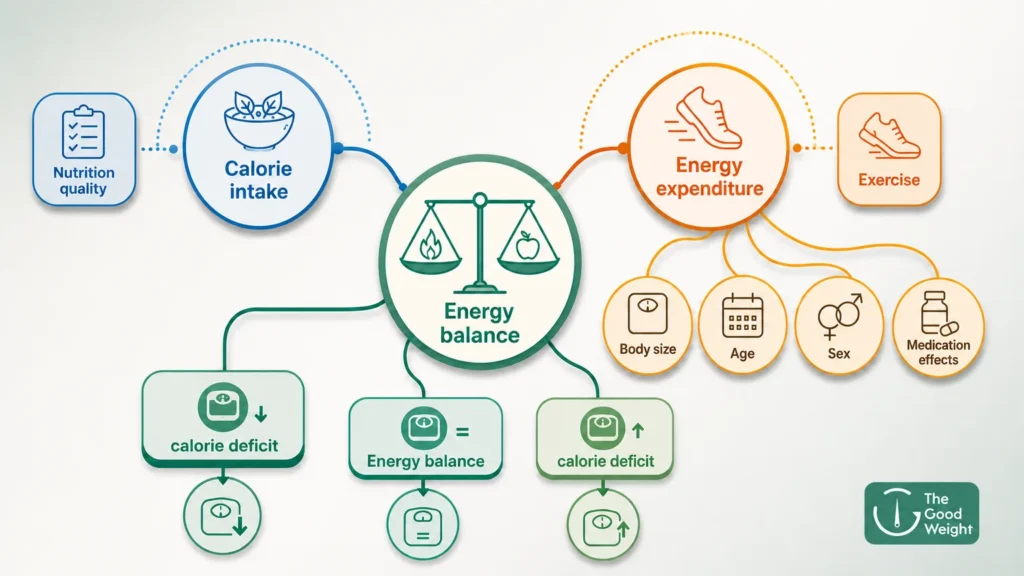
A viral post may tell you that “1,200 calories is enough for anyone” or that a certain calorie target guarantees weight loss. In reality, the same intake can create a meaningful calorie deficit for one person, maintain another person’s weight, and be overly restrictive for someone else. This confusion is understandable: calorie advice is often presented as a universal rule when weight loss is shaped by individual biology, routine, health conditions, and food intake patterns.
Understanding the basics of a calorie deficit diet can help clarify these concepts.
Clinical weight-management guidance generally supports gradual, individualized calorie reductions rather than extreme restriction. A common starting point is a moderate reduction from maintenance intake – often around 500 calories per day – but that figure is not a prescription. It may be too large, too small, or unsuitable depending on your starting weight, activity level, medical history, hunger, and ability to maintain the plan.
This guide explains how a calorie deficit diet works, why calorie needs differ so much from person to person, and how to tell whether your own target is realistic. The goal is not to find the lowest number you can tolerate. It is to find a calorie range that supports steady progress while protecting nutrition, energy, muscle mass, and long-term health.
What Is a Calorie Deficit Diet?
A calorie deficit diet means regularly consuming less energy from food and drink than your body uses over time. Your body needs energy to keep you alive at rest, digest food, move through the day, exercise, think, maintain body temperature, and repair tissues. When your average intake is lower than your average energy use, your body must draw on stored energy, including body fat.
This does not mean every day must look identical. Some days you may eat slightly more because of a social event, training session, travel day, or stronger hunger. What matters most is the overall pattern across weeks, not whether every meal is perfectly measured.
A simple calorie deficit example
Imagine that a person maintains their current weight at approximately 2,200 calories per day. If they consistently eat about 1,800 calories per day while maintaining similar activity, they create an estimated 400-calorie daily deficit. Over time, that gap may support weight loss, although the exact rate will vary because the body adapts and scale weight also shifts with water, digestion, hormones, and glycogen stores.
Another person may maintain weight at 1,800 calories per day. If they copy the first person’s 1,800-calorie plan, they may see little or no change on the scale because they are not in a meaningful deficit. This is why a calorie target that worked for a friend, influencer, partner, or online coach may not work for you.
A calorie deficit is therefore a relationship between intake and expenditure – not a single magic calorie number. Personalized nutrition begins by estimating where that relationship currently sits, then adjusting based on real-world progress and how you feel.
Why Two People Can Lose Weight on Different Calorie Intakes
Maintenance calories are not fixed across the population. They can differ by hundreds of calories per day between people of different sizes, ages, body compositions, routines, and health circumstances. Even the same person’s needs can change after weight loss, a job change, an injury, menopause, pregnancy, changes in sleep, or a new medication.
Consider two adults who both want to lose weight. Person A is taller, has more muscle mass, walks 10,000 steps most days, and works on their feet. Person B is smaller, has a desk-based job, is recovering from an injury, and averages 3,000 steps a day. Person A may lose weight steadily at an intake that causes Person B’s weight to plateau.
Body size and muscle mass
Larger bodies generally use more energy at rest and during movement because there is more tissue to support and move. Height also matters: a taller person often has higher energy needs than a shorter person with a similar lifestyle. This is one reason calorie targets should not be copied without context.
Muscle mass affects energy needs as well, although it is not a reason to chase extreme exercise or restrictive eating. Muscle is metabolically active tissue, and resistance training can help preserve lean mass during weight loss. Preserving muscle may also support strength, mobility, and better exercise tolerance as body weight changes.
Age and sex
Energy needs often decline with age, partly because people tend to lose lean mass and become less active over time. Hormonal changes can influence hunger, sleep, fat distribution, and fluid retention, all of which can make progress feel less predictable. For women, menstrual-cycle changes, perimenopause, menopause, pregnancy, and conditions such as PCOS may all affect the experience of weight management.
Sex-based averages can be useful for estimating needs, but they are not a substitute for individual assessment. Two women of the same age and body weight can have very different calorie needs because of differences in height, muscle mass, daily movement, sleep, medications, and health conditions. A more supportive approach is to use estimates as a starting point and then review what actually happens over several weeks.
Daily movement and exercise
Structured workouts are only one part of energy expenditure. Walking, standing, household tasks, commuting, childcare, and general movement throughout the day can add up significantly. Someone who completes three gym sessions per week but sits for the rest of the day may use less energy than someone who does not formally exercise but walks frequently and works in an active role.
Weight loss can also unintentionally reduce movement. When calorie intake drops too far, people may feel tired, sit more often, skip workouts, or take fewer steps without realizing it. This is one reason a very low intake does not always produce the faster, more sustainable result people expect.
Sleep, stress, and appetite changes
Poor sleep does not eliminate the laws of energy balance, but it can make a calorie deficit far harder to maintain. Short or disrupted sleep may increase cravings, reduce patience for meal planning, lower exercise motivation, and make higher-calorie convenience foods more appealing. Chronic stress can have similar effects by changing routines, increasing emotional eating, and disrupting recovery.
Appetite matters because the “best” calorie target is not useful if it leaves you preoccupied with food all day. If a plan causes persistent extreme hunger, dizziness, fatigue, irritability, or repeated overeating episodes, the issue may not be a lack of willpower. The deficit may be too aggressive, the meals may lack protein and fibre, or the plan may not fit your actual schedule.
Medication use and medical conditions
Some medications can affect appetite, fluid balance, blood glucose, digestion, or body weight. Conditions such as diabetes, hypothyroidism, PCOS, sleep apnea, depression, and binge-eating disorder can also change how a person experiences dieting and how safely they should pursue weight loss. A scale plateau does not automatically mean someone is “not trying hard enough.”
This is where medical supervision can be valuable. A clinician can look beyond calorie intake alone and consider laboratory findings, medication effects, symptoms, metabolic health, and the practical realities of your life. For people with PCOS, diabetes, or recurring weight regain, a tailored approach is often more useful than a generic calorie calculator.
How to Estimate a Realistic Starting Target
Online calculators can provide a broad estimate of maintenance calories using your age, height, weight, sex, and activity level. These tools are helpful for starting a conversation, but they cannot precisely measure your daily energy needs. They may overestimate activity, miss changes in routine, and cannot account for your individual hunger, health history, or metabolic adaptations.
A practical first step is to track your usual intake, body weight trend, and activity pattern for one to two weeks without dramatically changing your habits. If your average weight remains stable during that time, your average intake may be close to maintenance. If weight is rising or falling, the information still helps identify the direction of change.
From there, a modest reduction is usually more manageable than an aggressive cut. Many people begin with a reduction of roughly 10% to 20% of estimated maintenance calories, then reassess after two to four weeks. The right adjustment depends on weight trend, waist measurements, hunger, energy, medical needs, and whether the routine is sustainable.
For a more structured starting point, explore The Good weight’s approach to diet-based weight loss plans, which can be adapted to health goals and daily routines rather than built around a one-size-fits-all calorie number.
Before Cutting Calories Further: A Safety and Sustainability Checklist
When progress slows, the instinct is often to lower calories immediately. Before doing that, check whether the current plan is adequately nourishing and whether the apparent plateau reflects a true lack of progress. Weight can fluctuate from day to day because of sodium intake, menstrual-cycle changes, constipation, muscle soreness, alcohol, travel, and hydration.
Check protein intake
Protein helps support muscle retention, fullness, and recovery during weight loss. Your exact protein goal should be individualized, especially if you have kidney disease, are pregnant, or have another medical condition that affects dietary needs. In general, each meal should include a meaningful protein source such as eggs, dairy, fish, poultry, tofu, beans, lentils, or another suitable option.
If meals are mostly refined carbohydrates, snacks, or low-protein convenience foods, you may feel hungry even at a calorie level that looks “low” on paper. Improving protein distribution across the day can make a moderate deficit feel more manageable than simply removing another meal or snack.
Check fullness and food quality
A sustainable calorie deficit diet should include foods that provide volume, fibre, micronutrients, and satisfaction. Vegetables, fruit, legumes, whole grains, lean proteins, and healthy fats can support fullness, but the best combination depends on your preferences and cultural eating pattern. A plan made entirely of foods you dislike is unlikely to last long enough to create meaningful change.
It is also important to leave room for flexibility. When every restaurant meal, holiday, or family event feels like failure, people may swing between strict restriction and overeating. Sustainable results usually come from a pattern that has enough structure to guide choices and enough flexibility to fit real life.
Check energy, mood, and exercise tolerance
Persistent exhaustion, poor concentration, frequent dizziness, feeling cold, worsening mood, or declining workout performance can be warning signs that calorie intake is too low or nutrition quality needs attention. These symptoms deserve more than a motivational slogan. They are useful feedback that the current plan may need adjustment.
Regular resistance exercise and walking can support health during weight loss, but exercise should not be used as punishment for eating. If your intake is so low that you cannot recover from normal activity or complete your workday comfortably, cutting further is unlikely to be the safest next move.
Check for over-restriction
Be cautious if you are skipping meals to “earn” food later, avoiding entire food groups without a medical reason, repeatedly losing control around food, or feeling anxious about eating with others. Restrictive patterns can increase the risk of nutrient gaps, social isolation, and rebound eating. People with a history of an eating disorder, active eating-disorder symptoms, or frequent binge episodes should seek specialized professional support before pursuing calorie reduction.
What to Do if You Are Eating Less but Not Losing Weight
Not seeing immediate scale change can be frustrating, but it does not always mean a calorie deficit diet has failed. Before making a major change, look for patterns over at least two to four weeks. Compare weekly average weights rather than reacting to a single morning weigh-in.
“Could liquid calories be reducing my deficit?”
Possibly. Coffee drinks, alcohol, sweetened beverages, juices, smoothies, creamers, sauces, and cooking oils can add energy without creating the same fullness as a meal. For example, someone may carefully plan breakfast and lunch but drink several specialty coffees and glasses of wine over the weekend, narrowing or eliminating the weekly deficit.
The answer is not necessarily to remove every enjoyable drink. Instead, identify what is happening consistently and decide what is realistic. A smaller coffee, fewer alcohol occasions, measured oil portions, or a planned alternative may be more sustainable than an all-or-nothing rule.
“Am I eating more on weekends than I realize?”
Weekend drift is common because routines change. A person may be in a modest deficit from Monday through Friday but eat substantially more during restaurant meals, takeaways, social drinks, or unplanned snacks on Saturday and Sunday. This does not mean weekends are “bad”; it means weekly averages matter.
Try reviewing the full week without judgment. If weekdays feel very restrictive, a more moderate daily target may prevent the rebound pattern. Planning one restaurant meal, choosing a satisfying breakfast before social events, and keeping protein and vegetables in the day can make weekends feel less chaotic.
“Could portion creep be the issue?”
Portion creep happens when servings slowly increase without being noticed. Nut butters, oils, cheese, nuts, dressings, cereal, rice, takeaway meals, and “healthy” snacks can be especially easy to underestimate. You do not need to weigh food forever, but measuring a few calorie-dense staples for a short period can reveal whether portions match your assumptions.
For example, a person may record “one tablespoon” of olive oil but pour two or three while cooking. That small difference is not a moral failure; it is simply information. Accurate portions can sometimes solve a plateau without requiring a lower calorie target.
“What if I am moving less than before?”
Low movement is easy to miss, especially during busy periods, illness, poor sleep, or stressful workweeks. If your steps have fallen from 8,000 to 3,000 per day, your original calorie target may no longer create the same deficit. Increasing daily walking gradually can be a more supportive first adjustment than cutting food further.
Set a realistic movement goal based on your starting point. Adding a 10-minute walk after meals, taking phone calls while standing, or scheduling a short evening walk can build consistency. The goal is not to chase a perfect step count; it is to create a routine that supports your health and energy expenditure.
When Self-Guided Calorie Cutting Is Not Enough
Self-guided calorie reduction can work well for some people, particularly when they have stable health, a clear routine, and a moderate goal. However, it may not be enough when repeated dieting has led to regain, hunger feels unmanageable, weight changes are complicated by medications, or medical conditions need coordinated care. More support is not a sign of failure – it is often a practical response to a complex problem.
Self-guided approach versus supervised care
A self-guided plan may focus mainly on calorie estimates, meal choices, and activity. Supervised care can add medical history review, diagnostic testing when appropriate, medication assessment, nutrition coaching, and ongoing adjustments based on symptoms and results. For some people, this broader view is especially important when weight management intersects with diabetes, PCOS, menopause, sleep problems, or a history of unsuccessful restrictive diets.
At The Good weight, comprehensive care can include individualized nutrition support alongside medical weight-management options when clinically appropriate. Learning more about medical weight loss support may be helpful if appetite, metabolic health, or repeated regain is making self-directed efforts difficult.
Frequently Asked Questions
Is 1,200 calories enough to lose weight?
For some smaller, less active adults, 1,200 calories may create a deficit. For many others, it may be unnecessarily restrictive and difficult to sustain, particularly if they are taller, more active, have greater body mass, or are trying to preserve muscle while exercising. A calorie target should be based on your estimated maintenance needs, nutrition requirements, medical history, and response over time.
How fast should weight loss happen in a calorie deficit?
The rate varies widely. Many people aim for gradual loss rather than dramatic weekly changes because a moderate pace is often easier to maintain and less likely to compromise energy, nutrition, and muscle mass. Early changes may be faster because of water shifts, while later progress may slow as body weight and energy needs decrease.
Why am I in a calorie deficit but not losing weight?
You may not be in the deficit you think you are because of untracked portions, liquid calories, weekend intake, or reduced movement. You may also be experiencing normal fluid fluctuations that hide fat loss temporarily. If you have tracked consistently for several weeks and still see no change, reassessing intake, activity, medications, sleep, and medical factors is more useful than making an extreme calorie cut.
A Calorie Target Should Fit Your Body and Your Life
The most important reality check is this: a calorie deficit matters, but the best deficit is not the smallest number you can force yourself to eat. It is one that is appropriate for your body size, activity, protein needs, health history, hunger levels, and ability to repeat the plan week after week. Sustainable weight management is more likely when the plan supports your whole life rather than taking it over.
If you are unsure whether your calorie target is realistic, use this guide as a starting point rather than a rigid rulebook. You can also explore personalized diet and weight-loss support or book a supervised assessment with The Good weight to discuss a practical calorie range, protein goal, and next-step plan that fits your routine and medical history.