
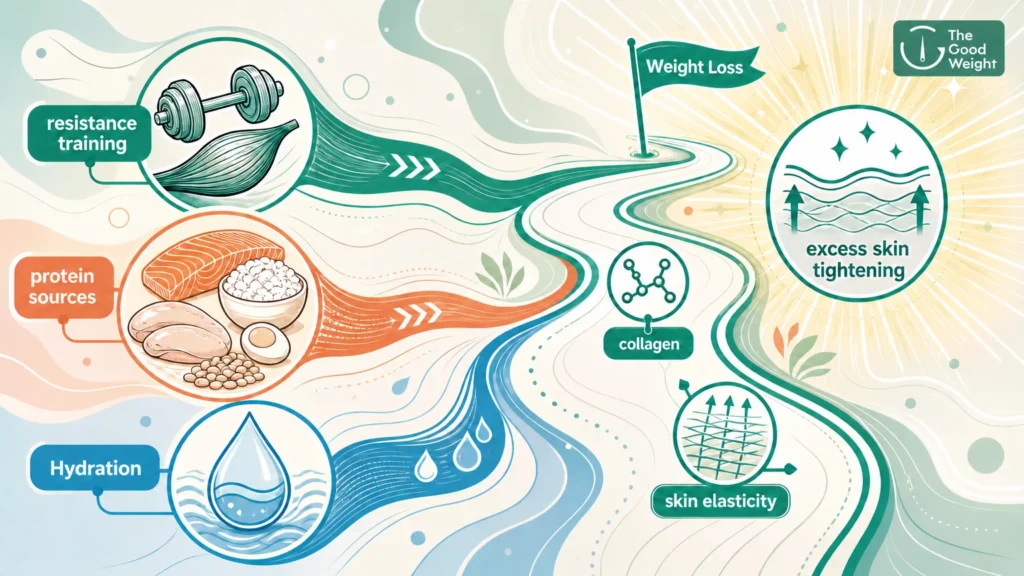
Losing weight can improve mobility, metabolic health, energy, and confidence – yet many people feel unprepared for the body changes that follow. Loose or hanging skin may appear on the abdomen, arms, thighs, breasts or chest, neck, and lower back, particularly after substantial weight loss. It is a common concern, and it does not mean your progress was unsuccessful.
Excess skin tightening is possible to a degree for some people, especially while weight is still stabilizing. However, it is important to set realistic expectations: lifestyle changes can improve skin quality and body composition, but they cannot reliably remove a large amount of stretched skin. Understanding the difference helps you make decisions based on your health, comfort, and personal goals rather than unrealistic promises.
Why Loose Skin Happens After Weight Loss
Skin is a living tissue that expands and contracts, but it does not always return fully to its previous shape after prolonged stretching. Its ability to retract depends partly on collagen and elastin, proteins that help provide structure and elasticity. When skin has been stretched for years by higher body weight, pregnancy, or repeated weight fluctuations, those supportive structures may not rebound completely.
The amount of weight lost is often one of the strongest predictors of how noticeable loose skin becomes. People who lose a larger percentage of their starting weight, including those who undergo bariatric surgery or endoscopic weight-loss procedures, may have more substantial skin redundancy afterward. Research on people after major weight loss describes excess skin as a frequent physical and quality-of-life concern, including challenges with comfort, hygiene, exercise, clothing, and body image.
Several personal factors influence what your skin may do after weight loss:
-
Age: Skin generally becomes less elastic over time, so younger people may see more retraction than older adults. Age is not a guarantee in either direction, but it can affect how quickly and how fully skin adapts.
-
Genetics: Natural differences in collagen, skin thickness, and elasticity can influence how someone’s body responds. Two people with similar weight-loss journeys may have very different visible outcomes.
-
Duration of higher weight: Skin that has been stretched for a longer period may have less capacity to retract. This is one reason a person who gained weight recently may have a different experience from someone who has lived at a higher weight for decades.
-
Pregnancy history: Pregnancy can stretch abdominal skin and connective tissue, sometimes leaving lasting laxity or muscle separation. Weight loss may make these changes more visible.
-
Muscle mass: Losing fat and muscle together can create a softer, less supported appearance. Preserving or rebuilding muscle will not eliminate excess skin, but it can improve body shape beneath it.
-
Weight cycling: Repeated losses and regain can repeatedly stretch skin and make maintaining results more difficult. A sustainable plan is more valuable than aggressive cycles of restriction.
For people considering treatment, it is also helpful to know that post-weight-loss body contouring is not merely cosmetic for everyone. The American Society of Plastic Surgeons’ clinical guidance on skin redundancy after massive weight loss recognizes that excess folds can contribute to functional concerns such as irritation, recurrent rashes, hygiene difficulties, and limitations in daily activity.
Temporary Looseness Versus Significant Excess Skin
It can be difficult to judge your long-term outcome immediately after weight loss. During active weight loss, remaining fat tissue may still be shrinking, muscle mass may be changing, and skin may be adjusting gradually. A body that looks “deflated” during this phase may look firmer after weight stabilizes, resistance training becomes consistent, and nutrition improves.
Signs skin may still improve with time
Mild wrinkling, crepey texture, or skin that appears loose only in certain positions may improve somewhat over several months. Skin is more likely to look better when weight loss has recently slowed, the area has good underlying muscle support, and the looseness is mild rather than forming a heavy overhang. Stable weight gives you a more accurate baseline for evaluating whether further excess skin tightening is realistic.
It is reasonable to allow time for your body to settle before deciding on a procedure, provided there are no urgent medical concerns. For people pursuing body-contouring surgery after major weight loss, clinicians commonly emphasize the importance of reaching a stable weight and maintaining sound nutritional status before elective surgery. Weight stability and medical optimization are central considerations in post-bariatric body-contouring care.
Signs there may be true excess skin
More substantial excess skin typically forms a persistent fold or overhang that remains even when your weight has been stable. It may pull downward, rub against nearby skin, interfere with movement, make clothing difficult to fit, or cause moisture-related irritation. In these cases, exercise and nutrition remain valuable for health, but they should not be presented as a way to remove the fold itself.
A practical distinction is this: muscle can improve the contour under the skin, while surgery removes skin. Non-surgical approaches may help mild laxity or skin texture, but they do not produce the same result as excisional body-contouring surgery for significant redundancy. That is why an individualized evaluation matters more than before-and-after images from people with different starting points.
What Can Help Naturally Support Excess Skin Tightening
Natural approaches are best viewed as tools to support skin health, preserve lean mass, and improve how your body feels – not as guaranteed skin-removal methods. They are still worthwhile because they can protect the long-term results of weight loss and may make mild looseness less noticeable.
Build and preserve muscle with resistance training
Resistance training can improve body composition by helping preserve or build lean tissue while fat mass decreases. More muscle in the arms, shoulders, glutes, thighs, back, and chest can improve the underlying shape of those areas, even though it does not shrink away a large skin fold. Start with a plan appropriate for your fitness level and medical history, ideally progressing gradually rather than relying on high-volume exercise during a calorie deficit.
If you are using medication, recovering from a procedure, or managing conditions such as diabetes or PCOS, ask your clinician how to structure activity safely. The Good weight’s medically supervised weight-loss programs can help patients align nutrition, activity, and treatment decisions with their health needs rather than following generic advice.
Prioritize enough protein and overall nutrition
Protein supports muscle maintenance during weight loss, which matters for strength and body composition. Your ideal protein target depends on body size, kidney function, activity level, calorie intake, and medical conditions, so it should be personalized rather than copied from social media. A dietitian or medical team can help you choose adequate protein sources while still meeting energy, fibre, vitamin, and mineral needs.
This becomes particularly important after bariatric surgery or rapid medically supervised weight loss, when appetite changes can make it harder to meet nutritional needs. Nutrient deficiencies can affect healing and surgical readiness, so people considering future body contouring should discuss laboratory monitoring and supplementation with their care team. The Good weight also offers diagnostic testing options that can support personalized nutrition planning.
Hydrate, protect your skin, and be patient
Hydration supports normal body function and can help skin look less dry, but drinking extra water does not tighten stretched skin. Daily sun protection, gentle skincare, avoiding smoking, and treating irritation within skin folds can all support skin health. These measures are practical, but they should not be confused with a treatment that removes excess tissue.
Patience is often the least satisfying recommendation, but it is an important one. Avoid the temptation to chase another aggressive diet solely because loose skin feels discouraging. Rebound dieting can undermine muscle retention, weight stability, and the ability to assess your true post-weight-loss body composition.
Creams, Collagen Powders, and Viral Hacks: Myth Versus Fact
Myth: A firming cream can remove hanging skin
Topical products may moisturize dry skin and temporarily improve its surface appearance, especially if the skin looks crepey. They do not penetrate deeply enough to remove a skin overhang or restore substantially stretched collagen structures. A cream may be a useful part of comfort-focused skincare, but it should not be marketed as a substitute for medical assessment.
Myth: Collagen powders will tighten loose skin after major weight loss
Some studies suggest certain oral collagen peptides may have modest effects on skin hydration or elasticity in selected populations, but that evidence does not establish that supplements can eliminate substantial post-weight-loss excess skin. The evidence on oral collagen supplementation remains limited by differences in products, study designs, and outcomes. If you choose a supplement, consider it optional nutrition support rather than a primary treatment.
Myth: Sweating, wrapping, dry brushing, or “skin tightening” devices at home will melt away skin
Sweating causes temporary fluid loss, not skin contraction. Wraps, massage tools, and dry brushing may feel pleasant or provide short-lived changes in puffiness, but they do not remove redundant tissue. Be cautious with any viral hack that causes burns, bruising, pain, or pressure on an area with reduced sensation or irritated skin.
When Non-Invasive Treatment May Help – and When Surgery Is More Realistic
Non-invasive procedures such as radiofrequency, ultrasound-based energy, or certain laser treatments may be considered for mild skin laxity. These treatments aim to create controlled heat in the skin and stimulate remodeling, and results tend to be gradual and modest. They may be more appropriate for someone with small areas of laxity, good skin quality, stable weight, and no significant hanging folds.
The limitations are just as important as the potential benefits. Non-invasive treatments generally require multiple sessions, can be costly, and do not replicate the results of surgery. A systematic review of non-invasive skin-tightening technologies found that outcomes vary by device, treatment area, and study quality, reinforcing the need for careful expectations.
Surgery is often the more realistic option when skin forms a substantial apron, causes recurrent rashes or infections, limits movement, or remains distressing after weight has stabilized. Procedures may include an abdominoplasty or panniculectomy for the abdomen, brachioplasty for the arms, thigh lift, breast lift, lower body lift, or neck lift. These are major procedures with scars, recovery time, costs, and potential complications, so consultation with a qualified plastic surgeon is essential.
Before surgery, a clinician will usually assess weight stability, smoking status, nutritional status, medication use, prior surgeries, medical conditions, and your goals. Complication risk after body contouring can be influenced by factors including BMI, procedure extent, and patient health status. The best candidate is not the person with the “perfect” body, but someone whose health, expectations, and timing make the procedure appropriate.
Frequently Asked Questions About Loose Skin After Weight Loss
Can abdominal loose skin tighten without surgery?
Mild abdominal looseness may improve after weight stabilizes, particularly when some remaining fat loss, muscle-building, and skin recovery are still possible. However, a persistent abdominal overhang is unlikely to disappear through exercise, creams, or supplements alone. If the fold causes rashes, discomfort, or limits activity, a specialist evaluation can clarify whether medical treatment or surgery may help.
What helps loose skin on the arms?
Strengthening the shoulders, back, and triceps can improve arm contour and function, especially when laxity is mild. Significant “batwing” skin can remain despite excellent fitness because the issue is redundant skin rather than weak muscle. Non-invasive treatments may offer subtle improvement for selected patients, while brachioplasty is the surgical option for more pronounced excess.
Can loose skin on the thighs or chest go away?
Thighs and the chest can be especially affected by genetics, age, fat distribution, and prior pregnancy or breastfeeding. Resistance training can improve support and shape, but it cannot reliably remove folds or extensive laxity. For chest concerns, it is important to distinguish loose skin from breast tissue changes, muscle loss, or gynecomastia, since treatment options differ.
Is loose neck skin common after weight loss?
Yes. The neck and jawline may appear looser after facial fat decreases, particularly in people with lower baseline skin elasticity. Skincare and non-invasive treatments may have a role when laxity is mild, but substantial skin redundancy often requires a surgical discussion for meaningful correction. A qualified clinician can also assess whether the concern is skin laxity, fat under the chin, or both.
What if loose skin makes me feel disappointed in my progress?
That response is understandable. Weight loss is often presented as a finish line, when in reality it can involve a period of adjustment to a changing body, wardrobe, self-image, and expectations. Your progress is still real: improved health behaviors, strength, laboratory values, mobility, and confidence are not erased by loose skin.
A Healthier Way to Plan for the “After” Phase
Excess skin tightening is not an all-or-nothing outcome. Some people see meaningful improvement with time, stable weight, resistance training, adequate nutrition, and skin care, while others have excess skin that cannot fully retract without a procedure. Neither outcome reflects a failure of effort or commitment.
If you are planning significant weight loss or navigating the changes afterward, speak with The Good weight about an evidence-based, medically supervised approach. A sustainable plan can help reduce rebound dieting, preserve health during weight loss, and prepare you for the body-composition changes that may follow.