
Persistent abdominal fullness can be frustrating, particularly when it does not seem to change in the same way as the rest of your body. It is understandable to begin by searching for belly fat removal cost, laser treatments, or non-surgical options in Chennai. However, a useful answer is rarely a single figure: the right treatment plan, and therefore its cost, depends on whether the concern is a local contour issue, overall weight change, skin laxity, or a combination of these factors.
Non-surgical body contouring can be appropriate for some adults with small, localised fat deposits and realistic expectations. It is not a replacement for medically supervised weight-management care, nutrition support, physical activity, or treatment for metabolic health concerns. This guide explains what influences the cost of treatment, what to ask at a consultation, and how to identify claims that deserve closer scrutiny.
Body contouring is different from treatment for overall weight loss
The most important distinction is between changing the shape of one area and treating excess body weight or metabolic risk. Non-surgical contouring technologies are designed to reduce selected pockets of subcutaneous fat – the fat located beneath the skin – in areas such as the abdomen, flanks, thighs, or under the chin. The FDA notes that non-invasive body-contouring procedures are not intended to treat obesity or produce weight loss.
A person may be close to a stable, healthy weight but still have a small abdominal area they would like to address. In this situation, body contouring may be one option to discuss. By contrast, someone experiencing progressive weight gain, a high waist circumference, diabetes risk, fatty liver disease, sleep concerns, hormonal symptoms, or difficulty controlling appetite may benefit more from a broader medical assessment before considering contouring.
| Local body-contour concern | Overall weight-management concern |
|---|---|
| Usually focuses on a defined area of pinchable fat | Focuses on body weight, health markers, appetite, mobility, or metabolic risk |
| May be considered when weight is reasonably stable | May require nutrition, activity, diagnostic testing, medicines, procedures, or multiple supports |
| Expected outcome is a gradual change in local shape | Expected outcome is improved health and sustainable weight reduction |
| Does not meaningfully change body mass or metabolic disease risk on its own | Can be part of doctor-led treatment for obesity and related health conditions |
This distinction matters for cost as well as suitability. Paying for a contouring procedure when the main goal is significant weight reduction can lead to disappointment, additional spending, and delayed care for an underlying health concern. A clinician should be clear about the role of non-surgical fat reduction options within a wider, personalised plan rather than presenting them as a universal solution.
What clinicians assess before discussing a procedure
A responsible recommendation starts with an in-person assessment, not a package price. Two people who describe the same “belly fat” concern may have very different tissue characteristics, health histories, and goals. This is why an advertised starting price can be less informative than a clinician’s explanation of what is included and why a particular approach is – or is not – appropriate.
Body-fat distribution and the area to be treated
Clinicians assess whether the fullness is likely to be subcutaneous fat, deeper visceral fat, loose skin, muscle separation, bloating, or a combination. Non-invasive treatments generally target superficial fat rather than visceral fat surrounding internal organs. The size, thickness, and number of areas being treated affect treatment time, device applicators, and whether one session is likely to be enough.
The abdomen is also not always one uniform treatment zone. A plan may address the upper abdomen, lower abdomen, or flanks separately, depending on the person’s contour and goals. A broader area often requires more applicator placements or longer treatment time than a small, localised deposit, which can increase the total non-surgical belly fat removal cost.
Skin quality and baseline contour
Fat reduction and skin tightening are not the same treatment goal. If skin has reduced elasticity after pregnancy, substantial weight change, or ageing, reducing fat alone may not create the contour a person expects. A consultation should include discussion of skin texture, laxity, scars, stretch marks, and the possibility that a different approach – or no procedure – would be more suitable.
This conversation is particularly important because cosmetic procedures have limits. The Mayo Clinic advises that candidates for cosmetic procedures should be physically healthy, understand the risks, and hold realistic expectations about what a procedure can achieve. A clinician who discusses possible trade-offs before recommending treatment is helping you make a safer, better-informed decision.
Medical history and safety considerations
Your medical history can influence both eligibility and the level of supervision needed. Share current medicines, prior abdominal procedures, pregnancy or breastfeeding status, implanted devices, skin conditions, hernias, clotting concerns, diabetes, and any relevant allergies. Certain technologies or settings may not be advisable for everyone, and a provider may need to modify the plan, request medical clearance, or recommend an alternative.
A consultation should also identify whether a person’s primary concern is health-related weight change rather than a local contour issue. At The Good Weight, this can include discussion of appropriate diagnostic tests and metabolic-health assessment when symptoms, risk factors, or treatment goals indicate that a broader evaluation would be useful.
Goals, timeline, and expectations
Be specific about what you want to change: clothing fit, a small bulge in one area, recovery time, or confidence after weight stabilisation. Equally, be honest about what you do not want: surgery, prolonged downtime, repeated appointments, or uncertain outcomes. Non-surgical treatments typically produce gradual rather than immediate visible changes, and results vary with the individual, technology, and treatment area.
A careful clinician will explain whether your desired outcome is realistic without surgery. Surgical liposuction may offer a different degree of correction for some candidates, but it involves incisions, anaesthesia considerations, recovery, and a different risk profile. It should not be treated as a like-for-like comparison with a non-invasive session.
The factors that influence overall cost
There is no single verified answer to “How much does belly fat removal cost?” in Chennai because a treatment plan is not a standard retail product. Published prices from other countries may be useful only as broad context and should not be used to estimate local costs. For example, professional society figures report an average U.S. physician fee for non-surgical fat reduction, but this does not represent a Chennai clinic’s pricing, inclusions, clinical standards, or individual recommendation.
Instead of comparing only a headline number, compare the full scope of care.
Treatment modality and device technology
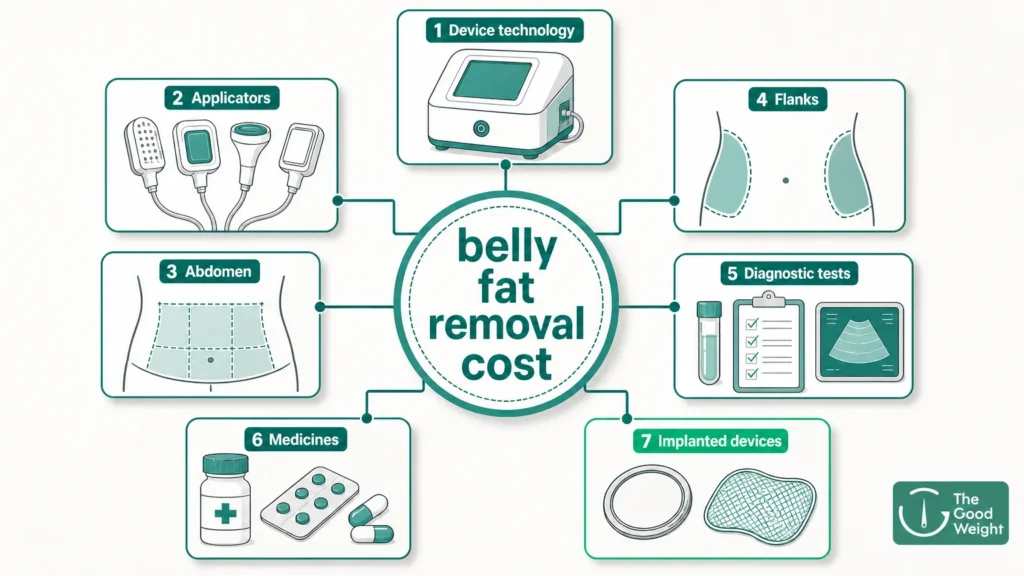
“Non-surgical” is a category, not one procedure. Technologies may use controlled cooling, heat, laser energy, radiofrequency, ultrasound, or other mechanisms to affect subcutaneous fat. The equipment used, the number of applicators, treatment duration, maintenance requirements, and consumables can all affect the quoted cost.
The phrase laser belly fat removal cost may refer to a laser-based contouring approach, but it should not be assumed that every device marketed with similar language has the same evidence, clearance status, or treatment protocol. Ask the clinic to identify the exact technology, explain why it is being recommended, and outline its expected role in your plan. The FDA explains that different non-invasive technologies have different intended uses and potential effects, making a device-specific conversation essential.
Treatment area and number of sessions
A small, well-defined abdominal deposit may require a simpler plan than an abdomen-and-flanks programme. A quote can change according to the number of zones, applicator cycles, handpieces, or energy-delivery sessions required. Some people may be advised to have staged sessions, while others may not be good candidates for repeat treatment.
The expected response should also be discussed carefully. Published research on non-invasive modalities reports variable levels of local fat-layer reduction, but studies differ in device type, measurement methods, follow-up periods, and patient selection. A review of cryolipolysis literature, for example, found evidence of measurable reductions in localised fat thickness rather than overall weight-loss outcomes. This is why a promised centimetre loss or a “guaranteed flat stomach” should not be the basis for deciding on a package.
Clinician oversight and facility standards
The provider’s qualifications, assessment process, device protocols, emergency preparedness, and follow-up access are meaningful parts of care. Lower pricing may reflect fewer inclusions, but high pricing alone does not prove quality either. What matters is whether the clinic can explain who will assess you, who performs the treatment, how suitability is determined, and what support is available if you have concerns after a session.
Medical oversight is particularly important because “non-invasive” does not mean risk-free. The FDA lists potential effects that can include redness, swelling, bruising, discomfort, numbness, burns, skin changes, and, for some technologies, other device-specific complications. The likelihood and severity vary by procedure and individual, but side effects should be addressed before consent – not added as an afterthought.
Follow-up, reviews, and the complete package
When comparing a non-surgical belly fat removal cost, ask whether the quote includes consultation, photographs or measurements, the planned session count, clinician reviews, post-treatment instructions, and follow-up appointments. Also clarify whether there are charges for additional zones, top-up sessions, medicines, compression garments where relevant, or management of complications.
A transparent estimate should state what is included, what could change the total, and what would happen if the clinician decides treatment is not appropriate after assessment. This protects you from comparing a comprehensive plan with a low advertised price that covers only one component.
What an appropriate consultation should clarify
Before agreeing to treatment, take time to ask questions and receive answers you can understand. A good consultation should leave you clearer about the expected scope of care, not pressured to decide on the day.
Use this checklist when discussing a proposed plan:
-
What is the specific concern being treated? Ask whether the fullness appears to be subcutaneous fat, loose skin, deeper abdominal fat, or another issue. This establishes whether the procedure can reasonably address the concern you see.
-
What changes are realistic, and when might they appear? Request a conservative explanation of the anticipated local contour change, the expected timeline, and the fact that individual outcomes can differ. Be cautious if a provider cannot describe limitations as clearly as benefits.
-
Which technology will be used and why? Ask for the device name, the number of areas or cycles proposed, and why that modality suits your anatomy and goals. This is more useful than comparing generic labels such as “fat freezing” or “laser slimming.”
-
What side effects, complications, and recovery needs should I expect? Discuss common short-term effects, uncommon but important risks, pain management if needed, activity restrictions, and when to contact the clinic. The FDA’s overview of body-contouring technology risks can help frame this discussion.
-
What alternatives should I consider? A clinician should explain when observation, nutrition support, exercise, medical weight management, a different non-surgical option, or surgery may be more appropriate. Alternatives are part of informed consent, not a sign that the recommended treatment is inadequate.
-
What does the complete estimate include? Ask for written clarification of consultation costs, all planned sessions, follow-up, taxes where applicable, and the conditions that may lead to additional charges. Do not rely solely on verbal assurances or a “starting from” figure.
Claims to approach carefully
Marketing can make body contouring sound more predictable than it is. Reviewing common claims through a myth-versus-fact lens can help you evaluate whether a clinic is communicating responsibly.
Myth: “You will see a flat stomach immediately”
Fact: Some temporary swelling, redness, tenderness, or numbness can occur after treatment, and the body’s response to a fat-reduction procedure is generally gradual. Immediate results may reflect lighting, posture, fluid shifts, or promotional imagery rather than a completed treatment outcome. Ask when results are usually assessed and how progress will be measured.
Myth: “A non-surgical treatment removes fat exactly where you choose”
Fact: A provider may target an eligible localised area, but no reputable clinician can guarantee a perfectly symmetrical or identical response in every patient. Anatomy, baseline fat thickness, skin quality, and biological response all matter. “Spot reduction” through exercise is also not a reliable way to selectively lose fat from one body region, which is why overall health goals need a separate plan.
Myth: “One package includes everything you will ever need”
Fact: Packages can be useful only when their inclusions are explicit. Confirm the number of sessions and zones, whether reviews are included, whether follow-up treatment is anticipated, and what happens if results are less than expected. An unclear package may make the initial non-surgical belly fat removal cost look lower while excluding clinically important parts of care.
Myth: “Non-invasive means there are no risks”
Fact: Non-invasive procedures avoid surgical incisions, but they still use energy or controlled temperature to create a biological effect. A 2025 review of adverse-event reporting highlights that safety conversations should remain device-specific and should include both common temporary effects and rare complications. Choose a setting where you can discuss concerns with a qualified clinician rather than relying only on social-media testimonials.
When a broader weight-management plan may be more helpful
How do I know if weight-management care should come first?
A broader plan may be the better starting point if your priority is substantial weight loss, your weight has been increasing, or you have health concerns such as high blood pressure, prediabetes, diabetes, sleep apnoea, fatty liver disease, or joint pain. It may also be appropriate if eating patterns, appetite, stress, sleep, medications, or hormonal symptoms are affecting weight. In these circumstances, local contouring is unlikely to address the core issue.
Doctor-led care can bring together nutrition support, activity planning, metabolic evaluation, behavioural strategies, and, when clinically appropriate, medication or procedural options. Explore medical weight-loss care when your goals include both sustainable weight loss and improved metabolic health rather than a localised cosmetic change.
Can body contouring and weight-management care be used together?
In some cases, yes – but sequence matters. Someone may first work toward stable weight and improved health markers, then consider contouring for a remaining localised area if appropriate. Others may decide that contouring is unnecessary once their broader health goals are being addressed. The best plan is individual, not a predetermined combination package.
A clinician should never make you feel that a body-contouring procedure is required to deserve support with weight or health. Sustainable progress is more likely when care is tailored to your health history, preferences, resources, and long-term goals.
Make cost comparisons after a proper assessment
The cost of non-surgical belly fat reduction depends on far more than a device name or a promotional offer. The treatment area, technology, session plan, clinician oversight, follow-up, and your individual suitability all affect what a responsible recommendation should include. Most importantly, local contouring should not be confused with treatment for obesity, metabolic risk, or meaningful overall weight loss.
If you are considering body contouring in Chennai, book an in-person assessment with The Good Weight to discuss your suitability, possible alternatives, realistic expected changes, the complete treatment scope, and verified pricing.