
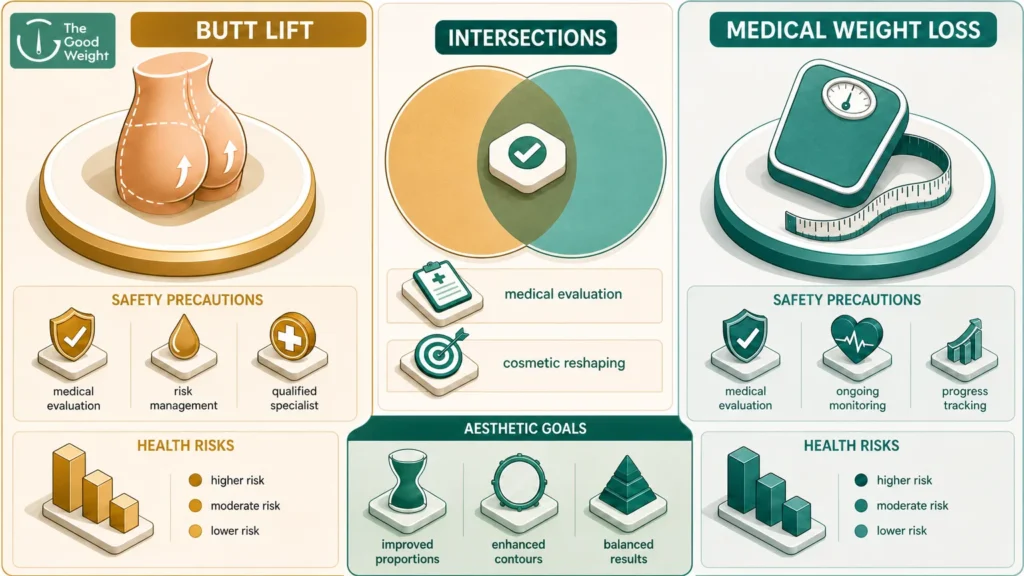
Wanting a smaller waist, fuller hips, or a more balanced silhouette is understandable. The confusion begins when a body-shape goal gets treated as though it were the same thing as a health or weight-management goal. Brazilian butt lifts (BBLs) can alter proportions, but they do not address the biological, behavioral, or metabolic factors that may be contributing to weight gain, abdominal fat, diabetes risk, or a cycle of losing and regaining weight.
A BBL may be appropriate for someone at a stable weight who wants cosmetic contouring and has been carefully evaluated by a qualified surgical team. But if you are considering surgery because dieting has repeatedly failed, your waistline is increasing, or you are worried about conditions such as PCOS, prediabetes, or diabetes, medical weight-loss treatment may need to come first.
The better question is not, “Which option will change my body fastest?” It is: “What problem am I trying to solve?” This guide explains what BBLs can and cannot do, when supervised weight loss is the more medically appropriate starting point, and when the two paths may fit together.
A Smaller Waist and Better Health Are Not the Same Goal
A common myth is that cosmetic fat removal or fat transfer can substitute for weight-loss treatment. It cannot. Liposuction and a BBL can redistribute some subcutaneous fat – the fat stored beneath the skin – to change visible contours. They do not treat appetite regulation, insulin resistance, elevated blood pressure, sleep apnea, fatty liver disease, or the drivers of long-term weight regain.
This distinction matters especially when the concern is central obesity, meaning excess fat around the abdomen. A smaller-looking waist after contouring may improve how clothes fit, but it is not the same as reducing the health risks associated with visceral fat, which is stored deeper in the abdomen around internal organs. A cosmetic result can be meaningful, but it should not be mistaken for a metabolic outcome.
Medical weight loss has a different purpose. It uses a personalized assessment to identify relevant factors such as health history, medications, eating patterns, laboratory results, sleep, stress, reproductive health, and prior attempts at weight loss. The goal is sustainable results: reducing excess weight where appropriate while improving health markers and building a plan that can be maintained after the initial progress.
For some people, the right answer is not “BBL or weight loss.” It is “weight management first, then reassess body contouring once my health and weight are stable.”
What a Brazilian Butt Lift Actually Does – and Does Not Do
A Brazilian butt lift is a cosmetic procedure that combines liposuction with gluteal fat grafting. A surgeon removes fat from areas such as the abdomen, flanks, back, thighs, or arms, processes it, and transfers a portion of that fat to the buttocks. The intended result is a more projected or rounded buttock shape and, in some cases, greater contrast between the waist and hips.
BBLs remain a commonly discussed aesthetic procedure, and the 2024 plastic-surgery statistics report tracks buttock augmentation with fat grafting among cosmetic procedures. Still, demand should never be confused with medical suitability. Every candidate needs an individualized assessment of their goals, medical history, body composition, and capacity to follow recovery instructions.
What a BBL can change
A well-planned BBL may change the visible relationship between the waist, lower back, hips, and buttocks. If there is enough donor fat and the patient is an appropriate candidate, liposuction can reduce fullness in selected areas while fat grafting adds volume to the buttocks. This is why many people perceive the procedure as a “smaller waist” surgery, even though its primary role is contouring rather than weight reduction.
The visual effect depends on far more than the amount of fat removed. Skin quality, muscle shape, skeletal proportions, existing fat distribution, healing, and future weight changes all influence the outcome. Not all transferred fat survives, and no ethical surgeon should promise a particular clothing size, body type, or social-media-style result.
What a BBL cannot treat
A BBL is not obesity care and is not designed to produce significant overall weight loss. It does not replace treatment for conditions such as type 2 diabetes, high blood pressure, PCOS-related metabolic concerns, binge-eating patterns, or repeated weight regain. It also does not make it easier to maintain a calorie deficit, manage hunger, or develop a sustainable relationship with food.
If your main concern is “I keep gaining weight around my middle,” “I cannot sustain the plans I try,” or “My labs are getting worse,” the first intervention should be medical evaluation – not cosmetic contouring. The same is true if your expectations depend on surgery changing how you feel about every part of your body. Surgery may change a feature; it cannot resolve distress rooted in body image, trauma, eating-disorder symptoms, or unrealistic standards.
Safety is part of the decision, not an afterthought
BBLs require particularly careful safety planning because gluteal fat grafting has had serious complications, including fat embolism. A landmark analysis described the risk of pulmonary fat embolism in gluteal fat grafting, which is why professional organizations have strengthened their safety guidance over time.
Current safety discussions emphasize surgeon qualifications, accredited facilities, appropriate anesthesia support, careful technique, and the use of real-time ultrasound to help keep fat injection in safer tissue planes. The joint safety statement on gluteal fat grafting supports ultrasound guidance during the critical part of fat injection. Patients should also understand that low-cost offers, rushed consultations, and vague answers about safety are not reassuring signs.
Avoid anyone offering injectable silicone for body contouring. The FDA has warned that illegal injectable silicone can cause serious injury, permanent disfigurement, and death. A legitimate surgical consultation should be transparent about benefits, limitations, recovery, costs, and complications.
Comparing Cosmetic Reshaping, Medical Weight Loss, and a Combined Sequence
The right path depends on your primary need. Cosmetic surgery is designed to improve contour. Medical weight loss is designed to improve weight-related health and help support lasting behavior and metabolic changes. Combining them can make sense, but usually in a planned sequence rather than as a substitute for proper care.
| Path | Main purpose | Best fit | What it does not solve |
|---|---|---|---|
| Cosmetic reshaping, including BBLs | Changes visible proportions and contour | People at a relatively stable weight with clear aesthetic goals | Metabolic disease, appetite regulation, repeated regain, or significant obesity |
| Supervised medical weight loss | Improves weight-related health and supports sustainable weight reduction | People with excess weight, central obesity, metabolic risks, or unsuccessful self-directed dieting | Specific contour concerns such as loose skin or a desired gluteal shape |
| Medical weight loss followed by contouring | Addresses health first, then aesthetic refinement | People who want both better health and later body-shape changes | The need for patience; surgery should not be rushed before weight stabilizes |
Path one: cosmetic reshaping
Cosmetic reshaping may be reasonable when a person is medically optimized, understands the recovery process, has realistic expectations, and expects their weight to remain relatively stable. The decision should be based on a detailed consultation with a board-certified plastic surgeon who performs the procedure in an appropriately accredited setting. A patient should feel able to ask how safety protocols are followed, what happens if complications occur, and how the surgeon evaluates candidacy.
However, a BBL is a poor first choice when the real goal is major weight loss. If you expect to lose a substantial amount of weight after the procedure, your results may change as fat cells in both donor and grafted areas shrink with weight loss. That does not mean weight change “ruins” every outcome, but it does mean timing matters.
Path two: supervised medical weight loss
Medical weight loss is appropriate when weight is affecting health, daily function, fertility goals, confidence, or quality of life – or when self-directed dieting has led to repeated cycles of restriction and regain. Comprehensive care can include diagnostic testing, personalized nutrition, physical-activity guidance, behavioral support, medication when clinically appropriate, and treatment of related conditions.
Evidence-based obesity management is typically multifaceted rather than dependent on willpower alone. Clinical guidance recognizes that nutrition, activity, behavioral strategies, and medical treatment may all have a role in weight management. At The Good Weight, a clinician can help determine whether a plan involving nutrition coaching, diagnostic evaluation, medication options, or a procedural referral is appropriate for your individual circumstances.
For readers who need a more structured starting point, doctor-supervised medical weight-loss care can clarify whether a cosmetic procedure is premature, unnecessary, or still a reasonable future goal. The aim is not to dismiss aesthetic concerns. It is to make sure health needs are not overlooked in pursuit of a particular silhouette.
Path three: weight loss first, contouring later
For many people, this is the most practical sequence. First, pursue health-focused weight management and work toward a weight that is both medically appropriate and sustainable for you. Then, after your weight has been stable for a period determined with your clinicians, consider whether remaining concerns are truly contour concerns: loose skin, stubborn localized fat, breast changes, or proportions that still do not feel balanced.
This sequence can make surgical planning more accurate. It also reduces the pressure to expect surgery to solve every frustration associated with weight. People who have lost meaningful weight may want to discuss post-procedure weight-loss support and body-change planning so their nutrition, recovery, and long-term maintenance strategies continue to work together.
When Weight Loss and Medical Evaluation Should Come First
Before pursuing BBLs, it is wise to pause for a medical review if any of the following apply. These are not judgments about appearance or worth. They are signals that health optimization and realistic planning may be more important than moving quickly toward surgery.
You have uncontrolled or poorly understood metabolic risk
If you have diabetes, prediabetes, high blood pressure, sleep apnea, fatty liver disease, or a strong family history of cardiometabolic disease, start with a medical assessment. Surgery and anesthesia require careful planning, and uncontrolled conditions can affect recovery. More importantly, changing the shape of your body will not treat the underlying condition.
Central weight gain, irregular periods, acne, excess hair growth, fatigue, or difficulty losing weight may also merit evaluation for concerns such as PCOS, thyroid dysfunction, medication effects, or insulin resistance. Testing cannot explain every weight challenge, but it can replace guesswork with a more informed plan. A diagnostic assessment for weight-related concerns may help identify what should be addressed before aesthetic surgery is considered.
You experience binge eating, restrictive cycles, or rapid regain
If you frequently feel out of control around food, compensate after eating, skip meals to “make up” for them, or alternate between strict dieting and overeating, a BBL will not resolve the pattern. The physical recovery period may even add stress when movement, sitting, sleep, and routine are temporarily disrupted. Behavioral-health support and nutrition care should be part of the plan before making an irreversible cosmetic decision.
Similarly, frequent weight cycling can make long-term body contour results less predictable. The priority is not perfection; it is developing a sustainable approach to meals, hunger, movement, and emotional triggers. That foundation supports both health and any future aesthetic choice.
Your expectations require surgery to transform your life
A helpful consultation explores what you hope will change after surgery. It is normal to want to feel more confident in clothing or photographs. It is less realistic to expect a procedure to repair a relationship, guarantee happiness, eliminate self-consciousness, or create a body identical to someone else’s.
Consider two common patterns. One person has a stable weight, good metabolic health, and a long-standing wish for more gluteal projection; after a careful consultation, cosmetic contouring may align with her goal. Another person has gained weight steadily, feels exhausted after years of restrictive dieting, and believes a BBL will finally make her “disciplined.” The second person deserves medical and emotional support first, because the issue is larger than contour.
The Emotional Trap: Treating Shape Change as a Health Solution
Appearance goals can be powerful, particularly in a culture that rewards narrow body ideals and heavily edited images. There is nothing shallow about wanting to feel at home in your body. But it is important to separate a genuine aesthetic preference from the belief that a single procedure will end the distress of living with weight-related health concerns.
Repeated regain often leads people to blame themselves. They may assume that they simply lack discipline, when in reality body weight is influenced by biology, medications, environment, sleep, stress, access to care, and life stage. A supportive medical program takes those realities seriously and avoids reducing care to another restrictive diet.
A healthier decision process gives both goals their place. You can want a more defined waist and also want better blood-sugar control. You can consider contouring later while choosing to address eating patterns now. The important point is that cosmetic surgery should complement a stable health plan when appropriate – not carry the burden of being that plan.
Frequently Asked Questions About BBLs and Weight Loss
How long is BBL recovery?
Recovery varies by procedure, surgeon, and individual health. Patients usually need to limit direct pressure on the buttocks for a period specified by their surgeon, use compression garments as instructed, and arrange help with work, transport, and daily activities. Swelling and changes in appearance can continue for months, so it is important not to judge the final result too early.
What happens if I gain or lose weight after a BBL?
Weight changes can alter your results because transferred fat cells and fat in untreated areas can expand or shrink. Significant weight loss may reduce volume in the buttocks, while weight gain may change proportions in ways you did not anticipate. This is one reason surgeons commonly prefer candidates to be at a stable, maintainable weight before contouring.
Can a BBL help me lose belly fat?
A BBL may include liposuction in the abdomen or flanks, which can change localized contour. It is not a treatment for obesity or a reliable method for substantial weight loss, and it does not replace care for visceral fat or metabolic disease. If abdominal weight is your main concern, start with a medical assessment and ask about a sustainable weight-management plan.
Is it safe to travel abroad for a BBL?
Travel for surgery can add complexity because follow-up care may be limited once you return home. The CDC notes that medical travelers may face infection, blood-clot, and continuity-of-care considerations, particularly when a procedure requires close postoperative monitoring. If you are considering surgery away from home, review the facility, surgeon credentials, emergency plan, insurance implications, and access to follow-up care before making a decision.
When does contouring make sense after weight loss?
Contouring may make sense after meaningful weight loss when your weight has stabilized, your nutrition is adequate, relevant medical conditions are controlled, and your expectations are specific and realistic. A plastic surgeon can assess skin quality, fat distribution, and the options most likely to fit your goals. Your weight-management clinician can help ensure that surgery does not interrupt the habits and treatment plan supporting your long-term health.
Make the Decision in the Right Order
BBLs can change silhouette. Medical weight loss can address the appetite, metabolic, behavioral, and health factors that cosmetic reshaping cannot treat. Neither goal is invalid, but they require different tools, different expectations, and often a different sequence.
If you are deciding between a Brazilian butt lift and weight-loss treatment, begin with a medical assessment before committing to surgery. The Good Weight offers evidence-based, personalized care to help you understand your eligibility, health risks, and realistic next steps – so your decision supports both how you want to look and how you want to feel.