
Living with PCOS can make weight changes feel frustratingly unpredictable. You may be managing irregular periods, acne, excess hair growth, fatigue, cravings, or concerns about blood sugar alongside pressure to “just lose weight.” A thoughtful dietitian consultation should make this feel more manageable – not hand you a restrictive food chart that ignores your symptoms, culture, budget, and schedule.
The right consultation can help you build eating routines that support sustainable weight loss, energy, menstrual health, and metabolic health. It cannot promise the same result for everyone or replace medical assessment when symptoms or risks need attention. Current international guidance emphasises that lifestyle care for PCOS should be individualised and can support health outcomes even when weight loss is not the only measure of progress.
What a PCOS dietitian consultation can realistically help you change
PCOS nutrition support is not about removing every carbohydrate, skipping meals, or following unfamiliar “PCOS superfoods.” It is about understanding the factors that shape your eating pattern and creating practical changes that you can maintain. For many people, this means improving meal regularity, increasing protein and fibre adequacy, reducing long gaps that lead to intense hunger, and finding more balanced ways to include favourite foods.
A dietitian may also help you identify patterns that affect symptoms and weight goals. For example, someone may notice afternoon fatigue after a low-protein breakfast, frequent late-night snacking after under-eating through the day, or inconsistent meals during demanding work weeks. These are not personal failures; they are useful details that can guide a more workable plan.
Lifestyle intervention is a core part of PCOS care, but the evidence does not support one universal “best” diet for every person with the condition. The international evidence-based guideline for PCOS recommends tailored lifestyle management rather than a single dietary pattern, because food access, health conditions, preferences, and daily routines differ substantially from person to person.
What to expect – and what not to expect
A useful appointment should leave you with clarity about your next few steps, rather than fear about food. Before booking with someone who presents themselves as the best nutritionist for PCOS weight loss, consider whether their process includes the following:
- A conversation about your health, symptoms, eating patterns, and goals before advice is given
- A plan built around foods you already eat and can reasonably access in Chennai
- Discussion of weight goals alongside energy, sleep, waist measurements, strength, periods, and blood-test trends where relevant
- Follow-up support to review what worked, what did not, and what needs adjustment
- Clear guidance on when a doctor, gynaecologist, endocrinologist, or another professional should be involved
Be cautious if you are offered a fixed detox, a very-low-calorie plan without assessment, supplements presented as a cure, or guaranteed centimetre loss within a specific number of days. Health-related marketing claims should be supported by evidence; the FTC’s guidance on health-product claims is a useful reminder that testimonials and dramatic transformations are not proof that a treatment will work for everyone.
Assessment comes before recommendations
A PCOS weight-loss plan should not begin with a “yes” or “no” list of foods. It should begin with an assessment that helps the clinician understand what is happening in your body and your everyday life. The aim is to identify safe, realistic opportunities for nutrition support while recognising when medical review is needed.
PCOS is associated with varying degrees of metabolic risk, and those risks cannot be judged from body size alone. The PCOS guideline recommends assessing glycaemic status in adults and adolescents with PCOS, with the appropriate method and timing determined by the treating clinician. A dietitian can use relevant results as part of nutrition planning, but testing and diagnosis should be coordinated with a qualified medical team.
A step-by-step walkthrough of a first consultation
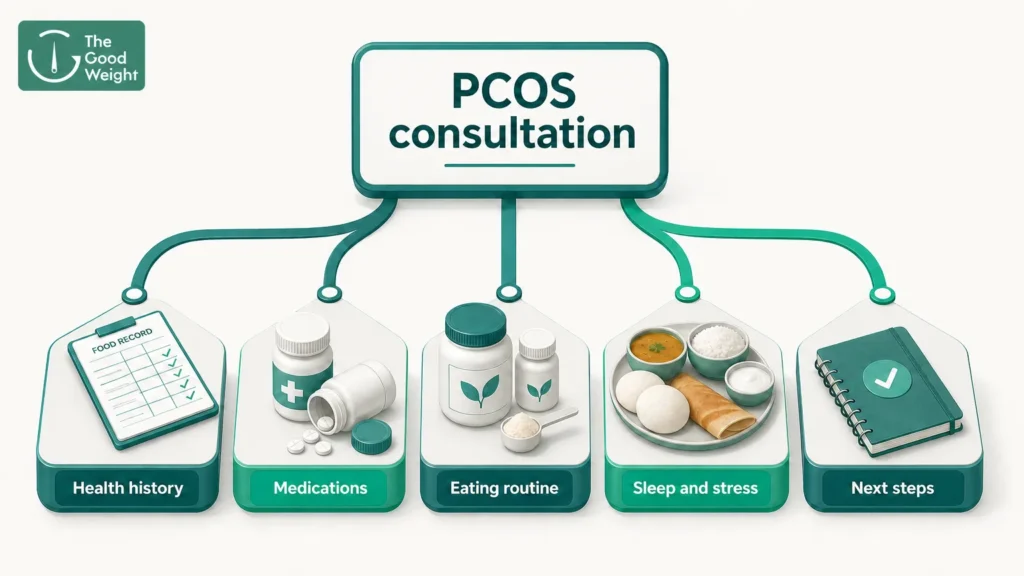
1. Your health and symptom history. A clinician may ask when you were diagnosed, how regular your periods are, whether you have acne or excess facial hair, and whether your weight has changed recently. They may also ask about thyroid conditions, diabetes, high blood pressure, digestive symptoms, fertility goals, pregnancy plans, or a history of disordered eating. These details matter because nutrition advice must fit your wider health picture.
2. Your medications and previous approaches. Bring a list of all prescribed medications, over-the-counter products, and supplements. This includes medicines used for insulin resistance, blood sugar, contraception, mood, thyroid conditions, or weight management. A helpful clinician will also ask what you have tried before, what felt unsustainable, and whether a previous diet left you hungry, anxious, exhausted, or socially isolated.
3. Your actual eating routine. Rather than asking what a “perfect” day of eating looks like, a dietitian should understand your usual day. This can include wake-up time, commuting, office meals, cooking access, tea or coffee habits, hunger levels, eating out, weekend routines, and who else shares your meals. A three-day food record can be useful, but it should be treated as information – not a test you can pass or fail.
4. Sleep, stress, and activity. Poor sleep, high stress, shift work, and limited recovery can influence appetite, food choices, energy, and activity levels. The discussion should cover movement you enjoy or can access, rather than assuming that everyone can commit to the same gym programme. If you have pain, breathlessness, injuries, or uncertainty about exercise safety, the care team may suggest appropriate medical or exercise-professional support.
5. Relevant investigations and next steps. Depending on your history, a doctor may consider blood pressure, glucose testing, lipids, or other tests. At The Good Weight, diagnostic testing for metabolic health can be considered as part of a broader doctor-led assessment when it is clinically appropriate. Results should be explained in context and used to inform care, not simply handed over as a list of abnormalities.
How a personalised plan can fit familiar Chennai meals
A PCOS-friendly food plan does not require you to stop eating idli, dosa, rice, chapati, curd, sambar, rasam, or family meals. The goal is often to improve the overall structure and nutrient balance of meals: adequate protein, fibre-rich foods, satisfying portions, and meal timing that fits your hunger and workday. Individual changes may be modest, but they can become meaningful when repeated consistently.
Nutrition care should also account for affordability. Recommending expensive powders, imported snacks, or elaborate recipes is rarely sustainable. A plan may instead use accessible foods such as dals, chana, rajma, curd, paneer, eggs, fish, chicken, soy, vegetables, fruits, nuts, seeds, and local whole grains according to dietary preferences and medical needs.
Example one: the early office commuter
Consider a person who leaves home at 7:30 a.m., drinks only coffee in the morning, eats a large cafeteria lunch, and reaches for biscuits at 5 p.m. before a late dinner. A rigid plan might simply tell her to eliminate biscuits and rice. A more useful approach would explore whether a portable breakfast with protein and fibre, a planned afternoon snack, and a more balanced lunch could reduce the intense hunger that drives the evening pattern.
Her familiar breakfast might remain idli or dosa, but the consultation could consider how to add a practical protein source and vegetables where possible. Lunch may still include rice, sambar, poriyal, and curd, with portions and combinations adjusted around her needs and satiety. The aim is not to make every meal “perfect”; it is to create a routine she can follow during real office days.
Example two: the late-shift worker with family dinners
Now consider someone who works late, wakes later in the morning, has irregular breaks, and eats dinner with family at 10 p.m. Giving this person the same eating schedule as an early commuter would be unrealistic. The plan may focus instead on preventing long gaps between meals, organising convenient options during the shift, and making late dinners balanced and satisfying without making family meals stressful.
She may continue to eat chapati, rice, curries, and shared weekend meals, while identifying which meal needs more protein or vegetables and which snack leaves her genuinely satisfied. If food delivery is a regular part of her week, the discussion should include realistic ordering choices rather than expecting daily cooking. This is the difference between a restrictive food chart and personalised diet and weight-loss support designed around lived routines.
Nutrition support works best as part of broader PCOS care
Dietary advice is valuable, but PCOS can involve reproductive, metabolic, dermatological, and emotional concerns that need more than nutrition alone. A dietitian should know the limits of their role and should be comfortable working alongside doctors and other health professionals. Integrated care does not mean everyone needs medication or extensive testing; it means the plan is matched to the individual’s risks, symptoms, and goals.
| Nutrition-only advice | Integrated PCOS care |
|---|---|
| Focuses primarily on food choices and meal plans | Connects nutrition with symptoms, medications, metabolic risk, activity, and medical history |
| May offer generic calorie targets or restrictive rules | Uses individual assessment and adjusts recommendations over time |
| Can miss medication side effects or new symptoms | Includes pathways for doctor review, investigations, or specialist referral |
| Often measures success only by the scale | Considers weight alongside habits, energy, strength, waist measures, periods, and relevant clinical markers |
A medication review may be important if you are taking treatments that influence appetite, blood glucose, menstrual cycles, or weight. It may also be relevant if you have been unable to make progress despite consistent efforts, or if symptoms are changing. Doctor-led weight care can help place nutrition decisions alongside appropriate medical options; learn more about medical weight-loss support when discussing a broader care plan.
Further assessment may be particularly important if you have very irregular or absent periods, rapid unexplained weight change, severe fatigue, symptoms of high blood sugar, persistent pelvic pain, or a new change in hair growth or acne. A dietitian should not dismiss these concerns as something that can be solved with stricter eating. They should help you understand when prompt medical review is the safer next step.
How to choose a qualified nutrition professional in Chennai
Searching for the best nutritionist can produce a confusing mix of dietitians, health coaches, wellness influencers, and clinics. Instead of relying on labels alone, ask how the professional was trained, what their consultation process looks like, and how they coordinate care when a medical issue emerges. The right choice is not necessarily the person with the most dramatic social-media content; it is the person or team offering appropriate, transparent, patient-centred care.
Use this consultation-selection checklist
Ask about credentials and scope of practice. Request the person’s academic qualification, training, experience with PCOS, and professional registration or association where applicable. Internationally, registered dietitian nutritionists complete defined education, supervised practice, and examination requirements; the RDN credential standards illustrate why verified training matters. Credentials and regulation differ by country, so Chennai patients should ask directly rather than assuming that “nutritionist” always means the same thing.
Confirm that assessment is individualised. Ask what information will be collected before you receive advice and whether the clinician reviews medical history, medications, symptoms, and prior dieting experiences. A good consultation should have room for your food preferences, vegetarian or non-vegetarian diet, household arrangements, faith practices, work commitments, and budget. If the same menu is sent to every patient, it is unlikely to meet the standard of personalised nutrition support.
Understand follow-up, fees, and inclusions. Ask how often follow-ups occur, what they include, whether messaging support is available, and whether lab reviews or doctor consultations are charged separately. It is reasonable to want a written explanation of the programme before paying. Follow-up matters because a plan usually needs adjustment as hunger, routine, symptoms, and progress change.
Ask about escalation pathways. Find out what happens if your periods become more irregular, your blood tests are concerning, you experience side effects, or you need mental-health or specialist support. A credible professional should be able to explain when they will refer you back to a doctor or coordinate with your existing clinician. This is especially important for PCOS because nutrition is only one part of comprehensive care.
Check feedback carefully. Look for independently checkable reviews that describe the consultation process, communication, and ongoing support – not only weight-loss photographs. Be sceptical of before-and-after images without context, since lighting, timing, editing, and individual circumstances can be misleading. Evidence-based care should be transparent about limitations and should not depend on dramatic claims to earn trust.
Frequently asked questions about your first appointment
What should I prepare for my first visit?
Bring recent test reports if you have them, your diagnosis details, a medication and supplement list, and a rough record of a few typical days of eating. Note your work hours, sleep timing, activity, menstrual history, and the symptoms that concern you most. You do not need to prepare a flawless diet diary; an honest picture of your routine is more useful than an idealised one.
How should I measure realistic progress?
Weight can be one useful measure, but it should not be the only one. Your clinician may also monitor meal consistency, hunger and fullness, energy, sleep, waist circumference, strength or activity capacity, menstrual patterns, and relevant clinical tests. Sustainable weight loss usually involves review and adaptation rather than a fixed weekly promise.
How often will follow-ups be needed?
The schedule depends on your starting point, medical needs, and the type of support you choose. More frequent early follow-ups may help establish routines, while later reviews can focus on maintaining progress and solving practical barriers. Ask at the first visit how progress will be monitored and when your plan will be reassessed.
When should I seek medical review rather than waiting for my next nutrition appointment?
Seek timely medical advice for new or worsening symptoms such as severe pelvic pain, very heavy bleeding, missed periods over a prolonged period, fainting, marked weakness, rapid unexplained weight change, or symptoms that may suggest high blood sugar. If you are pregnant, planning pregnancy, or have a history of an eating disorder, make this clear at the start of care. Nutrition recommendations should be adapted with appropriate medical oversight.
Take the next step with individualised PCOS care
A valuable PCOS weight-loss consultation starts by listening: to your symptoms, medical history, meals, schedule, concerns, and goals. It then turns that information into a practical plan with review points, rather than promising a universal diet or rapid result. Choosing the best nutritionist or dietitian for you means choosing someone who treats your health as more than a number on the scale.
If you are in Chennai, book an assessment with The Good Weight to discuss your PCOS symptoms, weight goals, usual meals, medical history, and appropriate next steps with a doctor-led care team. Recommendations follow an individual consultation and are not a substitute for personal medical advice.