
Considering orlistat for weight loss? Start with the medical questions that connect a treatment choice to a workable long-term plan.
A medicine that blocks some dietary fat sounds straightforward. You take a capsule, absorb less fat, and hope the weighing scale starts moving. But if you already struggle with unpredictable meals or digestive symptoms, that simple description leaves out much of the decision.
Searching for orlistat for weight loss often starts with a practical concern: could medication help when previous attempts haven’t lasted? That’s a reasonable question. The trouble begins when a product page answers it without asking about your health history or what made earlier approaches difficult.
Two people researching the same capsule may need different care. One might need a medication review because another treatment contributes to weight gain. Another might need help building regular meals around night shifts, with medication considered alongside that support.
Neither situation reflects a lack of effort. Both deserve an assessment that looks past a purchase.
The useful comparison, then, isn’t a capsule against “trying harder.” It’s the specific contribution a medicine might make within a plan that also addresses nutrition and ongoing care. For adults considering treatment in Chennai, that includes practical questions about familiar foods, appointment costs and access to follow-up.
A safe decision needs more than evidence that a drug works on average. It needs evidence that the treatment makes sense for you, plus an agreement about what happens if it doesn’t.
What decision sits behind a search for orlistat for weight loss?
Orlistat is a medicine that reduces the absorption of some fat from food by blocking digestive enzymes called lipases. It acts in the digestive tract; it doesn’t directly suppress appetite.
The prescribing information describes orlistat as an addition to a reduced-calorie diet for weight management, not a replacement for food planning. That distinction matters if your main difficulty is persistent hunger, irregular eating or a schedule that makes meals hard to organise. Blocking some fat absorption doesn’t resolve those difficulties.
What might someone reasonably expect? A systematic review of trials lasting at least a year found that orlistat produced about 2.9 kg more weight loss than placebo. Participants also received dietary or lifestyle support, so the result shouldn’t be read as the effect of a capsule taken without other care.
That average is neither a promise nor a personal forecast. Some people benefit more; others stop because the benefit is limited or side effects become difficult. Honestly, I’d treat the average as the beginning of a consultation, not the answer to it.
The more useful question is: what problem would this medicine help address, and what would still need attention? Medication can be a legitimate part of weight care without becoming the whole plan.
What should be reviewed before medication is discussed?
A history of urgent bowel movements deserves attention before choosing a medicine that can affect bowel habits. So does a medicine list that includes treatment for thyroid disease or diabetes. Details that seem unrelated to weight may change the discussion.
Bring the following questions to an assessment. They’re preparation prompts, not a checklist for deciding your own eligibility.
- What does my health history change? Mention diabetes, kidney or liver problems, previous weight-related procedures and pregnancy plans. Ask which measurements or tests would change the treatment decision, instead of assuming everyone needs the same investigations.
- Could anything I take interact with treatment? Bring prescription medicines, over-the-counter products and supplements, including doses. Ask the clinician or pharmacist to review the full list before you change anything yourself.
- Do my digestive symptoms need assessment first? Describe oily stools, persistent diarrhoea, abdominal pain or problems absorbing nutrients. Include how often symptoms occur and whether they disrupt work or travel.
- What does eating look like on an ordinary week? Discuss meal timing and the amount of oil or fat used in cooking, as well as restaurant meals. A useful plan should fit home-cooked food and your budget without pushing you into unnecessary restriction.
- Could my nutritional intake already be limited? Mention restrictive diets, known deficiencies or difficulty eating enough. Orlistat needs particular attention to fat-soluble vitamins, medicine interactions and conditions in which it shouldn’t be used, including pregnancy, chronic malabsorption and cholestasis.
- What happened with previous approaches, and what matters now? Explain what helped and why it became difficult to continue. Better glucose control or easier movement may matter alongside weight change.
At The Good Weight, doctor-led weight and nutrition care in Chennai brings the medication discussion into a wider assessment. The aim should be a reasoned recommendation, including the possibility that another approach would fit better. No prescription is a successful outcome unless the plan makes sense to the person following it.
How does medication compare with nutrition and follow-up?
A late restaurant dinner after a long shift exposes the limits of a product-only plan. Medication doesn’t choose the meal or solve the shift pattern. Food planning can address those problems, while medical review decides whether medication could contribute something useful.
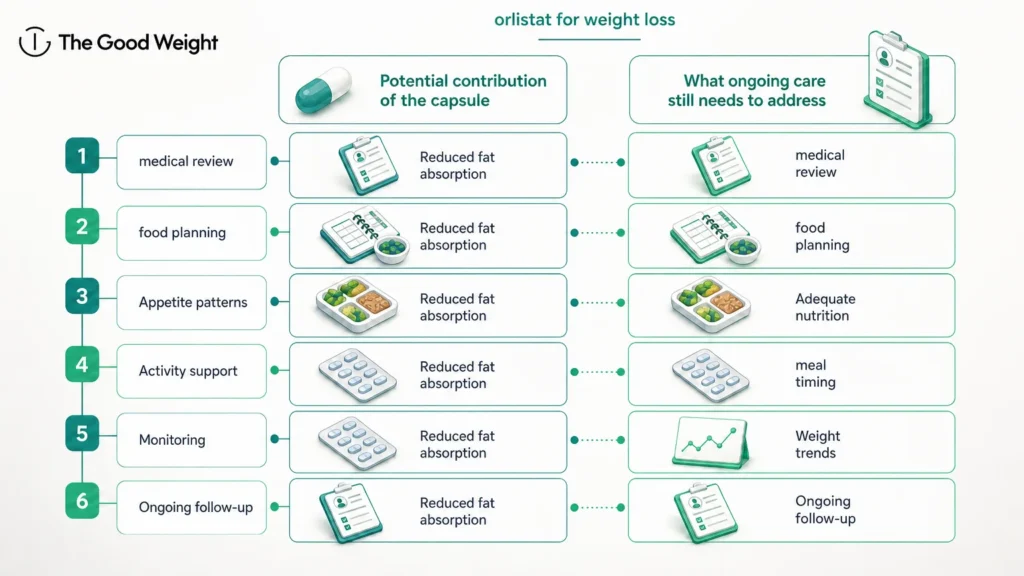
The table separates responsibilities; it doesn’t rank one form of care above another. Individual clinical advice still has to account for your health and preferences. Used together, the parts should support the same goals.
| Part of care | What orlistat may contribute | What a broader plan still needs to address |
|---|---|---|
| Medical review | A treatment option when the clinician judges it appropriate | Suitability, contraindications and alternatives |
| Food planning | Reduced absorption of some dietary fat | Adequate nutrition and a realistic distribution of fat across meals |
| Appetite and eating patterns | No direct appetite-suppressing action | Hunger, irregular meals and barriers to regular eating |
| Activity support | No substitute for movement | Activity adapted to joint symptoms, fitness and daily life |
| Monitoring | A medication response to assess | Weight trends, tolerability and relevant health measures |
| Ongoing follow-up | Continued use only while the benefit-risk balance remains acceptable | Troubleshooting, affordability and maintenance planning |
For example, a vegetarian meal pattern may need attention to protein intake even when the medication question concerns fat absorption. A household cooking with generous amounts of oil may need practical recipe adjustments, not instructions to abandon familiar foods. The details belong in the plan.
A sustainable food-planning approach should make daily decisions easier. It shouldn’t turn eating into a test you can fail. To be fair, the best-looking plan on paper may still need several revisions before it fits your life.
Which online claims and buying shortcuts should make you pause?
“Eat what you like and block the fat” is an attractive message because it removes uncertainty. Unfortunately, it also removes the questions that make treatment safer. A trustworthy explanation should leave room for limitations and individual assessment.
Pause when a seller:
- Promises a fixed result by a deadline. Ask what evidence supports the number and whether participants received other support. An online review can describe one person’s experience, but it can’t predict your response.
- Skips practical safety information. Oily stools and bowel urgency deserve plain-language discussion before purchase. Higher-fat meals can make digestive effects harder to manage, so “no dietary changes needed” is a warning sign.
- Encourages self-prescribing or switching medicines. A short questionnaire shouldn’t be treated as proof that interactions and health conditions have been reviewed. Know who takes clinical responsibility and how to contact them.
- Treats follow-up as unnecessary. Ask when someone will review benefit and tolerability, and what would prompt a change. A recurring payment isn’t a monitoring plan.
Rare harms also need proportionate explanation. The FDA warns that orlistat can increase the risk of kidney stones and kidney injury, which makes kidney history worth discussing rather than burying in small print. You shouldn’t have to choose between frightening language and silence.
Questions people ask before a consultation
Can I use orlistat without changing what I eat?
It’s intended to accompany dietary changes, not cancel out meals. The amount and distribution of dietary fat affect how treatment fits into your routine and how tolerable it feels. Ask for guidance based on your actual meals, not a generic forbidden-food list.
Will I need to avoid all fat?
No, the goal isn’t a fat-free diet. Your clinician or dietitian should explain an appropriate eating pattern and whether you need a multivitamin taken separately from the medicine. Don’t improvise supplement timing if you also take other medicines.
Is orlistat better than another weight-loss medicine?
There isn’t a universal winner. Different medicines have different mechanisms, contraindications and monitoring needs, while cost and access can affect continuity. A useful comparison connects those differences to your assessment instead of ranking treatments by online popularity.
What should you ask at a doctor-led medication consultation?
Print the template below, or save it on your phone. Bring your medicine list and any recent relevant reports, along with a description of an ordinary week’s eating. You don’t need a perfect food diary to have a useful conversation.
A printable consultation template
- Clarify the expected role. “What would orlistat address in my situation, and what wouldn’t it address?” Ask why it is being considered over another treatment or a plan without medication.
- Agree on realistic goals. “What changes should we look for, and over what period?” Record which health measures matter alongside weight.
- Write down monitoring arrangements. “When will we review progress, and which checks do I need?” Ask what would lead the clinician to continue, change or stop treatment.
- Request practical nutrition support. “How should I adjust my usual meals, and do I need supplements?” Check who can help if digestive effects or restrictive eating become a problem.
- Confirm the safety instructions. “Which side effects should I report, and which symptoms need urgent care?” Ask for written advice, including whom to contact outside appointment times.
- Plan continuity and maintenance. “What happens if treatment becomes unaffordable, doesn’t help or needs to stop?” Include follow-up costs and a plan for maintaining progress without assuming medication will continue indefinitely.
Leave space beside each question for the answer. If an instruction remains unclear, ask again before leaving; medication plans can be a lot to absorb in one visit. The aim is a shared decision you can explain in your own words.
Before purchasing orlistat for weight loss, arrange a clinician-led weight assessment and bring this list. At The Good Weight, that conversation can start with your health needs and daily routine, not an advertising promise. The next step should be a care decision, not a checkout page.