
Searching for C-section belly fat exercises is understandable when your abdomen feels unfamiliar after delivery. A C-section involves both pregnancy-related changes to the abdominal wall and recovery from major surgery, so the safest route back to activity is not an aggressive abdominal workout. It is a gradual return built around healing, comfort, breathing, mobility and strength.
Exercise can support mood, energy, cardiovascular fitness, muscle strength and long-term weight goals. However, it cannot selectively burn fat from the lower abdomen or guarantee that your stomach will return to its pre-pregnancy shape. Your recovery deserves an approach that respects your incision, pelvic floor, sleep demands and the individual advice of your obstetric team.
Start with recovery, not a workout plan
There is no single “right” week to resume exercise after a C-section. Factors such as an unplanned or complicated delivery, infection, significant blood loss, high blood pressure, pelvic-floor symptoms, pain levels and your baby’s care needs can all affect readiness. The most reliable starting point is the guidance from the clinician who knows your surgical and postpartum history.
The American College of Obstetricians and Gynecologists advises that women who have had a caesarean birth should ask their obstetrician when it is safe to resume exercise, because the timing depends on individual recovery circumstances. Postpartum exercise may be resumed gradually when it is medically safe, rather than according to a rigid online schedule.
A readiness checklist before you increase activity
Before progressing beyond gentle, comfortable movement, consider whether the following statements are true:
- Your surgeon, obstetrician or postpartum clinician has not advised you to restrict activity, and you understand any specific limits that apply to lifting, driving or exercise.
- Your incision is closed and healing as expected, without increasing redness, heat, swelling, drainage, separation or worsening tenderness.
- You can walk around your home and manage basic daily activities without a clear increase in incision pain, pelvic heaviness, dizziness or exhaustion afterwards.
- Postpartum bleeding is settling rather than becoming heavier or brighter red after activity.
- You can breathe normally, stand upright comfortably and move from lying to sitting with reasonable control.
This is not a test you have to “pass” perfectly. It is a practical way to notice whether your body is tolerating its current load. If one area is not improving, staying at a gentler level or seeking advice is not falling behind; it is appropriate surgical recovery.
It can also help to separate comfort from pressure to lose weight. The weeks after birth often involve interrupted sleep, feeding demands, fluid shifts and major hormonal changes. A plan focused first on recovery and nourishment is more likely to support sustainable health than restrictive eating or high-impact exercise too soon. If weight concerns remain important later, doctor-led medical weight-loss care can help assess the wider picture, including metabolic health, medications, nutrition and realistic activity options.
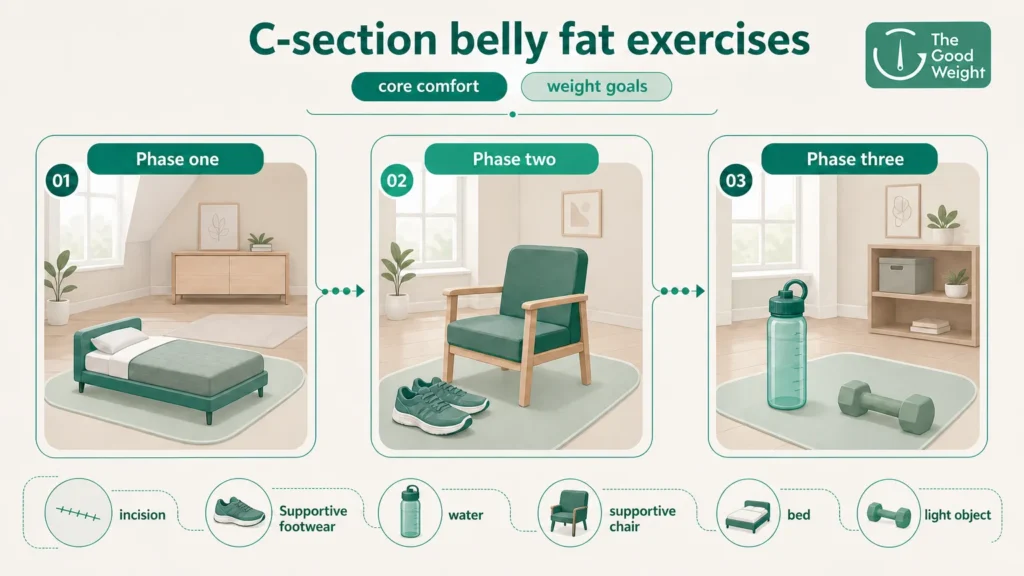
Phase one: build movement into everyday life
Once you have been cleared to begin and movement feels manageable, think in short, low-pressure bouts rather than formal workouts. The goal is to restore confidence in ordinary movement without provoking symptoms. Walking, changing positions regularly and gentle mobility are useful because they are easy to adjust to how you feel that day.
Begin with comfortable walking
Start with a pace at which you can speak in full sentences and breathe without straining. This may mean walking indoors, on a flat surface near home, or for only a few minutes at a time. Supportive footwear, water and a route that allows you to stop easily can make early walks more comfortable, especially in Chennai’s heat and humidity.
Use your next-day response as feedback. Mild general tiredness can be normal, but increased incision pulling, pelvic pressure, pain or heavier bleeding suggests that the duration, pace or terrain was too demanding. Reduce one variable at a time – such as walking more slowly or shortening the route – rather than stopping all movement unless a clinician tells you to.
Add gentle mobility between daily tasks
Simple mobility can be as useful as a dedicated session at this stage. Try slow shoulder rolls while feeding, relaxed neck movements, ankle circles, or standing up and sitting down from a supportive chair with control. When getting out of bed, rolling to your side first and using your arms to push up may reduce strain through the abdomen.
These movements should feel calm, not like a challenge to “push through.” A global public-health recommendation is that postpartum women without contraindications aim for at least 150 minutes of moderate-intensity physical activity each week, but that is a longer-term health target – not a deadline for a new parent recovering from surgery. Several brief walks and mobility breaks are a valid beginning.
Keep the first phase deliberately flexible
On a day with little sleep, a shorter walk or a few gentle movements may be the right amount. On a day when you feel well, it can be tempting to make up for lost time, but sudden leaps in activity often make consistency harder. Aim for the smallest routine you can repeat comfortably, then build from there after your body has shown it tolerates that level.
Phase two: reconnect with your core and pelvic floor
Your core is more than the visible abdominal muscles. It includes the diaphragm, deep abdominal muscles, back muscles and pelvic floor, which work together to manage pressure during breathing, lifting and movement. After pregnancy and a C-section, retraining this coordination can be more useful than starting with crunches, planks or intense “belly fat” routines.
Use breath to reduce pressure
Choose a comfortable position – supported sitting, side-lying or lying on your back with bent knees if that position is comfortable. Let your ribs and abdomen expand gently as you inhale. As you exhale, imagine softly drawing your lower abdomen inward, like tightening a wide belt by one notch, while allowing the pelvic floor to lift gently rather than clenching hard.
The movement should be subtle. Avoid holding your breath, bracing forcefully, flattening your back aggressively or bearing down into the pelvis. Exhale during effort when standing from a chair, lifting a light object or doing a gentle strengthening movement. This strategy can make daily tasks feel more controlled without putting unnecessary pressure through the healing area.
Try low-load core-control exercises
After clearance, a few controlled repetitions of a heel slide, marching one foot at a time while lying down, or a supported bridge may be appropriate for some people. Move slowly, breathe out with the effort and stop before form becomes strained. There should be no sharp incision pain, visible abdominal bulging or doming, pelvic pressure, leaking or increase in bleeding.
Pelvic-floor exercise is also not simply about squeezing harder. The pelvic floor needs both the ability to contract and the ability to relax. Evidence reviews suggest that postpartum pelvic-floor muscle training can reduce urinary incontinence, but an individual assessment is especially valuable if you have leakage, pain, heaviness or difficulty sensing the muscles.
Treat symptoms as useful information
Pain is not a sign that an exercise is “working.” Stop and speak with a clinician if you notice pulling or burning at the scar, a sensation of vaginal heaviness, urine or stool leakage, pain with pelvic-floor contractions, or an abdominal ridge that worsens with effort. A pelvic-health physiotherapist can assess breathing patterns, scar sensitivity, abdominal-wall function and pelvic-floor coordination, then adapt exercise to your needs.
Phase three: progress to full-body strength and activity
When gentle walking and core-control work are well tolerated, fuller-body strengthening can help rebuild capacity for real life: carrying your baby, pushing a pram, climbing stairs and getting up from the floor. Strength work also supports lean muscle mass and functional fitness, but progression still matters more than intensity.
Begin with exercises that use large muscle groups and can be easily modified: sit-to-stands, wall push-ups, supported rows with a resistance band, bodyweight squats to a chair, and light hip-hinge movements. Start with a small number of repetitions and leave a clear margin before fatigue changes your form. Increase only one element at a time, such as repetitions, resistance, range of motion or number of sessions.
Higher-impact work – running, jumping, fast interval training or heavy lifting – generally requires more readiness than walking. You should be able to perform lower-impact strength work without symptoms first. In particular, pelvic heaviness, leakage, pain or a feeling that your abdomen is not managing pressure well are reasons to pause progression and obtain individual guidance.
A realistic weekly planning example
A postpartum routine does not need to look like a pre-baby fitness schedule. One practical week might include three to five short walks based on energy and weather, two brief full-body strength sessions, and several minutes of breathing and pelvic-floor coordination on most days. Each session can be broken into small blocks: five minutes while the baby is settled, a few sit-to-stands during a feeding break, or a gentle walk with family support.
For example, Monday might be a 10-minute easy walk and breathing practice; Tuesday, a short strength session using a chair and wall; Wednesday, rest or gentle mobility; and Thursday, another walk. The remaining days can flex around appointments, feeding and sleep. The plan succeeds when it is adaptable enough to continue, not when every box is ticked.
If you are breastfeeding, regular meals, fluids and adequate overall energy intake are part of exercise recovery. Extreme calorie restriction may leave you depleted and is unlikely to create lasting results. A personalised plan that includes nutrition support for healthy weight loss can be more practical than trying to follow a generic postpartum diet online.
What C-section belly fat exercises can – and cannot – change
The phrase “C-section belly” can describe many different changes: body-fat distribution, stretched skin, swelling, scar tissue, a healing incision, altered posture, abdominal-muscle separation or simply the normal postpartum shape of the abdomen. Because these are different issues, no single exercise can change them all.
Myth: Ab exercises burn fat from the lower belly
Fact: Exercise does not choose where your body uses stored fat. Spot reduction has not been supported by controlled research; for example, a trial of abdominal resistance training found no reduction in abdominal subcutaneous fat from abdominal exercise alone. Core work can improve strength, movement confidence and trunk control, but it is not a targeted fat-loss treatment.
Overall body composition may change gradually through a combination of nutrition, activity, sleep where possible, medical factors and time. Genetics and hormonal shifts influence where fat is stored and lost. This is why a compassionate weight plan should measure more than the appearance of one body area.
Myth: A stronger core should make the stomach look flat
Fact: Strength and appearance do not always change at the same rate. Skin laxity, scar adherence, posture, body-fat distribution and diastasis recti can all affect abdominal shape. Diastasis recti is common in pregnancy, and while exercise may improve function for some people, research has found uncertainty about the most effective specific exercise programmes.
A visible gap or soft area does not automatically mean damage, and a flat-looking abdomen does not prove that the core is functioning well. Focus on symptoms and function: comfortable movement, improved strength, fewer pressure symptoms and confidence with everyday tasks.
Myth: Scar massage or hard exercise will “remove” the C-section shelf
Fact: A scar and the tissues beneath it can change over time, but they should not be forced. Scar-care advice must come from your surgical or postpartum team, especially until the wound is fully healed. If scar sensitivity, tightness or adhesions seem to limit movement, a clinician or pelvic-health physiotherapist can recommend suitable treatment rather than relying on painful self-treatment.
For people considering aesthetic or fat-reduction procedures later, it is important to distinguish these from postpartum rehabilitation and to wait until recovery and medical assessment are complete. Non-surgical fat-reduction options are not substitutes for healing, core rehabilitation or personalised medical advice.
When to stop and seek support
Stop exercise and contact your obstetric team promptly if activity brings on chest pain, shortness of breath beyond expected exertion, fainting, calf pain or swelling, severe headache, fever, or new heavy bleeding. Seek urgent care for wound separation, pus-like drainage, spreading redness, severe abdominal pain or symptoms that make you feel acutely unwell.
Less urgent symptoms also deserve support when they persist. These include increasing scar pain, pelvic pressure or bulging, urine or stool leakage, pain during sex, persistent back or pelvic pain, marked abdominal doming with effort, or anxiety about moving after birth. You do not have to wait until symptoms become severe to ask for help.
Frequently asked questions
When can I start C-section belly fat exercises?
The safest answer is after your own clinician has cleared you and your incision and symptoms indicate that you are recovering appropriately. Start with walking, breathing and low-load core coordination rather than intense abdominal exercises. The appropriate pace differs widely between people, particularly after complicated births or when pain and pelvic-floor symptoms are present.
Can walking reduce belly fat after a C-section?
Walking can support cardiovascular health, mood, daily energy expenditure and a gradual return to fitness. It cannot guarantee fat loss from the abdomen specifically, and it should not be used to override signs that your body needs rest. Comfortable, consistent walking is more useful than pushing for long or fast sessions before you are ready.
Are planks and crunches safe after a C-section?
They may be appropriate later for some people, but neither is an essential first exercise. They can create substantial abdominal pressure if performed before you have rebuilt breath control and basic core coordination. A clinician or pelvic-health physiotherapist can help you decide whether your form, healing and symptoms make these movements suitable.
What if I am still pregnant-looking months after delivery?
A changing abdominal shape can be normal, but persistent concerns merit a clinical review rather than self-blame. A clinician can consider scar healing, diastasis recti, pelvic-floor function, nutrition, sleep, thyroid or other health factors where relevant. Your body’s recovery is not a measure of your effort or worth.
A steady path toward recovery and sustainable goals
The most helpful C-section belly fat exercises are not necessarily the most intense ones. They are the movements you can perform comfortably after clearance, progress gradually and use to rebuild trust in your body. Walking, breathing, pelvic-floor coordination and full-body strength offer a stronger foundation than rushing into targeted abdominal workouts.
Before beginning a weight-loss programme, consider arranging an individual postpartum assessment with The Good Weight, particularly if you have pain, persistent bleeding, pelvic symptoms, wound concerns or complex medical needs. Personalised, doctor-led care can help you set weight and metabolic-health goals that protect recovery rather than compete with it.