
The sales pitch is easy to understand. You’ve had a few disciplined weeks, the scale barely moves, and then an ad appears promising that a capsule can “switch on ketosis,” curb hunger, or help your body burn stored fat faster. After repeated diet restarts, that kind of promise can feel less like marketing and more like a lifeline.
Products marketed as Ketone Plus often borrow familiar language from the keto diet: ketones, fat fuel, metabolic switch, and rapid energy. Those words sound scientific because they describe real biology. But a real biological term does not automatically turn a supplement into a proven weight-loss treatment.
I’ve found that people rarely buy these products because they are gullible. They buy them because weight loss can feel exhausting, especially when appetite, work schedules, sleep, hormones, or medical conditions keep getting in the way. The useful question is not “Do I have enough willpower?” It’s whether the product’s claims match the evidence, the ingredient label, and your own health needs.
Why ketone language keeps pulling people in
Ketosis is a real metabolic state. When carbohydrate intake stays very low, the body begins producing ketones that can act as an alternative fuel source. A well-planned ketogenic diet may change appetite and food choices for some people, but it also requires ongoing dietary structure. Swallowing a capsule is a very different act from changing the way you eat day after day.
That difference gets blurry in advertising. A label might say “supports ketosis” or “helps your body use fat for energy,” then pair those phrases with before-and-after photos or vague promises of a smaller waist. The wording leaves room for the buyer to assume the pill itself causes fat loss, even when the package never plainly says that.
And that’s the uncomfortable bit. The supplement does not need to promise an exact number of kilos lost to imply one. It only needs to place “ketones,” “fat burner,” and a photo of someone in gym clothes close enough together.
Plain-English definition: Nutritional ketosis is a state in which the liver makes ketones because carbohydrate intake is low enough to change fuel use. It is not proof that body fat is falling, and it is not something a product name can confirm.
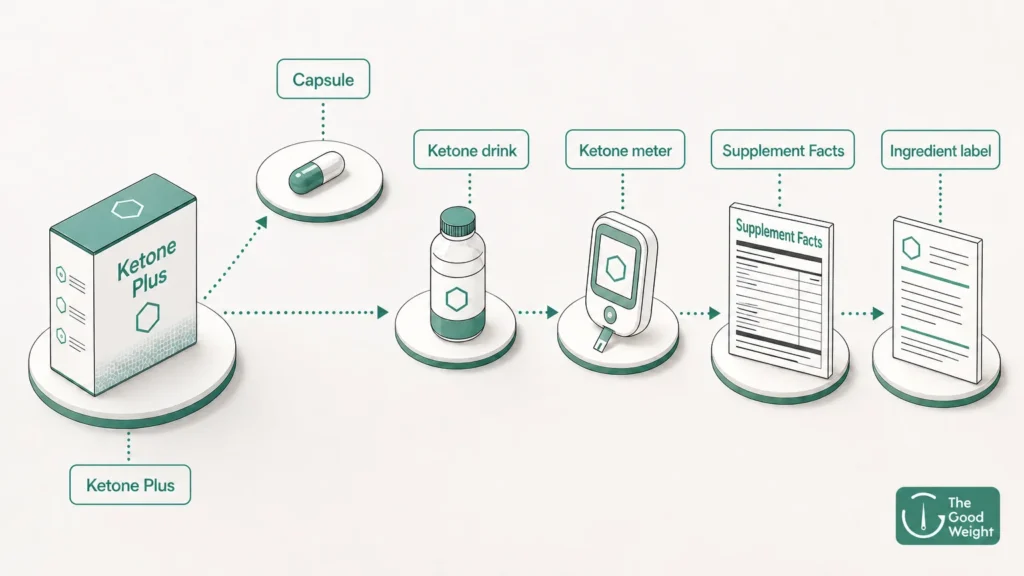
A product called Ketone Plus may contain exogenous ketones, minerals attached to ketones, caffeine, plant extracts, fibre, or a blend of several ingredients. Brand names can also be reused or altered across marketplaces, so the name alone tells you very little. Read the actual Supplement Facts panel, the dose per serving, and the full list of ingredients before assuming you know what you are buying.
What Ketone Plus claims can really mean
The phrase “fat burning” has no fixed medical meaning on a supplement label. Your body uses fat as fuel at rest, during exercise, and between meals. Yet using some fat for energy is not the same thing as losing enough body fat over weeks and months to change weight, waist size, or metabolic risk.
A rise in ketones is not a fat-loss result
Some ketone supplements can raise blood ketone levels for a short time. Research on exogenous ketones shows that they can alter circulating ketones, but that is a measurement of what is in the blood after taking the product, not evidence that the supplement has caused lasting loss of body fat. A review of exogenous ketone supplements and metabolic effects makes that distinction clear: the physiological response is more complicated than “more ketones equals more fat loss.”
Picture two people. One takes a ketone drink before breakfast but eats the same amount over the day. Another changes her breakfast from sweet tea and biscuits to eggs, curd, fruit, and a planned lunch that keeps her full until evening. The first person may notice a different reading on a ketone meter. The second may find it easier to eat less without feeling deprived. Only one of those changes directly addresses the habits that influence a sustained calorie deficit.
“Appetite support” needs proof, too
A product can make hunger feel different for a few hours without changing a person’s average intake over a month. Caffeine may blunt appetite temporarily. Fibre may help some people feel fuller. A strongly flavoured drink can interrupt snacking simply because it gives your mouth something else to do.
None of that makes a supplement useless in every setting. But it does mean the claim needs perspective. If a capsule does not help you build meals you can repeat on a busy Tuesday, it may end up as an expensive detour.
The NIH Office of Dietary Supplements notes that evidence for many weight-loss supplements is limited and that products can carry safety concerns. That is a sober reality check, not a scolding. Marketing often sells certainty where research only has scattered, short-term findings.
Ketosis, appetite, and body-fat loss are different things
Body-fat loss happens when, over time, your body uses more energy than it takes in. That sentence sounds almost annoyingly simple. Human behaviour and biology make it harder: hunger changes, food is social, sleep affects cravings, and some medicines or conditions can alter weight patterns.
Still, the distinction matters. Ketosis describes a fuel state. Appetite control describes a feeling or behaviour. A calorie deficit describes the energy gap that can lead to weight reduction. None of these terms is interchangeable.
Here’s a better way to read a weight-loss claim:
-
Ask what outcome was measured. Did the company measure blood ketones, a short-lived increase in energy, or actual changes in body weight and waist circumference over months? Those are very different endpoints.
-
Check who funded and completed the research. A small study on healthy young adults does not settle whether a capsule works for a 42-year-old with insulin resistance, PCOS, poor sleep, and a long history of dieting.
-
Look for the missing behaviour. If the product works only alongside strict calorie control and regular activity, the behaviour change may be doing most of the work. The capsule may be riding in the passenger seat.
-
Ask whether you can sustain the plan. A result that lasts ten days is not the result most people are seeking. Weight care needs to survive festivals, deadlines, travel, and the weeks when motivation is flat.
Honestly, I think the phrase “fat burner” causes more confusion than it helps. Your metabolism is not a broken stove waiting for a tablet to light a flame. It responds to food intake, muscle mass, movement, sleep, stress, medications, and health conditions in ways that no label can neatly compress.
The risks are not limited to wasted money
The obvious risk is paying for something with weak evidence. But the less obvious risks deserve attention. Some fat-burning blends contain caffeine or other stimulant-like ingredients that can worsen palpitations, anxiety, reflux, headaches, or poor sleep. Poor sleep, ironically, can make appetite and food decisions harder the next day.
Ingredient blends are another problem. “Proprietary blend” can hide the amount of each component, leaving you unable to tell whether an ingredient has a studied dose or merely appears on the label. If the formula includes multiple extracts, you may also find it hard to identify what caused nausea, diarrhoea, dizziness, or a racing heart.
The NIH’s professional guidance warns that weight-loss supplements may interact with medicines and that some ingredients have safety issues at higher doses or in certain people. Read the health-professional review of weight-loss supplement ingredients before mixing a product with diabetes medication, blood-pressure treatment, thyroid medicine, or antidepressants.
Look, a supplement can also create a quieter problem: false permission. Someone takes Ketone Plus in the morning, feels they have “done something healthy,” then skips planning meals, keeps late nights, and waits for the pill to compensate. That cycle is frustrating because the product becomes the plan. It isn’t one.
A better next step than the supplement aisle
For someone with a small amount of weight to lose and no concerning symptoms, the first move may be surprisingly unglamorous: create a food routine that makes overeating less likely. Planned protein at meals, vegetables or fruit you’ll actually eat, realistic portions of rice or roti, and a repeatable evening-snack plan beat a cupboard full of half-used tubs.
The diet and weight-loss support at The Good Weight focuses on the details that ads skip: meal timing, food preferences, hunger patterns, and the situations in which eating plans fall apart. No two people need the exact same structure. Some need easier breakfasts. Others need help with restaurant meals or late-night hunger.
Doctor-led care makes more sense when weight concerns come with PCOS, prediabetes, diabetes risk, sleep apnoea symptoms, high blood pressure, fatty liver disease, or repeated weight regain. A clinician can review medicines, examine metabolic markers, and decide whether nutrition support alone is appropriate or whether medical treatment deserves a conversation. Diagnostic tests for metabolic health can turn vague worries into information you and your doctor can act on.
For people living with obesity, supervised treatment can include structured nutrition support, medication when suitable, or procedures for selected patients. The point is not to jump straight to the most intensive option. The point is to stop treating a medical issue as a character flaw. Medical weight-loss care starts with the person, not the product shelf.
Questions people ask before buying a ketone supplement
Can any supplement replace diet structure?
No. A supplement may fit into a broader plan in limited cases, but it cannot plan meals, reduce restaurant portions, repair poor sleep, or address emotional eating. Sustainable weight loss comes from a pattern you can keep doing when life gets messy, not from a short burst of motivation.
What are the biggest red flags on a Ketone Plus label?
Be wary of dramatic promises, vague “proprietary” blends, missing ingredient doses, and claims that sound medical without showing credible human research on the finished product. Extra caution is wise when a product pairs ketone language with stimulants or tells you to avoid speaking with a clinician. That’s a hard pass.
What should I ask before I buy it?
Ask: What exact ingredient is supposed to cause weight loss? At what dose? Was the same finished product studied in humans for more than a few weeks? And what happens if I stop taking it? If the answers are slippery, save your money.
A capsule cannot carry the full weight of a person’s hopes for better health. If you’ve been spending on products that promise a metabolic shortcut, pause before the next purchase. Book a clinician-guided review for a plan built around fat loss, appetite management, and your health history – then decide what belongs in that plan.
Learn more about doctor-led weight care at The Good Weight.