
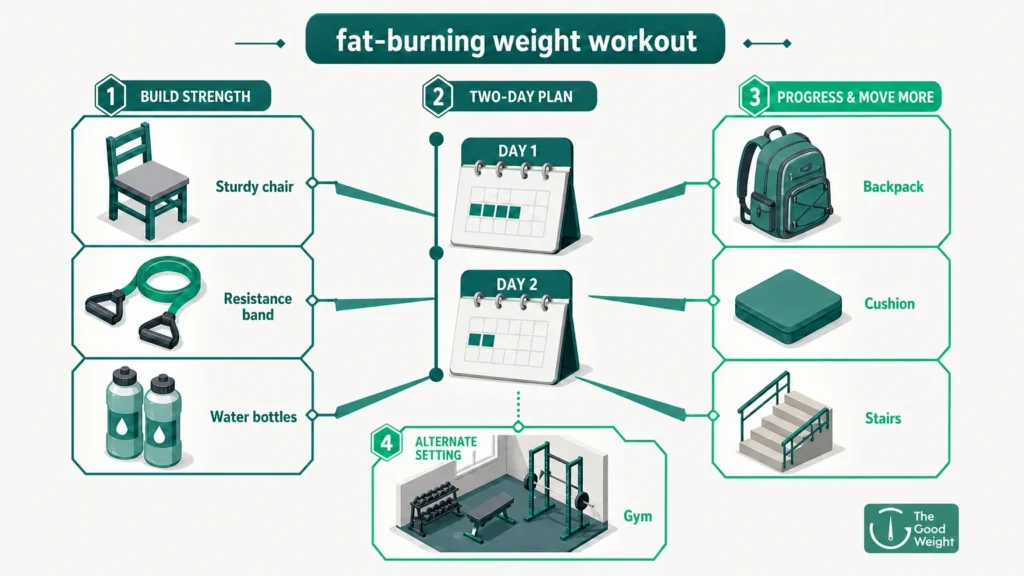
Searching for a fat-burning weight workout can make it seem as though you need punishing circuits, long gym sessions, or daily soreness to lose weight. You do not. For many beginners, people returning after a break, and people in larger bodies, the most useful starting point is a manageable strength-training routine that makes everyday movement easier – not a plan that leaves you exhausted by week two.
Strength training can support sustainable weight loss by helping you maintain or build muscle while improving strength, stamina, and confidence. It works best when paired with daily movement, recovery, and an eating pattern that fits your health needs and lifestyle. This guide explains what exercise can realistically do for fat loss, how to begin safely at home or in a gym, and when to seek personalised advice.
What “boosting metabolism” really means
“Boost your metabolism” is a popular phrase, but it can create unrealistic expectations. Metabolism is not a switch that one workout permanently turns on. It includes the energy your body uses at rest, to digest food, and during all forms of movement. Exercise can influence parts of this picture, but lasting weight change still depends on consistent habits over time.
Myth: A hard workout will keep burning large amounts of fat for days
A strength session does use energy, and a challenging session may slightly increase energy use for a period afterwards. However, the main benefit of resistance training is not a dramatic, permanent rise in calorie burn. It is the ability to train consistently, preserve lean tissue during weight loss, and become more capable in daily life.
Research suggests that resistance training can improve body composition, including reductions in body fat, even when the number on the weighing scale does not change quickly. A systematic review found that resistance training can reduce body fat percentage and fat mass, although the results vary with training consistency, food intake, starting fitness, sleep, and other health factors.
Fact: Muscle retention matters while losing weight
When weight decreases, the body can lose both fat mass and lean mass. Lean mass includes muscle, which helps with strength, mobility, balance, and daily function. Strength training gives your body a reason to retain more muscle while you are in an energy deficit, especially when your meals include enough protein for your individual needs.
That does not mean muscle alone creates a huge increase in resting calorie needs. The change is generally modest. The more practical advantage is that preserving strength can help you stay active, continue doing your sessions, and feel physically better while pursuing weight-management goals.
Fact: Everyday movement often matters more than a single workout
A 30-minute workout is valuable, but it does not cancel out long periods of sitting. Walking to nearby errands, standing up regularly, taking stairs when comfortable, household tasks, and playing with children all add to daily movement. These habits can be easier to sustain than trying to make every workout harder.
Public-health guidance recommends that adults work towards 150 to 300 minutes of moderate-intensity aerobic activity each week, alongside muscle-strengthening activity on two or more days. This is a long-term destination, not a requirement for your first week. Starting below that level still brings benefits, particularly if you are currently inactive.
Build a safe weekly foundation
The best beginner plan is one you can repeat next week. Start with two full-body strength sessions per week, separated by at least one rest day. If you are already walking regularly and feel comfortable with the movements, you may progress to three sessions. More is not automatically better when your body is adapting.
Choose your starting level
If you have been mostly inactive, begin with two 20- to 30-minute sessions. On the days in between, try a short, comfortable walk or another form of movement you enjoy, such as cycling, swimming, dancing, or gentle yoga. The purpose is to build a routine without overloading joints, muscles, or your schedule.
If you are returning after a long break, start lighter than you think you need to. Use body weight, a light resistance band, water bottles, or a backpack with a small amount of weight. A session should feel like work, but you should finish feeling that you could have done a little more with good form.
If time and confidence are limited, divide your workout into smaller blocks. Ten minutes of sit-to-stands, wall push-ups, and band rows in the morning can count. You can add a short walk later in the day. Consistency is more important than completing a perfect 45-minute session.
A simple two-day weekly schedule
| Day | Focus | Example |
|---|---|---|
| Monday | Full-body strength | Squat pattern, push, pull, hinge, carry, core |
| Tuesday | Recovery movement | Easy walk, mobility work, or rest |
| Wednesday | Optional movement | Comfortable walk or enjoyable activity |
| Thursday | Full-body strength | Repeat Monday’s patterns with the same or slightly adjusted load |
| Friday | Recovery movement | Easy walk, stretching, or rest |
| Saturday | Optional movement | Family walk, cycling, swimming, or recreational activity |
| Sunday | Rest | Prepare for the coming week |
Aim for one to two sets of each exercise in the first two weeks. Do roughly 6 to 12 controlled repetitions per set, stopping while you still feel able to complete two or three more repetitions with good form. This approach is often more sustainable than training to complete exhaustion.
Learn movement patterns before chasing hard workouts
A useful full-body routine covers a small number of movement patterns rather than a long list of complicated exercises. These patterns mirror daily tasks: standing from a chair, picking up an object, pushing a door, carrying groceries, and staying steady while moving.
Begin each session with five minutes of gentle preparation. Walk in place, roll your shoulders, move your ankles, and practise a few slow body-weight repetitions of the first exercise. Warm-ups do not need to be elaborate; they should help you feel ready to move.
Squat or sit-to-stand
The squat pattern strengthens the legs and helps with getting up from a chair, toilet seat, or low surface. For a beginner-friendly option, sit down on a sturdy chair and stand up again slowly. Keep your feet about hip-width apart, press through your whole foot, and use the chair height that feels manageable.
To make it easier, use armrests or place a cushion on the chair to raise the seat. To make it harder, slow the lowering phase, hold a backpack close to your chest, or use a lower chair only if your knees and balance tolerate it comfortably. Your knees do not need to remain perfectly still, but they should track generally in the direction of your toes.
Hinge
A hinge is the pattern used to pick something up from the floor. It trains the hips, hamstrings, and glutes while teaching you to keep the spine supported. Start by standing a few inches from a wall, softly bending your knees, and sending your hips backwards until your buttocks gently touch the wall.
Keep your chest comfortably open and imagine reaching your hips back rather than folding forward. When this feels natural, practise a light backpack deadlift from a raised surface such as a stable table or bench. Make it easier by raising the object higher; make it harder by gradually lowering the starting height or adding small amounts of weight.
Push
Push movements build strength in the chest, shoulders, and arms. Wall push-ups are an accessible place to begin: place your hands against a wall at chest height, step back, bend your elbows, and press away. Keep your body in a straight line from head to heels without holding your breath.
As you become stronger, move your hands to a kitchen counter or sturdy table. A lower surface increases the challenge. Floor push-ups are optional, not a required milestone. The right version is the one that you can perform steadily without shoulder pain or losing control.
Pull
Pulling movements support the upper back and can improve confidence with tasks such as carrying bags or lifting objects. At home, use a resistance band secured safely around a stable anchor point, or loop it around your feet while seated. Pull your elbows back gently, keeping your shoulders away from your ears.
Avoid using doors, furniture, or fixtures that are not designed to hold tension. If you do not have a band, a light backpack row can work: place one hand on a stable chair or table for support, pull the backpack towards your hip, and move slowly. Keep the load light enough that your trunk does not twist.
Carry and core stability
Carries and core-stability exercises are less dramatic than crunches, but they are useful for building everyday strength. Hold two light bags or bottles by your sides, stand tall, and walk slowly for 20 to 40 seconds. Keep your ribs stacked over your hips and breathe normally.
For a no-equipment core option, try a wall plank: place your forearms on a wall, step back, and gently brace your abdomen as if preparing for a cough. Avoid bearing down or holding your breath. These exercises should help you feel steadier, not strain your lower back.
Progress without turning training into punishment
Progressive training simply means gradually asking your body to do a little more once the current level feels manageable. It does not mean adding weight every week or feeling sore after every workout. Gradual progression in resistance training is generally more effective and safer than making large, sudden jumps in volume or intensity.
Use a simple progression checklist
Before changing your programme, repeat the same routine for at least two weeks. Track the exercise, resistance used, repetitions, and how it felt. You may be ready to progress when you can finish all planned repetitions with steady form, normal breathing, and two to three repetitions still “in reserve.”
Choose only one change at a time:
- Add one or two repetitions to each set.
- Add a second set if you currently do one.
- Use a slightly firmer band or a little more weight.
- Slow the lowering phase of the movement.
- Add a third weekly session after two sessions feel sustainable.
Do not progress if your joints hurt, your form breaks down, you are unusually fatigued, or you are struggling to recover between sessions. Improvement can also show up as less breathlessness on stairs, easier chair stands, better balance, or being able to carry groceries more comfortably.
Understand soreness and recovery
Mild muscle soreness, especially in the first weeks, can be normal. It often appears 24 to 48 hours after an unfamiliar activity and should gradually improve. Severe pain, sharp pain, swelling, weakness, or soreness that changes how you walk or use a joint is not something to push through.
A tough session is not automatically a productive session. Sustainable progress comes from training often enough to practise the movements, then allowing your muscles and nervous system time to recover. Sleep, rest days, and adequate food are part of the programme – not signs that you are “doing less.”
Pair resistance training with habits that support fat loss
Exercise supports health and weight management, but it cannot reliably compensate for an eating pattern that does not match your needs. Fat loss generally requires an energy deficit over time, meaning the body uses more energy than it takes in. The size and pace of that deficit should be personalised, especially for people managing diabetes, thyroid conditions, medications, or a history of restrictive dieting.
Build meals around structure, not restriction
Rather than eliminating entire food groups, aim for predictable meals that include protein-containing foods, fibre-rich produce, and satisfying carbohydrate and fat sources. In an Indian context, protein might come from dal, chana, rajma, curd, paneer, eggs, fish, chicken, soy, tofu, or milk, depending on your preferences and medical needs.
Protein is particularly relevant while strength training because it supports muscle repair and maintenance. Evidence indicates that higher protein intake can help preserve lean mass during weight loss, but the right amount differs by body size, kidney health, food preferences, and overall diet. A registered dietitian or doctor can help you set a practical target instead of following generic social-media advice.
For more support with meal structure and sustainable nutrition, explore The Good Weight’s approach to diet and weight loss. The aim is not to “earn” food through exercise; it is to create habits that help you feel nourished, energised, and able to train consistently.
Protect sleep and daily activity
Short or poor-quality sleep can make appetite regulation, energy, and exercise recovery harder. Keep your sleep routine realistic: aim for a regular wind-down time, reduce late-night screen use where possible, and discuss persistent snoring, daytime sleepiness, or insomnia with a clinician.
Daily movement should also fit your starting point. A person who currently averages 1,500 steps does not need to jump immediately to 10,000. Add a five- or 10-minute walk after one meal, take short movement breaks during work, and gradually build from there. The health benefits of any increase in physical activity are meaningful, even before you reach formal exercise targets.
Adapt your plan when health needs change
Strength training can be adapted for many people, but certain health situations require more caution. A personalised plan may involve changing exercise range, reducing load, using a chair or wall for support, scheduling activity around medicines or meals, or beginning under clinical guidance.
When to modify or speak with a clinician first
Speak with a qualified clinician before starting or substantially increasing exercise if you have uncontrolled blood pressure, chest pain, unexplained dizziness, known heart disease, severe breathlessness, diabetes treated with insulin or medicines that can cause low blood sugar, or a recent injury or surgery. You should also seek advice during pregnancy, after delivery, or when returning to activity after a procedure.
For knee, hip, shoulder, or back pain, modify the range of motion and load rather than assuming you must stop all movement. For example, use a higher chair for sit-to-stands, choose wall push-ups instead of floor work, or shorten carrying intervals. However, stop the exercise and get assessed if pain is sharp, worsening, associated with swelling, numbness, weakness, or a loss of function.
Frequently asked questions
Should I do cardio or strength training for fat loss?
Both can be useful. Walking and other aerobic activities support cardiovascular fitness and increase daily energy use, while strength training helps preserve muscle and build physical capability. For most beginners, a combination of regular walking and two full-body strength sessions is more realistic than choosing one form of exercise exclusively.
Can I lose fat without going to a gym?
Yes. A chair, wall, resistance band, backpack, and open floor space can support an effective beginner routine. The key is choosing movements you can perform safely, gradually progressing them, and pairing exercise with suitable nutrition and recovery habits.
What if the weighing scale does not change at first?
Early progress may show up in ways the scale does not capture: improved strength, less fatigue, better mobility, or a more consistent routine. Body weight can also fluctuate because of hydration, digestion, menstrual cycles, medication changes, and normal day-to-day variation. Review trends over several weeks alongside other measures, such as waist circumference, activity consistency, and how you feel.
Build capability first, then build on it
A useful fat-burning weight workout is not the one that leaves you depleted. It is the one you can repeat, gradually improve, and fit around your life. Begin with two full-body sessions, learn the basic movement patterns, add daily movement you enjoy, and treat recovery and meal structure as essential parts of sustainable weight loss.
If you have a health condition, have struggled with repeated weight-loss attempts, or need a plan that accounts for medicines, mobility, pregnancy recovery, or metabolic risk, book an assessment with The Good Weight. Our doctor-led approach can combine activity guidance, nutrition support, diagnostics, and personalised weight-management care around your health history.