
A headline suggesting that GLP-1 drugs could “slow ageing” can make an already personal weight-loss decision feel urgent. If you are considering treatment – or are already taking it – it is understandable to wonder whether these medicines offer benefits beyond weight management. But an attention-grabbing claim is not the same as a reason to start, stop, or change a prescription.
GLP-1 medicines have established roles in the treatment of certain people with obesity, overweight with related health conditions, and type 2 diabetes. Some medicines have also demonstrated specific cardiovascular benefits in defined patient populations. However, “anti-ageing” is not an established indication. The right decision should come from an individual assessment of your metabolic health, medical history, goals, nutrition, and ability to continue follow-up – not from a viral post.
Why are GLP-1 medicines being discussed in longevity conversations?
GLP-1 drugs mimic or enhance the action of a natural gut hormone involved in appetite regulation, insulin release, and blood-sugar control. By helping some people feel fuller sooner and for longer, they can support meaningful weight loss when used alongside nutrition, activity, and medical follow-up. This has prompted broader interest in whether improvements in body weight, blood sugar, inflammation-related pathways, and cardiovascular risk factors could also influence aspects of health associated with ageing.
Part of the discussion comes from legitimate research questions. Excess weight and insulin resistance can raise the risk of conditions that become more common with age, including type 2 diabetes, cardiovascular disease, sleep apnoea, and fatty liver disease. If a treatment helps a suitable patient improve weight and metabolic markers, it may improve some health risks linked with those conditions. That is different from proving that a medicine extends lifespan, reverses biological ageing, or will produce the same result for every individual.
Evidence snapshot: what the headlines actually claim
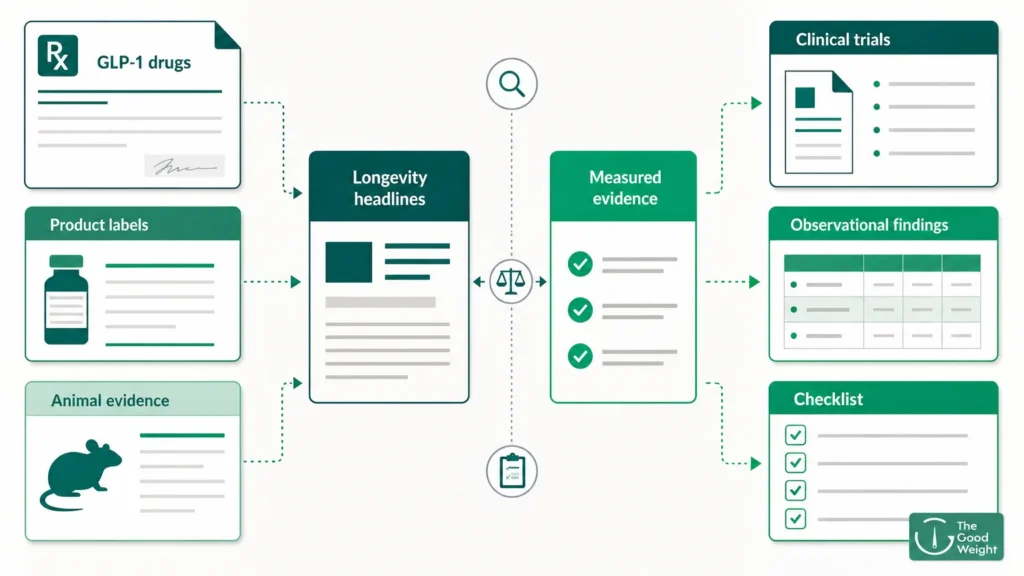
Most longevity headlines combine several very different ideas: changes observed in laboratory research, associations seen in real-world patient data, and proven outcomes from clinical trials. These pieces of evidence are not interchangeable. A social-media claim may move quickly from “researchers are studying this pathway” to “this drug keeps you younger,” without showing that a large, long-term human trial measured ageing itself.
There is strong evidence that specific GLP-1-based treatments can support weight management for appropriately selected patients. For example, in a 68-week trial, adults receiving semaglutide alongside lifestyle intervention had a mean weight change of −14.9% compared with −2.4% with placebo. In another major trial, tirzepatide produced substantial average weight reductions over 72 weeks in adults with obesity without diabetes, alongside lifestyle support.
Those are important outcomes, but they are weight-management findings – not proof of slower ageing. Longevity claims require carefully defined measures, long follow-up, and evidence that any observed effect is caused by the treatment rather than by differences in participants’ health, care access, or lifestyle.
What can current studies tell us, and what can they not tell us?
Before acting on a health claim, ask what was studied, in whom, against what comparison, and for how long. A finding can be promising without being ready to guide a personal prescription. The table below can help place common evidence types in perspective.
| Type of evidence | What it can tell us | Important limitation |
|---|---|---|
| Early-stage or mechanistic research | How GLP-1 signalling may affect inflammation, metabolism, appetite regulation, or cellular pathways | It does not show that people will live longer or experience slower biological ageing |
| Animal evidence | Whether a biological hypothesis is worth studying further | Animal metabolism, doses, disease models, and lifespan findings may not translate to humans |
| Observational findings | Patterns in large groups of people using medicines in routine care | Associations can be affected by differences in health status, prescribing, income, healthcare use, and other factors |
| Randomised clinical trials with established outcomes | Whether a treatment improved the specific outcome measured in a defined population | Results should not be extended to outcomes the trial did not measure, including longevity |
| Regulatory evidence and product labels | Approved uses, major safety information, and evidence reviewed for a medicine | Approval for one indication is not proof of benefit for every possible condition |
The strongest evidence for GLP-1 drugs is tied to specific medicines, populations, doses, and outcomes. Weight loss has been measured in randomised trials, and some treatment benefits extend beyond the number on the scale. For example, the FDA approved semaglutide to reduce the risk of cardiovascular death, heart attack, and stroke in certain adults with established cardiovascular disease and overweight or obesity after evidence from a large outcomes trial. That decision was based on a defined clinical endpoint – not on a general anti-ageing claim.
In the SELECT trial, semaglutide was associated with a 20% reduction in major cardiovascular events among adults with pre-existing cardiovascular disease and overweight or obesity who did not have diabetes. This is meaningful evidence for the patients studied. It does not mean the medicine prevents all age-related illnesses, makes every user healthier, or should be taken by people without an appropriate medical indication.
It is also important to separate average trial results from personal outcomes. People respond differently, and treatment may be limited by side effects, existing health conditions, cost, access, pregnancy plans, or interactions with other medicines. Weight regain can occur after stopping therapy, which is one reason treatment decisions should include a sustainable long-term plan rather than a reaction to a headline.
When might a clinician consider GLP-1 treatment for weight management?
A doctor-led consultation looks beyond weight alone. Clinicians consider whether medication is likely to offer more benefit than risk within a broader plan for metabolic health. For some people, nutrition support, physical activity, sleep care, treatment of another health condition, or a procedural option may be more appropriate; for others, medication may be one useful component of care.
Doctor-led assessment checklist
A thoughtful GLP-1 assessment may include:
-
Medical and weight history: Your weight pattern over time, previous approaches, eating behaviours, sleep, mobility, and conditions such as diabetes, high blood pressure, fatty liver disease, or sleep apnoea all provide context. A clinician will also consider whether weight changes may relate to thyroid disease, medicines, menopause, stress, or another underlying issue.
-
Metabolic risk and baseline testing: Blood pressure, glucose status, lipids, liver health, and other appropriate tests help identify risks and establish a baseline for follow-up. At The Good Weight, diagnostic tests for metabolic assessment can support a more informed care plan rather than relying on a single measure such as BMI.
-
Current medicines and safety factors: Your clinician should review prescription medicines, supplements, and relevant conditions before treatment. GLP-1 medicines carry important warnings and are not appropriate for everyone; for example, the semaglutide prescribing information lists a personal or family history of medullary thyroid carcinoma or multiple endocrine neoplasia syndrome type 2 as contraindications.
-
Nutrition, muscle health, and practical goals: Appetite reduction does not automatically ensure adequate protein, fibre, hydration, vitamins, or regular meals. Your goals may include improving mobility, blood-sugar control, energy, or confidence with daily routines – not simply reaching a rapid target weight.
-
Capacity for follow-up: Dose adjustments, side-effect review, nutrition planning, and progress monitoring are part of safe treatment. This is why medical weight-loss care should be structured as an ongoing clinical relationship, not a one-time medication purchase.
The rise of compounded and unsupervised products makes this assessment especially important. The FDA has warned that dosing errors with compounded injectable semaglutide have led to some patients requiring medical attention, including for severe gastrointestinal symptoms and dehydration. Do not self-start a product, alter a dose, or source injections from an unverified provider because an online claim makes treatment seem universally beneficial.
What questions should I ask after seeing a GLP-1 headline online?
Taking a headline to your appointment can be useful. It gives you and your doctor a chance to discuss the science in relation to your health profile. The goal is not to dismiss every new finding, but to distinguish a promising signal from information that should change established care.
A practical discussion checklist
Consider asking these questions:
-
Who was included in the study? Were participants similar to me in age, health conditions, starting weight, diabetes status, and cardiovascular risk? A result in people with established heart disease, for example, may not apply to someone without it.
-
What kind of study was it? Was it a randomised clinical trial, an observational database analysis, an animal study, or a laboratory experiment? Randomisation can reduce certain biases, while observational findings are better viewed as signals for further research.
-
What outcome was actually measured? Did researchers measure weight, blood sugar, cardiovascular events, hospital admissions, physical function, a laboratory marker, or survival? Be cautious if the headline uses “ageing” when the study measured something narrower.
-
How long did follow-up last? Chronic health outcomes and safety often require longer observation than early weight-loss changes. A short-term improvement should not be presented as proof of lifelong benefit.
-
What side effects and treatment burdens were reported? Ask how nausea, vomiting, constipation, diarrhoea, reduced appetite, gallbladder concerns, hydration, and nutritional intake were managed in the study and how they would be managed for you.
-
Does this finding change standard care today? Your clinician can explain whether a professional guideline, medicine label, or established trial evidence supports a change. If not, the appropriate response may simply be to keep monitoring the research.
These questions can protect you from a common online-health trap: assuming that “more benefits” means “right for me.” Good care is not about missing out on a trend. It is about choosing evidence-based treatment that fits your risks, preferences, and long-term health needs.
What does safe ongoing treatment support look like?
If GLP-1 treatment is appropriate, the prescription is only one part of the care pathway. Regular reviews allow your clinician to assess weight trends, blood pressure, glucose where relevant, symptoms, medication adherence, and whether the plan remains helpful. Treatment can be adjusted slowly and thoughtfully rather than changed abruptly in response to online content.
Nutrition support matters because reduced appetite can make it easier to unintentionally under-eat protein and other essential nutrients. A practical plan should prioritise protein-rich foods, fibre, hydration, and regular meal patterns that are realistic for your routine. Personalised diet and weight-loss support can help translate clinical treatment into meals and habits that protect energy and overall nutrition.
Strength and movement support are equally valuable. During weight loss, preserving muscle mass and physical function is an important goal, particularly for adults who are less active or have joint pain. A clinician or qualified professional can help tailor resistance training and activity to your current ability rather than promoting an extreme exercise plan.
Finally, safe care includes reviewing side effects and deciding what to do if treatment is paused, not tolerated, or no longer suitable. Never stop or escalate a GLP-1 medicine without medical advice. Your care team can help address symptoms, reassess alternatives, and build a maintenance plan that protects progress without overpromising results.
Make your decision based on your health, not a headline
Emerging research into GLP-1 drugs is worth following, but it is not evidence that these medicines slow ageing or are suitable for everyone. Established findings on weight management and selected cardiovascular outcomes should be considered within the exact populations studied, alongside known risks and the need for ongoing support.
If you are in Chennai and are considering treatment – or wondering whether a recent GLP-1 headline changes your plan – The Good Weight can help you discuss whether medical weight management is appropriate for your individual health profile. A personalised metabolic assessment and doctor-led follow-up are safer foundations for sustainable change than making treatment decisions alone.